Technology
Raksha Bandhan Scam Alert: Fake Gifts, Courier Messages and UPI Refunds Could Empty Your Bank Account
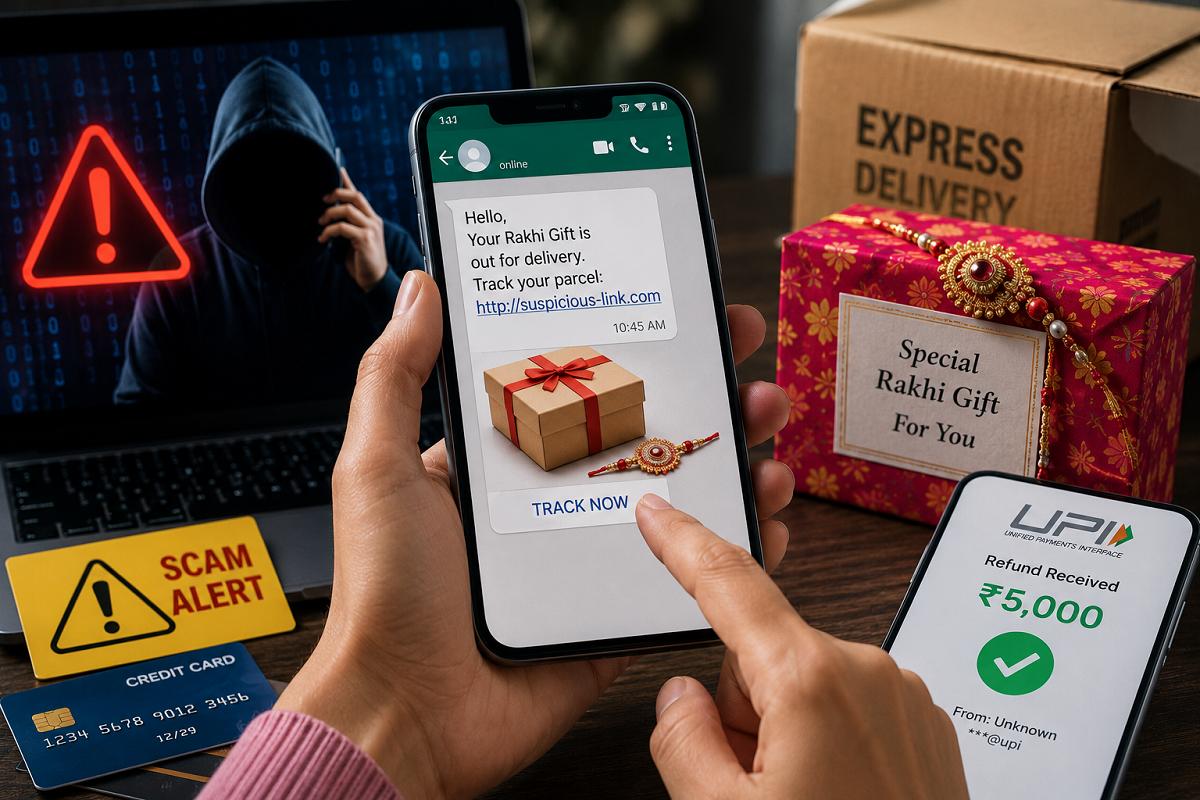
Raksha Bandhan Cyber Fraud 2026: As Raksha Bandhan approaches, online shopping, gift deliveries, digital payments and festive offers are increasing. Cybercriminals are trying to exploit the same activity with fake gift links, bogus discounts, malicious files, courier messages and UPI refund scams.
Recent warnings are particularly relevant this festive season. Rajasthan Cyber Crime Police has cautioned users about festival-themed malicious APK files, fake courier messages and gift offers, while reports on August 26 highlight fake gift links, discounts, courier scams, UPI refund tricks and cashback offers as common traps.
Here are some of the major scams you should watch out for.
1. Fake Raksha Bandhan Gift Links
A message may suddenly arrive on WhatsApp or SMS claiming that you have received a Raksha Bandhan gift, voucher or surprise from a family member.
The link included with the message may lead to a fake website designed to collect your mobile number, card details, UPI credentials or other personal information.
An even bigger danger is an attachment presented as a greeting or gift. Rajasthan Cyber Crime Police has specifically warned about malicious APK files circulating with festival-related names. Installing such a file could potentially give attackers access to sensitive information on the phone.
Safety tip: Never install an APK received through an unknown WhatsApp message, SMS or social-media link.
2. Huge Discounts on Rakhi, Sweets and Gifts
Another popular trick involves unbelievable festive discounts.
You might see an advertisement offering expensive gifts, sweets, clothes or electronics at discounts of 80% or 90%. Clicking it could take you to a website designed to resemble a genuine shopping portal.
You make the payment, but the product never arrives. In more dangerous cases, payment or card information entered on the website could be stolen.
Reports around this year's festive scams specifically flag fake deals and fraudulent shopping platforms among the methods being used to target consumers.
Always open a retailer's official website or app yourself instead of shopping through an unsolicited link.
3. ‘Your Rakhi Parcel Could Not Be Delivered’ Scam
This trick can be particularly convincing around Raksha Bandhan because many people genuinely send rakhis and gifts through courier companies.
A fraudulent message might say:
“Your Rakhi parcel could not be delivered because the address is incomplete. Update your address immediately.”
The message then provides a link or phone number.
After clicking, you may be asked to enter personal information or pay a small “redelivery fee”. Similar parcel scams have previously impersonated India Post, with fraudulent messages claiming that an address must be updated to prevent cancellation or failed delivery. India Post has warned users against fraudulent address-update links.
Instead of clicking the message, independently open the courier company's official website or app and enter the genuine tracking number.
4. UPI Refund Scam
Suppose you recently ordered a Rakhi or gift and are waiting for a refund. A scammer may contact you claiming to be from the shopping platform.
They might say your refund is ready and ask you to scan a QR code or enter your UPI PIN to receive the money.
This is a major warning sign.
You do not normally need to enter your UPI PIN simply to receive money. A UPI PIN authorises a transaction from your account.
If somebody tells you to scan a QR code and enter a PIN to receive a refund, do not proceed.
5. Cashback and Reward Scam
“₹2,000 Raksha Bandhan cashback credited.”
“Claim your festive reward before midnight.”
Messages like these are designed to create excitement and urgency.
You may be directed to a fake bank or payment page and asked to enter card details, OTPs or a UPI PIN. In some cases, scammers may ask for a small “processing fee” before releasing the supposed reward.
Do not trust a cashback offer merely because it contains the name or logo of a well-known bank or company. Check the offer independently through the company's official app or website.
6. A ‘Relative’ May Ask for Money on WhatsApp
There is another dangerous version of festive fraud.
A scammer may create a WhatsApp or social-media profile using the photograph and name of a sibling or relative and then send an urgent request for money.
Rajasthan Cyber Crime Police has also warned about impersonation tactics in which criminals pose as relatives and request transfers.
Before transferring money, call your relative on the number you already know and confirm the request.
Malicious Files Are an Increasing Threat
Users should be particularly careful about unexpected APK, ZIP and executable files.
Earlier this month, India's Indian Cyber Crime Coordination Centre (I4C) warned about another malware campaign in which malicious ZIP files were circulated through WhatsApp, SMS and email to compromise devices and WhatsApp accounts. The government advised users not to download or open files received from unknown or unverified sources.
The lesson applies equally to festive messages: a file named “Rakhi Gift”, “Festival Gift”, “Greeting” or something similarly attractive should not be trusted simply because it appears festive.
7 Safety Rules to Follow This Raksha Bandhan
- Don't click unknown gift or discount links.
- Never install APK files received through WhatsApp or SMS.
- Never share an OTP, ATM PIN, CVV or UPI PIN.
- Don't enter your UPI PIN to receive money.
- Don't scan an unknown QR code to receive a refund or reward.
- Verify courier deliveries through the courier company's genuine website or app.
- Confirm unusual money requests by directly calling your relative or friend.
You should also consider disabling automatic downloads for unexpected WhatsApp media and reviewing your phone's installed apps if you accidentally opened a suspicious file.
What If You Have Already Lost Money?
Speed matters after a suspected cyber fraud.
If money has been transferred fraudulently, immediately contact your bank or payment provider and report the incident. Cybercrime complaints in India can also be reported through the National Cyber Crime Helpline at 1930 or the government's National Cyber Crime Reporting Portal.
National Cyber Crime Reporting Portal
Keep screenshots of the fraudulent message, phone number, website, transaction ID, UPI ID and payment receipt because these details can be useful when filing a complaint.
Bottom Line
Raksha Bandhan brings a surge in gifts, courier deliveries and online transactions, giving cybercriminals an opportunity to make fraudulent messages appear believable.
A message saying “Your sister has sent you a gift” or “Your Rakhi parcel is waiting” may look perfectly timed, but that is precisely what makes these scams dangerous.
Treat unexpected gift links, massive discounts, APK files, refund requests and delivery-payment messages with caution. A few seconds spent independently verifying a message can protect your bank account and personal data.