
Business
8th Pay Commission: 7% Increment, 2.0 Fitment Factor—How Much Could Your Salary Increase? See the Calculation
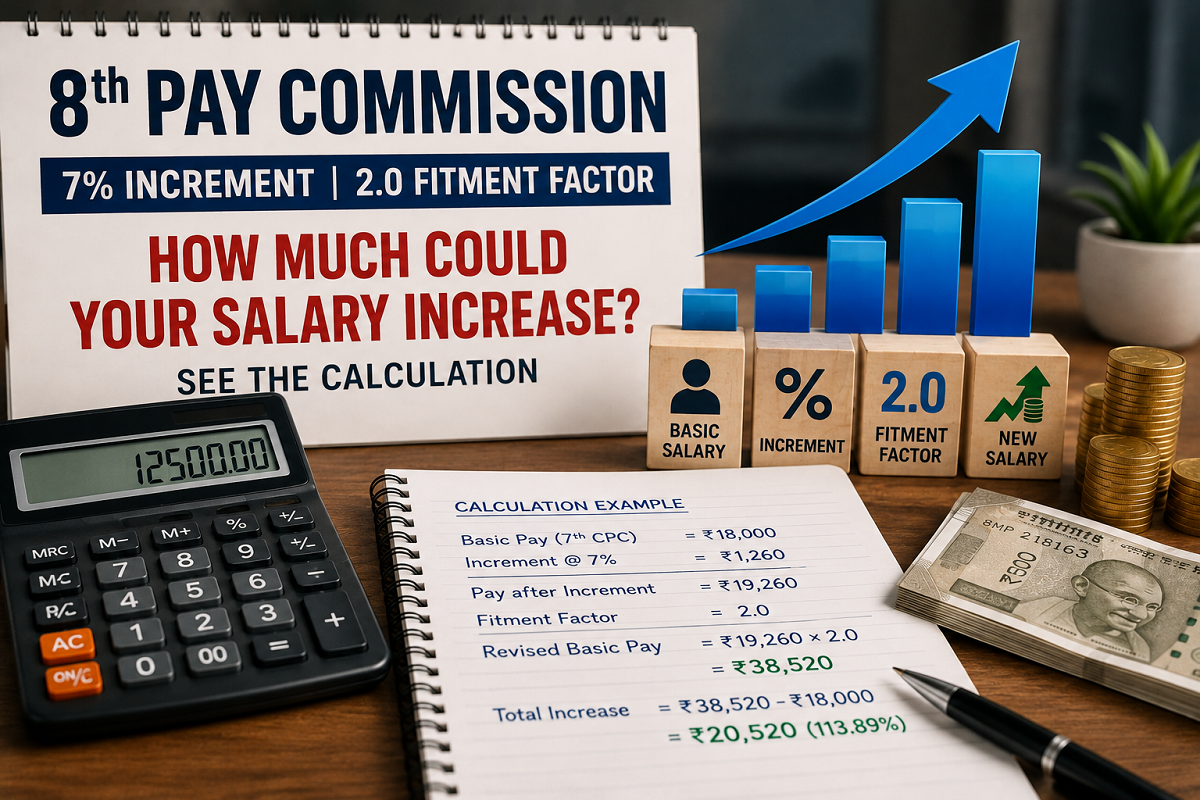
8th Pay Commission Salary Calculation: Discussions around the 8th Pay Commission have brought renewed attention to how much central government employees’ salaries could rise under a new pay structure. Among the figures being discussed are a 2.0 fitment factor and a possible 7% increment.
If a 2.0 fitment factor is eventually adopted, an employee’s basic pay could mathematically double. However, this does not mean that the employee’s total take-home salary will automatically become twice the current amount. Here is how the calculation works.
What Does a 2.0 Fitment Factor Mean?
The fitment factor is a multiplier used to determine revised basic pay when a new Pay Commission’s recommendations are implemented.
For example, if an employee currently has a basic salary of ₹18,000 and a fitment factor of 2.0 is assumed, the calculation would be:
₹18,000 × 2.0 = ₹36,000
This means the revised basic pay could become ₹36,000.
Similarly:
| Current Basic Pay | At 2.0 Fitment Factor |
|---|---|
| ₹18,000 | ₹36,000 |
| ₹25,000 | ₹50,000 |
| ₹30,000 | ₹60,000 |
| ₹40,000 | ₹80,000 |
| ₹50,000 | ₹1,00,000 |
These figures are only illustrative because the final fitment factor for the 8th Pay Commission has not yet been officially fixed.
Why Won’t the Total Salary Double?
This is where many employees may get confused. Doubling the basic pay does not necessarily mean doubling the gross or take-home salary.
An employee’s current salary includes several components apart from basic pay, such as Dearness Allowance (DA), House Rent Allowance (HRA), Transport Allowance and other applicable benefits.
When a new Pay Commission structure comes into effect, the existing DA is generally factored into the salary revision framework, while DA under the revised structure starts accumulating again from the new base.
Therefore, comparing only the old basic pay with the revised basic pay can exaggerate the actual percentage increase in total earnings.
Example: ₹18,000 Basic Pay Could Become ₹36,000
Suppose an employee currently receives a basic salary of ₹18,000. With an assumed fitment factor of 2.0:
Revised Basic Pay = ₹18,000 × 2 = ₹36,000
The basic pay has increased by 100%.
However, the employee was already receiving DA and other allowances on top of the existing ₹18,000 basic pay. Therefore, the increase in the overall salary package would be considerably different from the 100% increase visible in basic pay.
The final take-home salary would also depend on revised HRA, TA, deductions, pension-related contributions and other allowances.
What Does the 7% Increment Mean?
Another figure being discussed is a possible 7% annual increment. If such an increment were introduced, it could accelerate salary growth over the years.
For example, suppose the revised basic pay is ₹36,000.
A 7% increase would amount to:
₹36,000 × 7% = ₹2,520
The basic salary after the increment would therefore become approximately:
₹38,520
If the same percentage were applied subsequently, the impact would compound over time.
However, employees should note that a 7% annual increment should not be treated as an officially confirmed provision unless notified by the government or recommended in the final Pay Commission framework.
8th Pay Commission: What Employees Should Watch
The actual salary revision will ultimately depend on the fitment factor recommended by the commission, the structure of the new pay matrix, treatment of DA, revised allowances and the government’s final acceptance of the recommendations.
This means employees should avoid assuming that a 2.0 fitment factor will automatically result in their take-home salary doubling.
Even if the basic pay rises sharply, the percentage increase in gross salary can be lower because the current salary already includes DA and several other components.
Final Salary Will Be Clear Only After Official Recommendations
The 8th Pay Commission could bring a significant revision in salaries and pensions for central government employees and pensioners. However, figures such as a 2.0 fitment factor and 7% increment remain assumptions or proposals unless officially approved.
Employees should therefore treat online salary calculations as estimates rather than guaranteed increases.
Once the commission recommends the new pay matrix, fitment factor, increment structure and allowances—and the government accepts them—it will become possible to calculate the actual increase in basic, gross and take-home salary with greater accuracy.
Disclaimer: The calculations above are illustrative and based on assumed figures. The final salary revision will depend on the recommendations of the 8th Pay Commission and subsequent government approval.