
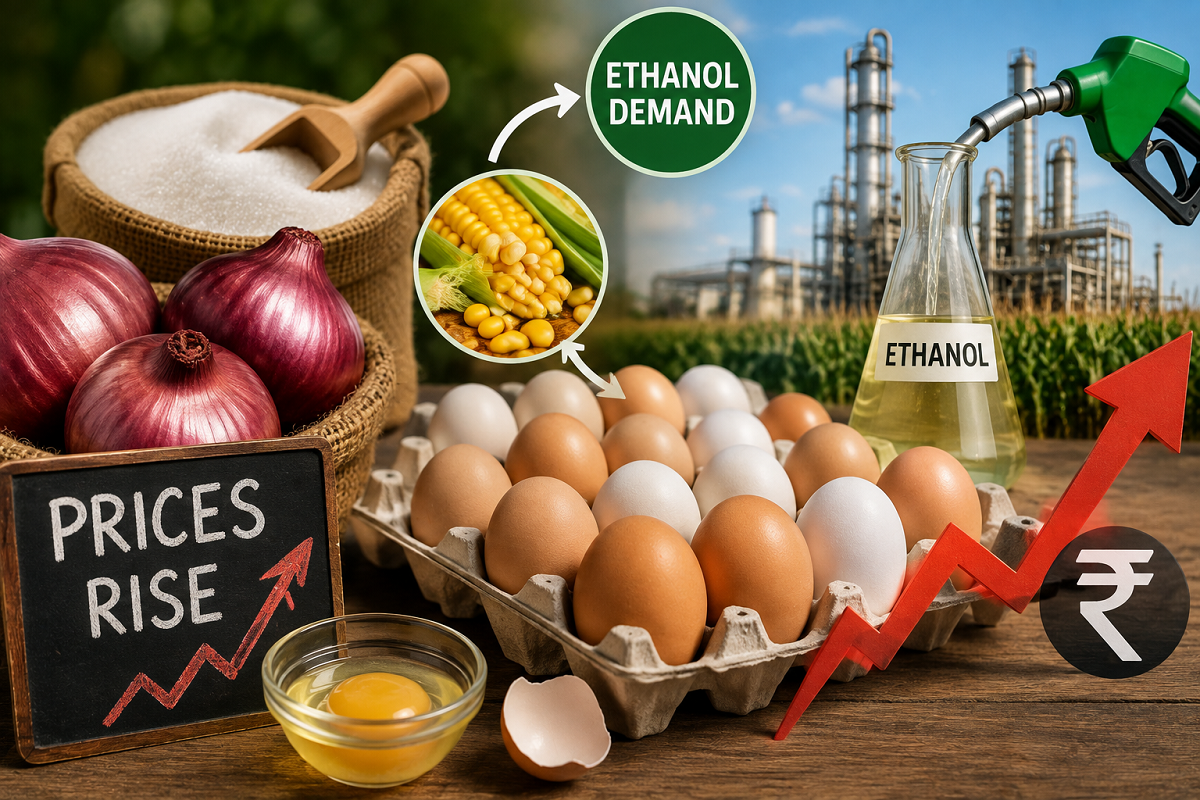
Egg Price Hike 2026: After increases in the prices of sugar, onions and several other food items, consumers are now facing higher egg prices. While eggs may appear to have little connection with fuel, the recent increase has brought India's expanding ethanol programme into the discussion. The link runs through maize, one of the important ingredients used in poultry feed.
Demand for maize has been growing from multiple sectors, including poultry and animal feed as well as ethanol production. When maize prices rise, poultry farmers face higher feed costs, which can eventually affect the prices consumers pay for eggs and chicken.
Why Are Egg Prices Increasing?
The cost of producing eggs depends on several factors, including feed, transportation, medicines, electricity and farm operations. Among these, poultry feed represents a major component of production expenses.
Maize is widely used as an energy source in poultry feed. Therefore, a sustained increase in maize prices can directly raise the cost of feeding laying hens.
Farmers and poultry businesses may eventually pass part of this additional expense through the supply chain, contributing to higher wholesale and retail egg prices.
What Does Ethanol Have to Do With Eggs?
The connection becomes easier to understand when the supply chain is considered:
Maize → Poultry Feed → Production Cost → Egg Prices
At the same time:
Maize → Ethanol Production → Additional Demand for Maize
India has been expanding ethanol blending with petrol to reduce dependence on imported fossil fuels and encourage greater use of domestically produced feedstocks.
As maize becomes an increasingly important feedstock for ethanol production, it creates another major source of demand for the same agricultural commodity already required by poultry and livestock industries.
The concern is that if maize production does not increase sufficiently to match demand, competition among different users could put upward pressure on prices.
Why Maize Is So Important for Poultry Farmers
Feed is one of the largest recurring expenses for poultry farms, and maize is a major component of many poultry-feed formulations.
If the cost of maize rises sharply, farmers cannot always immediately switch to another ingredient without considering nutrition, availability and price.
This means that even a relatively modest increase in feed prices can have a noticeable impact when multiplied across thousands of birds and several production cycles.
For egg producers, higher input costs can consequently affect the price at which eggs can be profitably supplied to wholesalers and retailers.
Ethanol Demand for Maize Has Increased
India's ethanol-blending programme has created additional demand for agricultural feedstocks.
While sugarcane-based products have traditionally played an important role in ethanol production, grain-based ethanol has also expanded. Maize has consequently become increasingly relevant for distilleries.
This creates an unusual situation in which the same crop has competing uses across food, livestock feed and fuel production.
Higher demand itself is not necessarily a problem if agricultural production and productivity expand alongside it. Pressure emerges when demand grows faster than available supply.
Government Focuses on Increasing Maize Production
The government has also recognised the need to increase maize availability as demand grows from ethanol, poultry feed and other industries.
Increasing production can come from expanding the area under maize cultivation, but productivity is equally important.
Higher-yielding varieties, improved farming practices, better irrigation, quality seeds and more efficient supply chains could allow farmers to produce more maize without relying entirely on additional agricultural land.
Greater production could help ensure that demand from the ethanol sector does not excessively squeeze supplies available to food and animal-feed industries.
Why Ethanol Producers and Poultry Farmers Compete for the Same Crop
For poultry farmers, maize is primarily a feed ingredient. For ethanol manufacturers, maize can be converted into alcohol that is subsequently used for blending with petrol.
Both industries therefore enter the market as buyers.
If ethanol manufacturers are able to pay higher prices while poultry producers need large quantities of maize, competition can intensify.
Poultry farmers then either have to absorb the higher feed expense, find suitable alternatives or pass some of the increased cost through to egg and chicken buyers.
Does Ethanol Alone Explain Higher Egg Prices?
No. It would be misleading to attribute every increase in egg prices solely to ethanol production.
Egg prices are influenced by several variables, including seasonal consumption, poultry-feed costs, weather conditions, disease outbreaks, transportation expenses, supply fluctuations and changes in the population of laying birds.
Maize demand from ethanol production is therefore better understood as one potential cost pressure within a much larger supply chain.
The actual retail price in a particular city can also vary considerably depending on local supply and distribution costs.
Why Consumers Should Pay Attention
Eggs are an important and relatively affordable source of protein for millions of households. They are also widely consumed by restaurants, bakeries, hotels and food-processing businesses.
A sustained increase in egg prices therefore affects more than household breakfast budgets.
Higher egg and poultry costs can eventually increase expenses for businesses that use eggs as an ingredient, creating a wider impact across the food sector.
The Food vs Fuel Debate
The development also revives the broader debate over using agricultural commodities for energy production.
Ethanol blending has several potential advantages, including reduced dependence on imported crude oil, additional demand for farmers' crops and diversification of India's energy sources.
However, when crops that are important for food or livestock feed are diverted toward fuel production, policymakers need to maintain a balance.
If ethanol demand expands much faster than crop production, it can create unintended pressure elsewhere in the agricultural economy.
Increasing Productivity Could Be the Key
The long-term solution may therefore lie less in restricting one particular industry and more in substantially increasing maize productivity.
If farmers can produce more maize per hectare, India could potentially meet growing requirements from poultry, livestock, food-processing and ethanol industries simultaneously.
Higher productivity could also benefit farmers if growing industrial demand translates into stronger and more stable crop prices.
The challenge is ensuring that increased demand benefits producers without creating excessive inflation for consumers.
Bottom Line
The rise in egg prices demonstrates how closely India's food and energy markets can be connected.
An egg does not contain ethanol, but the hen producing that egg consumes feed in which maize plays an important role. When ethanol plants and poultry farms compete for increasing quantities of maize, higher maize prices can raise poultry production costs.
However, ethanol is only one part of the equation. Feed availability, seasonal demand, farm costs and local supply conditions also influence egg prices.
As India's ethanol programme expands, increasing maize production and productivity will be crucial to balancing the requirements of farmers, poultry producers, ethanol manufacturers and consumers.