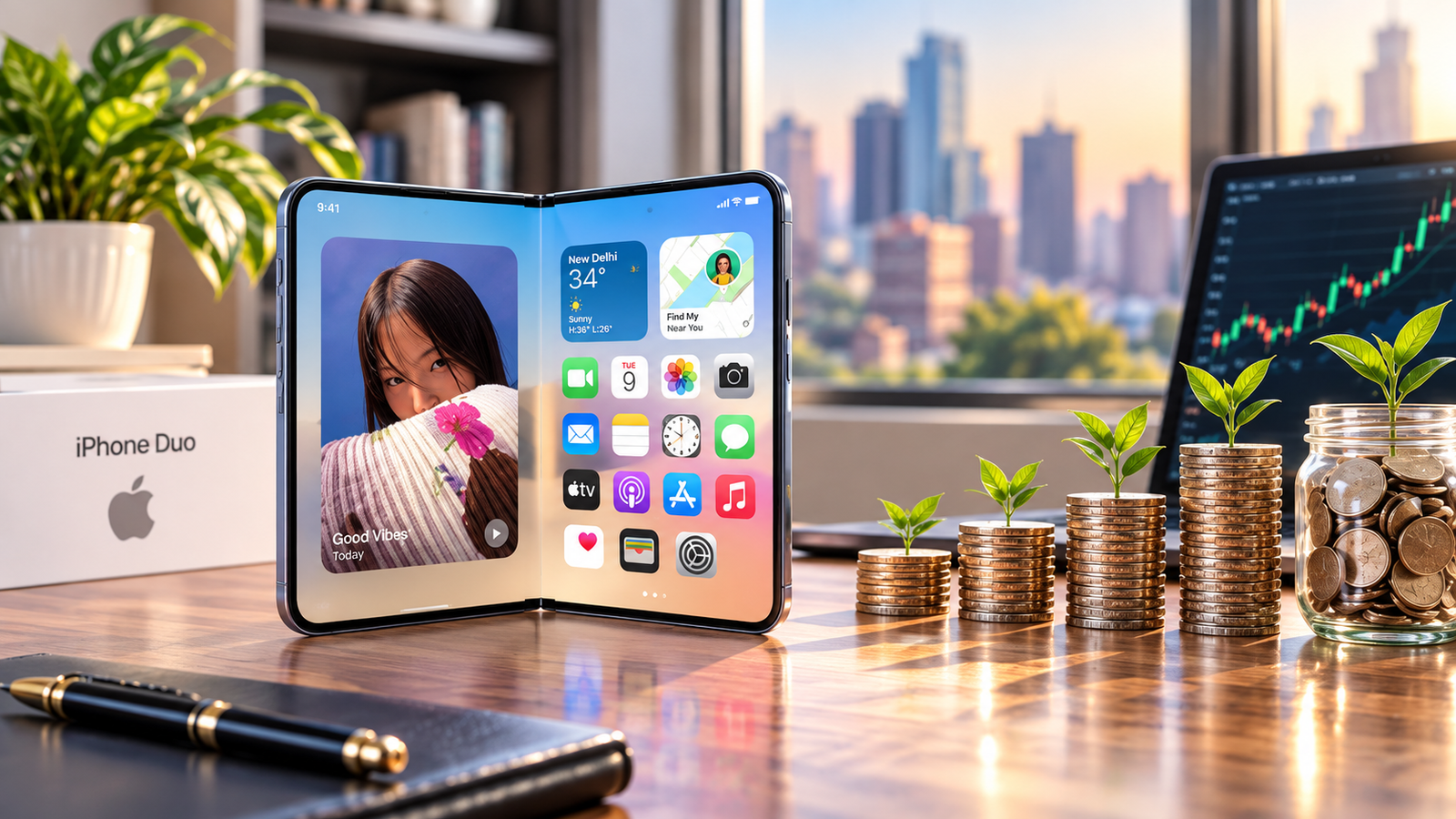
Would you spend ₹4.49 lakh on a premium smartphone if the same amount had the potential to grow to more than ₹50 lakh over the next 20 years?
That is the financial trade-off highlighted by the price of Apple's iPhone Duo 2TB, which is listed at ₹4.49 lakh in India in the supplied article. At this price, the device clearly falls into the luxury-purchase category.
But deciding whether such an expensive phone is worth buying is not simply about whether you have ₹4.49 lakh in your bank account.
Your income, savings, emergency fund, insurance, existing loans and long-term investments all matter. There is also another factor that is easy to overlook: opportunity cost.
If you don't spend ₹4.49 lakh today and invest it instead, how much could that money potentially become over the next 10, 15 or 20 years?
₹4.49 Lakh Phone Is a Lifestyle Expense, Not an Investment
From a wealth-building perspective, buying an expensive smartphone is consumption.
The phone gives you immediate utility—communication, photography, entertainment, productivity and access to premium technology—but its monetary value generally starts declining after purchase.
An investment works differently. Instead of being consumed, the money is given an opportunity to compound over time.
The experts cited in the supplied article therefore suggest that a ₹4.49 lakh phone purchase may be reasonable when it comes from surplus income and does not interfere with important financial goals.
If an adequate emergency fund, sufficient insurance and long-term investments are already in place, the phone can simply be treated as a lifestyle expense.
What If ₹4.49 Lakh Is Invested Instead?
The difference becomes striking when the same amount is projected over a long investment period.
The source provides two illustrative scenarios.
The first assumes the ₹4.49 lakh is invested as a lump sum in an index fund generating an 11% CAGR.
The second assumes investment in a diversified equity fund delivering 13% CAGR.
Here is the projected growth:
| Period | Index Fund at 11% CAGR | Diversified Equity Fund at 13% CAGR |
|---|---|---|
| 10 Years | ₹12.7 lakh | ₹15.25 lakh |
| 15 Years | ₹21.5 lakh | ₹28.1 lakh |
| 20 Years | ₹36.2 lakh | ₹51.8 lakh |
These figures come from the assumptions used in the supplied article and should be treated as illustrations, not guaranteed future returns.
₹4.49 Lakh Could Potentially Become ₹12.7 Lakh in 10 Years
Suppose you decide against buying the premium smartphone and invest the entire ₹4.49 lakh in an index fund.
At an assumed 11% CAGR, the investment could grow to approximately ₹12.7 lakh in 10 years.
Under the 13% diversified-equity assumption, it could potentially reach around ₹15.25 lakh.
This means the difference between spending and investing becomes significant even over a 10-year period.
Of course, the investor has to accept market risk and volatility during those years.
Wait 15 Years and Compounding Becomes More Powerful
Time becomes increasingly important as the investment horizon expands.
At the assumed 11% CAGR, ₹4.49 lakh could grow to approximately ₹21.5 lakh after 15 years.
At the assumed 13% CAGR, the projected corpus rises to approximately ₹28.1 lakh.
The initial investment remains exactly the same. What changes is the amount of time the money is allowed to compound.
This demonstrates why long-term investing can create substantial wealth even when the starting amount is relatively modest compared with the final corpus.
20 Years: ₹4.49 Lakh Could Potentially Cross ₹50 Lakh
The 20-year projection makes the opportunity cost even more visible.
At an 11% assumed CAGR, the original ₹4.49 lakh could potentially become approximately ₹36.2 lakh.
At a 13% assumed CAGR, the projected value rises to approximately ₹51.8 lakh.
In other words, a purchase costing ₹4.49 lakh today represents not only ₹4.49 lakh of current spending. It could also represent the future investment value that you give up by spending that money.
That is the basic concept of opportunity cost.
But 11% and 13% Returns Are Not Guaranteed
There is an important caution behind these impressive figures.
Index funds and diversified equity funds are market-linked investments. Neither 11% nor 13% annual growth is guaranteed.
The article cites a brokerage estimate that the Nifty 50 has delivered roughly 10%-11% over the long term, while actively managed diversified equity funds may potentially deliver higher returns.
Historical performance, however, cannot guarantee future results.
Markets can go through prolonged periods of volatility, and actual investor returns may be substantially higher or lower than the assumptions used in these calculations.
Another Option: Buy a Cheaper Phone and Invest the Difference
The choice doesn't necessarily have to be between spending ₹4.49 lakh and buying no phone at all.
A middle path is possible.
One of the experts cited in the source suggests buying a less expensive smartphone and investing the remaining amount instead.
For example, if someone has a ₹4.49 lakh budget but purchases a ₹1 lakh phone, roughly ₹3.49 lakh remains available.
That money could then potentially be invested towards retirement, children's education, a house or another financial objective.
This approach allows the buyer to enjoy a premium device while retaining a significant portion of the original budget for wealth creation.
Buying the Phone on EMI Requires More Caution
The decision becomes more complicated if you need a loan or EMI to afford the phone.
According to the supplied article, financing a phone costing around ₹4.5 lakh for two years could result in an EMI of approximately ₹18,000-₹19,000 per month, based on the expert estimate cited there.
If that EMI exceeds around 5%-10% of take-home salary, particularly when other EMIs are already running, the purchase could become a significant financial burden.
The issue is not simply whether the monthly instalment can be paid.
A large EMI also reduces the amount available every month for investing, emergency savings and other goals.
Think of ₹4.49 Lakh as ₹12,500 Per Month
Another interesting way of evaluating the purchase is to spread the cost over the period you expect to use the phone.
The source suggests looking at the ₹4.49 lakh expense over three years.
On that basis, the cost works out to roughly ₹12,500 per month.
This provides a different perspective.
Instead of asking, “Can I afford ₹4.49 lakh today?”, ask:
“Would I comfortably spend around ₹12,500 every month for three years for the benefits this phone gives me?”
For some buyers, the answer may be yes. For others, that calculation may make a less expensive smartphone look considerably more attractive.
Check Your Emergency Fund Before Making the Purchase
A premium smartphone should ideally not come at the cost of financial security.
The experts quoted in the supplied article suggest having an emergency fund covering around six to eight months of expenses before making such a large discretionary purchase.
Adequate health and term insurance should also be in place, and high-interest debt should preferably not be outstanding.
Long-term investments towards important financial goals should continue without interruption.
The article also cites the view that total monthly EMIs and fixed expenses should generally not exceed around 40%-50% of income.
These are financial-planning guidelines rather than universal rules, but they provide a useful framework for evaluating affordability.
When Buying a ₹4.49 Lakh iPhone May Be Fine
Buying the iPhone Duo is not automatically a poor financial decision.
Suppose someone has sufficient surplus income, a strong emergency fund, adequate insurance, no problematic high-interest debt and investments for retirement and other goals already running.
If spending ₹4.49 lakh does not disturb any of those priorities, buying the phone can simply be a lifestyle choice.
People earn money not only to invest but also to enjoy products and experiences they value.
The financial concern arises when the purchase requires someone to empty emergency savings, stop long-term investments or take on an uncomfortable amount of debt.
When Investing May Make More Sense
The equation changes if ₹4.49 lakh represents a large percentage of your total savings.
If buying the phone requires breaking long-term investments, exhausting emergency funds or borrowing at a high cost, the opportunity cost becomes much more significant.
The expert view cited in the source similarly suggests that the purchase may be reasonable if sufficient disposable money remains after buying the phone and essential financial goals remain unaffected. If ₹4.49 lakh represents a substantial portion of savings, investing the money could be the more financially prudent alternative.
iPhone Duo or Investment: The Final Calculation
The comparison ultimately comes down to priorities.
Spend ₹4.49 lakh today, and you get a premium smartphone that provides immediate lifestyle and technological benefits.
Invest the same ₹4.49 lakh at an assumed 11% CAGR, and the illustration shows it potentially becoming ₹12.7 lakh in 10 years, ₹21.5 lakh in 15 years and ₹36.2 lakh in 20 years.
At an assumed 13% CAGR, the projected corpus rises to ₹15.25 lakh, ₹28.1 lakh and ₹51.8 lakh, respectively.
Neither decision is automatically right or wrong.
The better question is whether buying a ₹4.49 lakh phone affects your emergency fund, insurance coverage, existing investments or major financial goals.
If it doesn't and the money genuinely comes from surplus income, the purchase can be viewed as a luxury you can afford. If it consumes a major portion of your savings or forces you to sacrifice long-term investments, the potential opportunity cost could be several times the phone's current price.
Disclaimer: The investment calculations are illustrative and based on assumed CAGRs. Equity and mutual fund returns are market-linked and not guaranteed. Past performance does not assure future returns. Consider your financial circumstances and seek qualified professional advice where appropriate before making investment decisions.