Railway employees covered under the National Pension System (NPS) have received an important update regarding retirement benefits. The Ministry of Railways has notified rules for implementing the Unified Pension Scheme (UPS) for eligible employees, covering areas such as contributions, assured payouts, family benefits, voluntary retirement and the option to move from UPS back to NPS.
The Unified Pension Scheme was introduced by the Central Government as an option under the NPS framework with effect from April 1, 2025. Its implementation for eligible railway employees provides greater clarity on how retirement payouts and contributions will work.
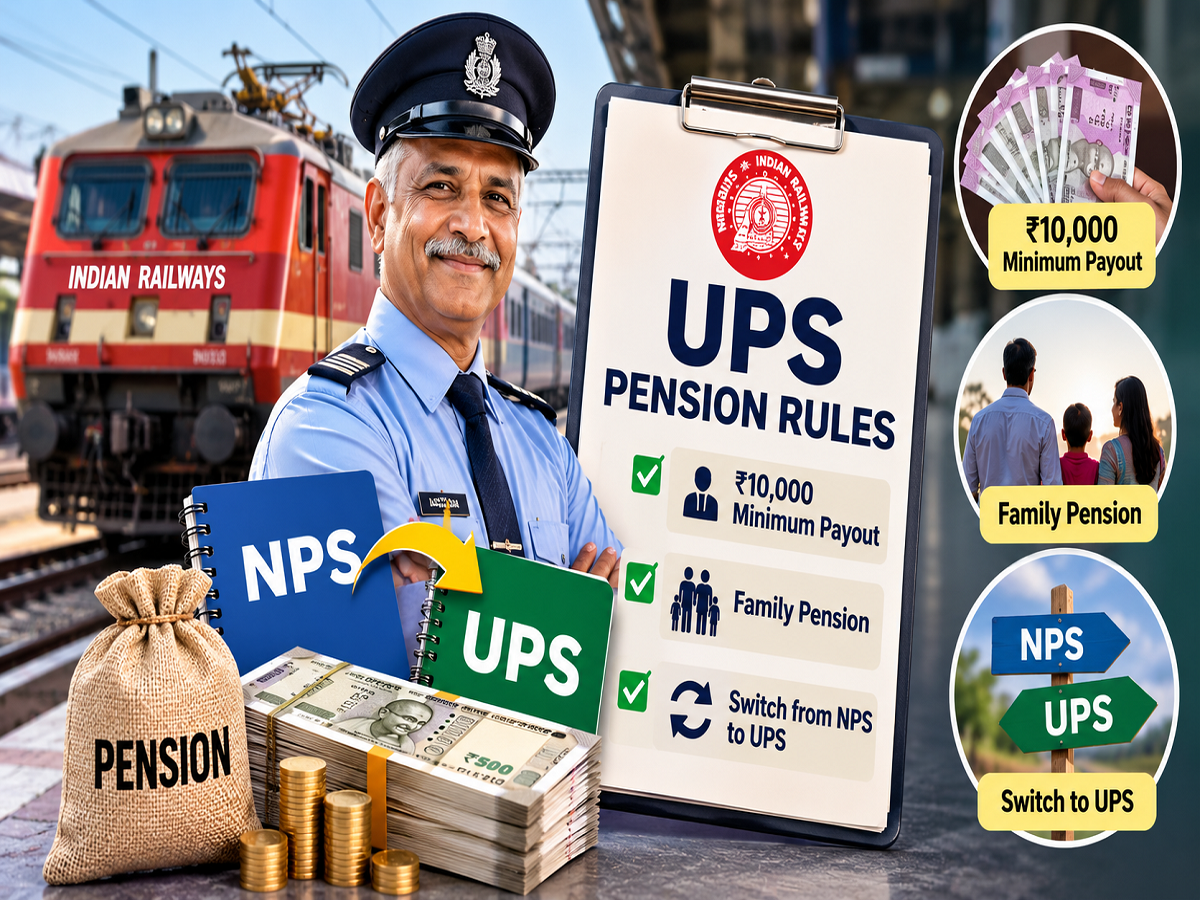
One of the most important provisions is a minimum assured payout of ₹10,000 per month, subject to the prescribed conditions, for employees who complete at least 10 years of qualifying service.
Employees completing 25 years of qualifying service can become eligible for the full assured payout calculated under UPS rules.
Who Among Railway Employees Can Opt for UPS?
UPS is relevant to eligible Central Government employees covered under NPS, including qualifying railway employees.
Railway employees appointed on or after January 1, 2004, who fall under the NPS framework can come within the UPS eligibility structure, subject to the applicable rules and option requirements.
However, not every person working with the Railways automatically becomes eligible.
Casual workers, daily-wage workers, contractual employees and categories governed by separate pension or retirement-benefit arrangements may fall outside the UPS framework.
Employees should therefore check their individual service category before assuming eligibility.
Minimum ₹10,000 Monthly Payout After 10 Years
A key feature of UPS is the provision for a minimum assured payout.
An eligible employee completing at least 10 years of qualifying service can receive a minimum assured payout of ₹10,000 per month, subject to the scheme's conditions.
This should not be confused with the full assured payout available after 25 years of qualifying service.
The amount payable under UPS depends on factors including qualifying service and the employee's eligible pay under the prescribed calculation rules.
What Happens After Completing 25 Years of Service?
Employees completing 25 years of qualifying service can become eligible for the full assured payout under the UPS framework.
Under the broader UPS structure, the assured payout for an employee with 25 years of qualifying service is linked to 50% of the average basic pay drawn during the 12 months immediately preceding retirement, subject to applicable conditions.
For employees with qualifying service between 10 and 25 years, the payout is proportionately determined according to the scheme's rules, while the minimum assured payout provision applies subject to eligibility conditions.
This means the ₹10,000 figure should not be interpreted as the pension amount that every UPS-covered railway employee will receive.
How Much Will Railway Employees Contribute?
Employees opting for UPS are required to make a monthly contribution.
The employee contribution is 10% of basic pay plus Dearness Allowance (DA).
For example, if an employee's eligible basic pay and DA together amount to ₹70,000 for contribution purposes, a 10% employee contribution would work out to ₹7,000 for that month.
The actual amount will naturally change whenever the employee's basic pay or DA changes.
Contributions are governed by the applicable UPS and NPS framework.
Government Contribution Is Also Part of the System
UPS is a contributory retirement arrangement, meaning the employee is not the only party making contributions.
Government contributions are also made under the prescribed structure.
Employees should note that the UPS funding mechanism includes both the individual corpus and additional government-supported arrangements under the notified framework. Therefore, the overall contribution structure should not be reduced to a simple assumption that the government contribution is identical in every respect to the employee's 10% contribution.
What Happens During Probation or Deputation?
The contribution requirement can continue even when an eligible railway employee is serving a probationary period or is on deputation with another Central or State Government department, subject to applicable service and pension rules.
The relevant employee and government contributions continue to be handled according to the prescribed framework.
Employees going on deputation should nevertheless check how their individual contribution and service records are being maintained so that qualifying-service information remains accurate.
Voluntary Retirement Is Also Covered
The rules also address voluntary retirement.
Eligible railway employees can have the option of voluntary retirement after completing the required service period, including the specified 20 years of qualifying service condition under the relevant UPS framework.
However, voluntary retirement should not be interpreted as automatically producing the same immediate payout outcome as normal retirement in every circumstance.
The date from which an assured payout becomes payable and the amount involved depend on the specific UPS voluntary-retirement provisions.
Employees considering VRS should therefore examine the applicable rules before making a retirement decision.
Family Pension Benefit for Spouse
UPS also provides financial protection for the family of an eligible employee.
If a UPS-covered employee or pensioner dies under circumstances covered by the scheme, the legally wedded spouse can become eligible for a family payout in accordance with the rules.
The family payout is generally set at 60% of the admissible payout that was payable to the employee, subject to applicable conditions.
This provision is intended to ensure continuing financial support for the surviving spouse.
Dearness Relief Will Apply to Eligible Payouts
Another important feature is Dearness Relief (DR).
Eligible assured payouts and family payouts under UPS can receive Dearness Relief in accordance with the applicable government rules.
DR is intended to provide inflation-related adjustment to retirement income.
The applicable rate can change over time based on government decisions, so retirees should check the prevailing DR rate rather than relying on an older percentage.
Can Railway Employees Move From UPS Back to NPS?
An important flexibility is the option for eligible employees to switch from UPS to NPS under prescribed conditions.
The rules provide a one-time, one-way option to move from UPS to NPS during service, subject to the specified timelines and eligibility requirements.
This decision needs careful consideration because once an employee exercises the permitted switch to NPS, returning to UPS is generally not allowed under that option.
Employees should therefore compare the implications for retirement income, accumulated corpus and other benefits before exercising the switch.
UPS and NPS Should Not Be Treated as Identical
Although UPS operates as an option within the NPS framework, the retirement-benefit structures are different.
NPS is primarily based on accumulated contributions and investment returns, with retirement benefits linked to the corpus and applicable withdrawal and annuity rules.
UPS, meanwhile, introduces an assured-payout framework for eligible Central Government employees who satisfy the prescribed qualifying-service and contribution conditions.
This makes service length, contribution history and eligible pay particularly important when estimating benefits under UPS.
Railway Employees Should Check Their Service Records
Employees planning for retirement should ensure that important information such as their date of joining, NPS coverage, qualifying service, basic pay, DA and contribution history is correctly reflected in official records.
Those considering the UPS-to-NPS switch or voluntary retirement should pay particular attention to the financial consequences before submitting an option.
The new framework provides eligible railway employees with clearer rules for retirement income, including the ₹10,000 minimum assured monthly payout after the prescribed minimum qualifying service, a full assured payout framework after 25 years, a 60% family payout for eligible spouses, Dearness Relief and a one-time option to switch back to NPS.
Note: Pension benefits depend on qualifying service, contribution history, retirement circumstances and other conditions under the notified UPS rules. Employees should check the latest Ministry of Railways, Department of Pension and Pensioners' Welfare, and PFRDA notifications before making retirement or pension-related decisions.