Technology
MUDRA Loan Scam Alert: Got an Approval Message on WhatsApp? Don’t Share Aadhaar, PAN or OTP
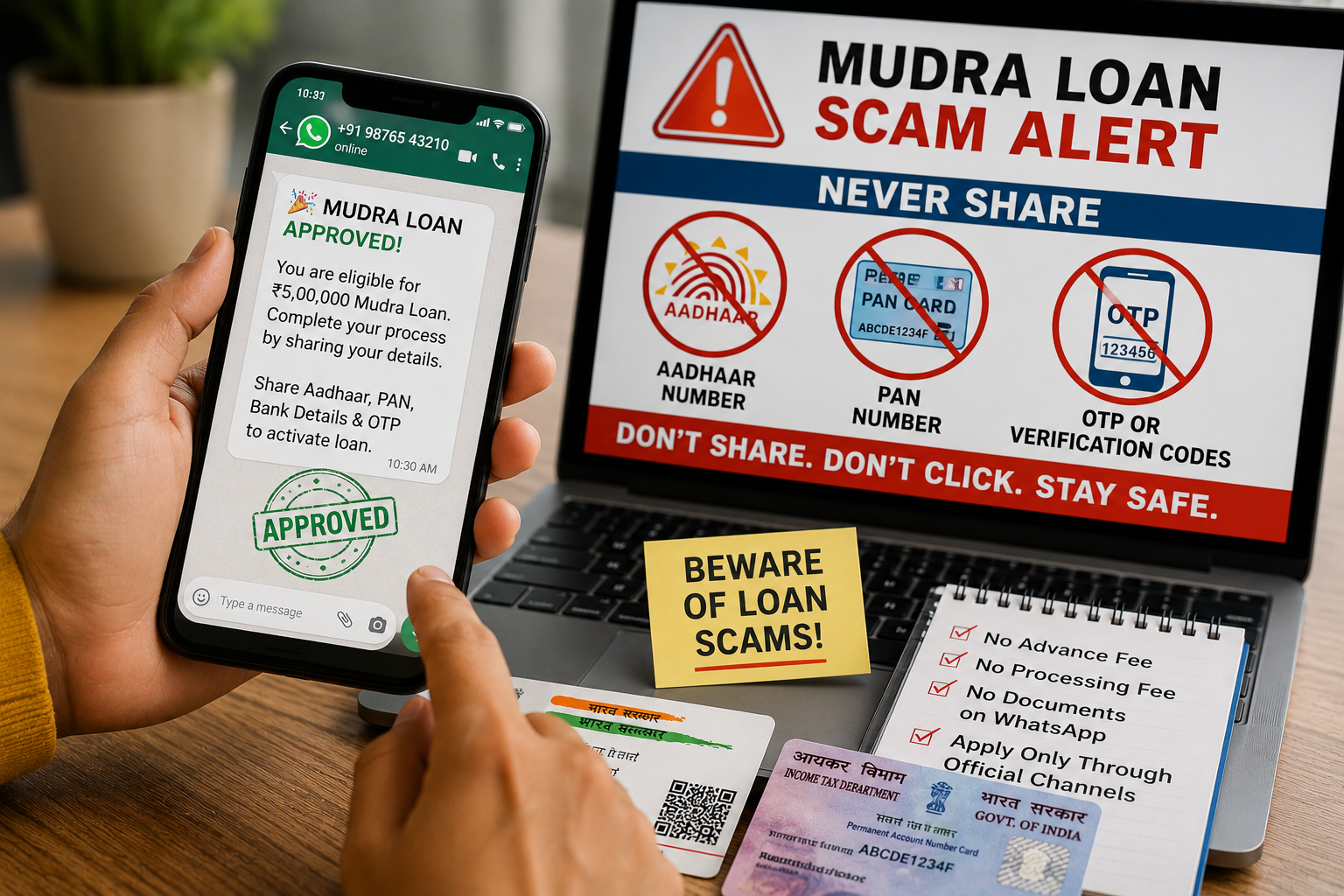
If you have recently applied for a loan under the Pradhan Mantri MUDRA Yojana (PMMY), be careful about unexpected WhatsApp messages claiming that your loan has been approved.
Fraudsters are circulating fake MUDRA loan approval messages to make people believe that their application has been sanctioned. Once the recipient trusts the message, scammers may try to obtain personal or financial information or demand money under the guise of processing, registration or other charges.
PIB Fact Check has warned people about such fraudulent messages and clarified that MUDRA loan approvals are not communicated through social-media platforms.
The government fact-checking unit has also stressed that MUDRA is a refinancing institution and does not directly provide loans to individual borrowers or micro-entrepreneurs.
So, if an unknown person contacts you on WhatsApp claiming to be a MUDRA representative and asks for Aadhaar, PAN, OTP or payment, treat it as a major warning sign.
How the Fake MUDRA Loan Scam Works
The scam usually begins with an attractive message.
A person may receive a WhatsApp message stating that a loan under the Pradhan Mantri MUDRA Yojana has been approved.
The message may appear convincing because fraudsters can use government scheme names, official-looking logos, fabricated approval letters or other details designed to create trust.
Once the recipient responds, the fraudster may ask for documents or financial information.
This can include Aadhaar details, PAN information, bank account details, card information or other sensitive data.
In some variations of loan scams, fraudsters may also demand a processing fee, agreement charge, registration fee or another upfront payment before supposedly releasing the loan.
PIB Fact Check has previously flagged fake PMMY approval letters that demanded upfront charges, making it particularly important to verify any unexpected loan-related demand.
MUDRA Does Not Give Loans Directly to Individuals
This is one of the most important facts consumers should know.
MUDRA does not directly lend money to individual borrowers or micro-entrepreneurs.
It functions as a refinancing institution.
Loans under PMMY are made available through eligible lending institutions, including banks, RBI-registered Non-Banking Financial Companies (NBFCs) and Microfinance Institutions (MFIs).
Therefore, a message suggesting that “MUDRA” itself has directly sanctioned and is about to transfer a loan to you should immediately raise suspicion.
Always verify the status of your application with the authorised lender through which you actually applied.
MUDRA Has Not Appointed Agents or Middlemen
Another warning sign is someone claiming to be an authorised “MUDRA agent.”
According to PIB Fact Check, MUDRA does not engage agents or middlemen to facilitate loans.
Scammers may introduce themselves as loan officers, facilitators, government representatives or MUDRA agents to gain a victim's trust.
They may then claim that they can get a loan approved quickly in exchange for documents or money.
Do not rely on such claims.
Loan applications and approvals should be handled through legitimate lending institutions and authorised channels.
Never Send Aadhaar and PAN to an Unknown WhatsApp Number
Aadhaar and PAN are important identity documents and should be handled carefully.
There may be legitimate situations in which an authorised lender requires Aadhaar, PAN or other documents as part of the loan application and KYC process.
The danger arises when these documents are sent to an unverified individual, unknown WhatsApp number, suspicious website or fake loan agent.
If you receive an unsolicited WhatsApp message asking you to send copies of Aadhaar and PAN, first verify who is requesting them.
Do not assume that a person is genuine simply because their WhatsApp profile displays the name or logo of a bank, MUDRA or another government-related organisation.
Never Share Your OTP
An OTP should be treated as confidential.
If someone contacts you claiming that your MUDRA loan has been approved and asks you to share an OTP, do not provide it.
Fraudsters frequently use urgency to persuade victims to disclose security information.
They may claim that an OTP is required to complete KYC, activate a loan, release funds or confirm an application.
Whatever explanation is given, never share banking OTPs, UPI PINs, card PINs or passwords with another person.
A genuine representative should not need you to verbally disclose confidential authentication credentials.
Beware of Fake Processing and Agreement Fees
A fake approval message may be followed by a demand for money.
For example, a scammer could claim that the loan is ready but will only be released after payment of a processing, registration, legal or agreement fee.
PIB Fact Check has previously exposed fake loan approval letters claiming to sanction loans under PMMY in exchange for upfront charges.
Such demands should therefore be independently verified with the authorised lender.
Do not transfer money to a personal bank account or UPI ID simply because someone promises that a much larger loan amount will be released immediately afterward.
Don't Trust an Official-Looking Logo
Cybercriminals can make fake messages appear professional.
A fraudulent message may contain the MUDRA name, PMMY branding, a government emblem, a bank logo or an apparently official signature.
Similarly, scammers can create fake websites and documents that resemble genuine financial-service pages.
An official-looking design is not proof of authenticity.
Instead of clicking the link supplied in an unsolicited message, independently visit the official website or contact the bank, NBFC or MFI through verified contact information.
Where Can You Actually Get a MUDRA Loan?
PMMY loans are available through participating lending institutions rather than directly from MUDRA.
Depending on eligibility and applicable lending policies, borrowers can approach nearby branches of participating:
- Banks
- RBI-registered NBFCs
- Microfinance Institutions (MFIs)
- Other eligible lending institutions under the scheme
Online applications can also be made through authorised government-supported channels such as the Udyamimitra platform, as highlighted in the PIB Fact Check advisory.
The lending institution evaluates the application and decides whether the borrower meets its applicable eligibility and credit requirements.
Receiving a WhatsApp message by itself does not constitute genuine loan approval.
What Should You Do If You Receive a Fake Approval Message?
Do not respond immediately.
First, check whether you actually applied for a MUDRA loan.
If you did, contact the same bank, NBFC, MFI or authorised platform through which the application was submitted and independently verify its status.
Avoid clicking links included in unsolicited messages.
Do not download unknown files or applications sent by the sender.
Never transfer money to an unknown account for supposed loan release, verification or approval.
Most importantly, do not share sensitive personal or banking credentials merely because the sender claims to represent a government scheme.
What If You Already Shared Your Details?
If you have already disclosed sensitive banking information or made a payment, act quickly.
Contact your bank immediately and explain what information or transaction may have been compromised.
If money has been fraudulently transferred, report the incident promptly through India's official cybercrime reporting channels.
Quick reporting can be important because fraudulent funds are often moved rapidly through multiple accounts.
You should also change compromised passwords or other credentials where appropriate and remain alert for unexpected transactions or authentication requests.
Verify Digital Loan Providers Before Trusting Them
Fake loan offers are not limited to MUDRA.
Fraudulent digital lending apps and websites have also become a broader consumer-protection concern.
The government has said that the RBI operates a Digital Lending Apps directory, which contains information on digital lending apps deployed by RBI-regulated entities. The directory has been operational since July 1, 2025 and is intended to help consumers verify claims that a lending app is associated with a regulated entity.
The government has also been taking action against illegal lending applications.
Therefore, consumers should verify the lender before installing an unfamiliar loan app or submitting financial information online.
How to Identify a Suspicious MUDRA Loan Message
Several signs should make you cautious.
An unexpected message announcing instant loan approval, a demand for an upfront fee, pressure to act immediately, requests for OTP or banking credentials, suspicious links and claims of being an authorised MUDRA agent are all reasons to stop and verify the communication.
Remember that even a professionally written message can be fraudulent.
The safest approach is independent verification through the financial institution with which you applied.
MUDRA Loan Scam: Key Safety Rules
If you receive a MUDRA-related WhatsApp message, remember these precautions:
Don't trust unsolicited approval messages: PIB Fact Check says MUDRA loan approval messages are not communicated through social-media platforms.
Don't deal with supposed MUDRA agents: MUDRA does not appoint agents or middlemen for facilitating loans.
Don't send Aadhaar or PAN blindly: Provide KYC documents only through a verified and authorised application process.
Never reveal OTP or PIN: Keep OTPs, UPI PINs, card PINs and passwords confidential.
Don't pay an unknown person: Verify any fee directly with the authorised lender before making payment.
Avoid suspicious links and files: Do not install apps or open attachments simply because they arrived with a loan offer.
Check with your lender: If you have genuinely applied for PMMY financing, confirm the application status directly with the concerned bank, NBFC or MFI.
Bottom Line
A WhatsApp message claiming that your MUDRA loan has been approved may not be the good news it appears to be.
PIB Fact Check has warned that fake approval messages are circulating and has clarified that MUDRA loan approvals are not communicated through social-media platforms. MUDRA also does not directly lend to individuals and does not appoint agents or middlemen to facilitate loans.
PMMY loans are provided through authorised lending institutions such as banks, NBFCs and MFIs.
Therefore, if an unknown WhatsApp sender asks you to provide Aadhaar, PAN, OTP, bank details or an upfront payment to receive a MUDRA loan, do not comply without independent verification.
Check your application directly with the authorised lender. A few minutes spent verifying a message can prevent identity theft, financial fraud and potentially significant monetary losses.