Technology
Delhi Digital Arrest Scam: Retired Railway Employee Loses ₹30 Lakh After Fake NIA Officers Threaten Him
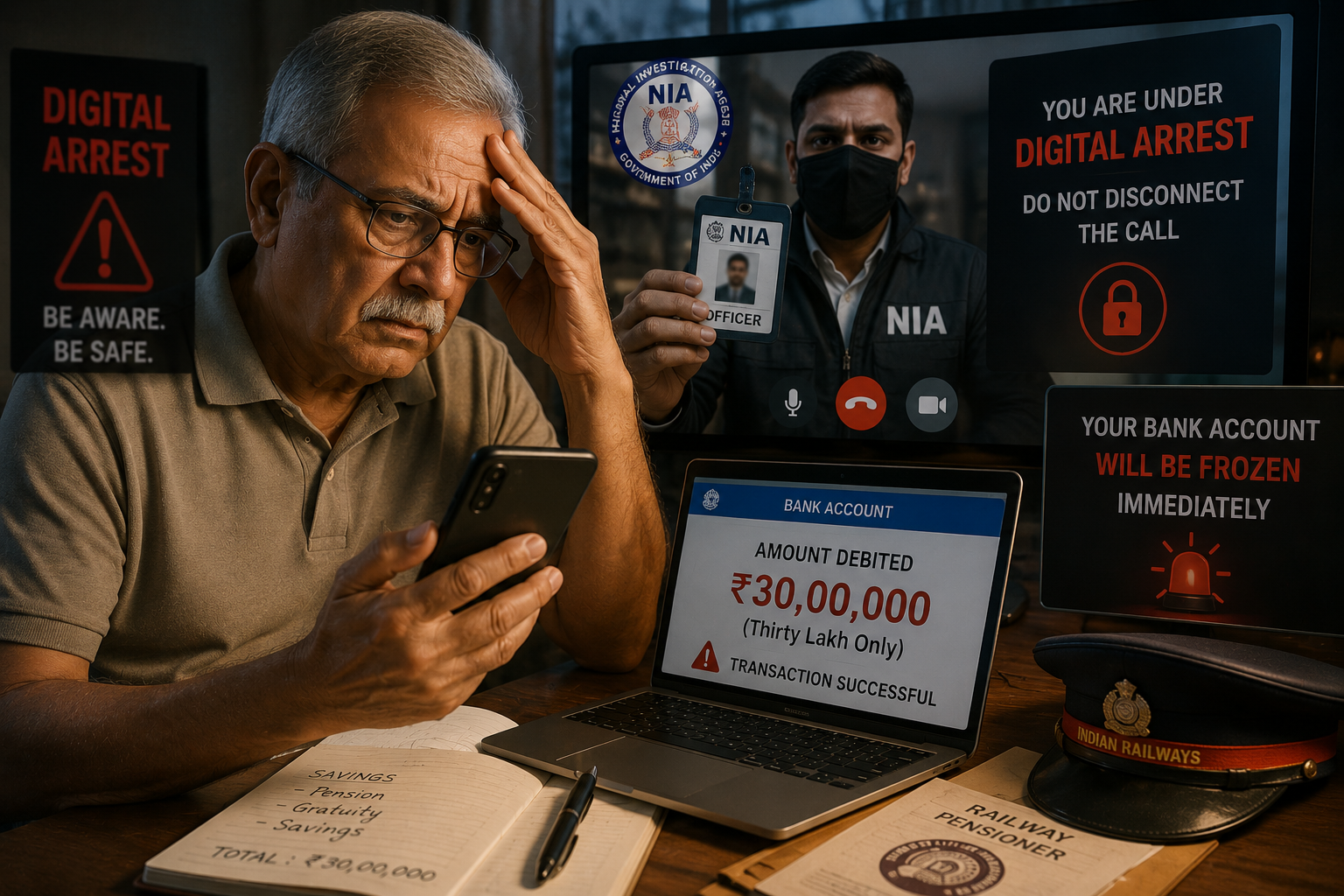
A disturbing cyber fraud case from Delhi has highlighted how criminals are using fear, fake government identities and high-profile criminal investigations to manipulate victims into transferring their savings.
A 74-year-old retired Indian Railways employee from Delhi's Dwarka and his wife were allegedly kept under a so-called “digital arrest” for nearly seven days after fraudsters falsely linked the man to the Red Fort blast case.
The scammers allegedly posed as officials from agencies including the National Investigation Agency (NIA), Anti-Terrorism Squad (ATS) and Reserve Bank of India (RBI). By repeatedly threatening the elderly man with arrest and sending fake documents, they convinced him that his bank account had been linked to terror financing.
Under intense pressure, the victim eventually transferred a total of ₹30 lakh.
Delhi Police investigated the money trail and arrested an accused identified as Sunil Singla, a resident of Fatehabad in Haryana. Police have also managed to recover ₹12 lakh and return it to the victim.
Scam Began With a Frightening Phone Call
According to the police account, the fraud began on November 23, 2025.
The retired railway employee was preparing to attend a relative's wedding when he received a call at around 4 pm.
The caller allegedly introduced himself as an NIA official and made a serious accusation: the elderly man's bank account had supposedly been used to finance people involved in the Red Fort blast.
The allegation immediately frightened the victim because the blast near Delhi's Red Fort had occurred only days earlier.
The caller used this fear to convince the man that he was facing a genuine investigation by a national security agency.
Fraudsters Posed as NIA and ATS Officers
The operation became more elaborate the following day.
The scammers allegedly contacted the victim through video calls. One person presented himself as an NIA officer, while another claimed to represent the ATS.
They told the retired employee that his bank account was connected to people accused in the blast investigation.
The criminals then warned him that he could be arrested if he failed to cooperate with the supposed investigation.
By using the names of powerful government agencies and making serious allegations involving terrorism and money laundering, the scammers created a sense of urgency and fear.
Couple Kept Under 'Digital Arrest' for Nearly Seven Days
The fraudsters allegedly maintained constant pressure on the elderly couple for about seven days.
They remained in contact through phone and video calls and reportedly instructed the victims not to discuss the investigation with anyone, including their children.
This is a common psychological technique associated with digital arrest scams.
The criminals isolate the victim from family members, friends and other people who might recognise the fraud. They then use repeated calls and threats to make the victim believe that following their instructions is the only way to avoid arrest.
There is, however, no legitimate legal procedure called “digital arrest” under which police or investigation agencies keep a citizen confined through WhatsApp or video calls.
Fake Documents Made the Scam Look Genuine
Phone calls were not the only tool used by the fraudsters.
The scammers allegedly sent fake documents through WhatsApp to make the supposed investigation appear authentic.
The victim was reportedly sent a bogus confidentiality agreement and was made to sign it.
The fraudsters also sought information about the couple's bank accounts, fixed deposits and other financial assets.
Later, they told the victims that their money needed to be transferred to a supposedly authorised account so that the source of the funds could be verified.
Fake official-looking paperwork played an important role in making the story appear credible.
₹30 Lakh Transferred in Two Transactions
After several days of intimidation, the scammers allegedly told the victim that his funds needed to be verified before the investigation could be closed.
The man was assured that the money would be returned after the verification process.
On December 3, the victim liquidated a fixed deposit and arranged ₹30 lakh.
He initially transferred ₹15 lakh through RTGS to a bank account specified by the fraudsters.
The following day, the scammers demanded another ₹15 lakh.
Believing that he was cooperating with an official investigation, the victim transferred the second amount as well.
In total, ₹30 lakh was transferred.
Fake RBI Verification Letter Sent After Payment
The deception continued even after the money had been transferred.
The fraudsters allegedly sent the victim a fake verification letter purportedly issued by the Reserve Bank of India.
The document was designed to convince the couple that their funds were being handled as part of an official financial verification process.
However, after receiving the money, the scammers eventually stopped responding to the victim's calls.
It was then that the retired employee realised that the entire investigation had been fabricated and that he had fallen victim to a cyber scam.
Police Followed the Money Trail
Following the complaint, the case was investigated by the Delhi Police Crime Branch.
Investigators examined bank records, KYC information, digital evidence and transaction details to identify where the stolen money had gone.
A significant lead emerged from one of the ₹15 lakh transfers.
Police found that the money had been credited to a bank account operated in the name of Shri Balaji Tractor.
The investigation eventually led police to Sunil Singla, a resident of Fatehabad, Haryana.
Police arrested Singla in connection with the case.
Bank Account Allegedly Linked to Other Cyber Fraud Cases
Investigators reportedly found that the bank account identified during the probe was not associated with only this incident.
According to police, the account had surfaced in several other cyber fraud complaints registered in different states.
Transactions involving nearly ₹1 crore across multiple cyber fraud cases had allegedly been routed through the account.
The investigation indicated that such bank accounts can form an important part of cybercrime networks because fraudulently obtained money needs to be transferred rapidly through different accounts to make recovery more difficult.
Accused Allegedly Offered Commission for Bank Transactions
According to investigators, Singla told police that he had been looking for an online loan to expand his business when he came into contact with another person.
He was allegedly offered a commission for allowing large transactions to be routed through his bank account.
The broader investigation into the cyber fraud network and the role of other individuals involved in the scam remains important because digital arrest frauds are often operated through multiple participants rather than a single caller.
Police Recover ₹12 Lakh
Police were able to prevent the onward transfer of part of the stolen money.
Out of the ₹30 lakh transferred by the victim, authorities managed to recover ₹12 lakh.
The recovered amount was subsequently returned to the complainant.
While this represents a significant recovery, the case demonstrates how quickly money can move through different accounts after a cyber fraud transaction.
This is why victims are generally advised to report suspicious financial transactions immediately rather than waiting for scammers to return the money.
What Is a Digital Arrest Scam?
“Digital arrest” is a term commonly used for a type of cyber fraud in which criminals impersonate police officers, investigation agencies, government officials or financial regulators.
They contact victims by phone or video call and make serious allegations.
A victim may be falsely told that:
- Their Aadhaar or mobile number has been used in a crime.
- Their bank account is connected to money laundering.
- A parcel in their name contains illegal items.
- Their account has been linked to terrorism or another serious offence.
- An arrest warrant has been issued against them.
- Their money needs to be transferred for “verification.”
The fraudsters then try to prevent the victim from speaking to family members or contacting the actual police.
The ultimate objective is usually to obtain money or sensitive financial information.
Government Agencies Do Not Demand Money on Video Calls
One of the biggest warning signs is a demand to transfer money to prove innocence or verify funds.
Legitimate police officers, courts, the NIA, RBI or other government authorities do not conduct a “digital arrest” through WhatsApp and demand that people transfer their savings into a supposedly safe account.
Similarly, receiving a document bearing an official logo, stamp or government agency name does not prove that it is genuine.
Modern editing tools make it relatively easy for criminals to produce convincing fake notices, letters and identity documents.
Any unexpected communication involving arrest threats and financial demands should therefore be independently verified.
What Should You Do If You Receive Such a Call?
Anyone receiving a suspicious call claiming to be from a police or investigation agency should avoid panicking.
Do not transfer money merely because the caller threatens arrest.
Never reveal OTPs, UPI PINs, card PINs, passwords or other confidential banking credentials.
If the caller claims to represent a government agency, disconnect the call and independently contact the agency using contact details obtained from its official website.
Victims of financial cyber fraud should report the incident as quickly as possible through the official cybercrime reporting mechanism and contact their bank immediately.
Speed can be crucial because banks and law-enforcement agencies may have a better chance of freezing funds before they are transferred through multiple accounts.
Why This Case Is a Warning for Other Users
What makes this case particularly concerning is the way the criminals allegedly used a recent, high-profile criminal investigation to make their threat believable.
Instead of relying on a generic claim, the fraudsters invoked the Red Fort blast, NIA, ATS and RBI to create fear and authority.
The victim was then isolated through repeated calls, supplied with apparently official documents and persuaded to move his life savings for supposed verification.
The case demonstrates that digital arrest fraud is fundamentally based on psychological manipulation.
Criminals do not necessarily need to hack a bank account if they can frighten the account holder into transferring the money voluntarily.
Bottom Line
A retired Indian Railways employee and his wife in Delhi were allegedly subjected to a sophisticated digital arrest scam in which fraudsters falsely accused the man of being connected to the Red Fort blast investigation.
The criminals allegedly impersonated NIA, ATS and RBI officials, communicated through phone and video calls, sent fake documents and threatened the victim with arrest.
After nearly seven days of pressure, the couple transferred ₹30 lakh in two transactions of ₹15 lakh each.
Delhi Police followed the money trail, arrested an accused identified as Sunil Singla and recovered ₹12 lakh for the victim.
The incident offers an important lesson for every mobile and internet user: no matter how serious an allegation sounds, never transfer money simply because someone claiming to be a police officer or government official demands it over a phone, WhatsApp or video call. Verify the claim independently through official channels before taking any financial action.