India’s LPG Use Drops 16% as Government Pushes PNG and Diversifies Gas Imports
India's cooking gas market is undergoing a noticeable shift. Liquefied Petroleum Gas (LPG) consumption fell sharply during the first five months of the current financial year, while the government is simultaneously encouraging households in areas with city gas networks to consider Piped Natural Gas (PNG).
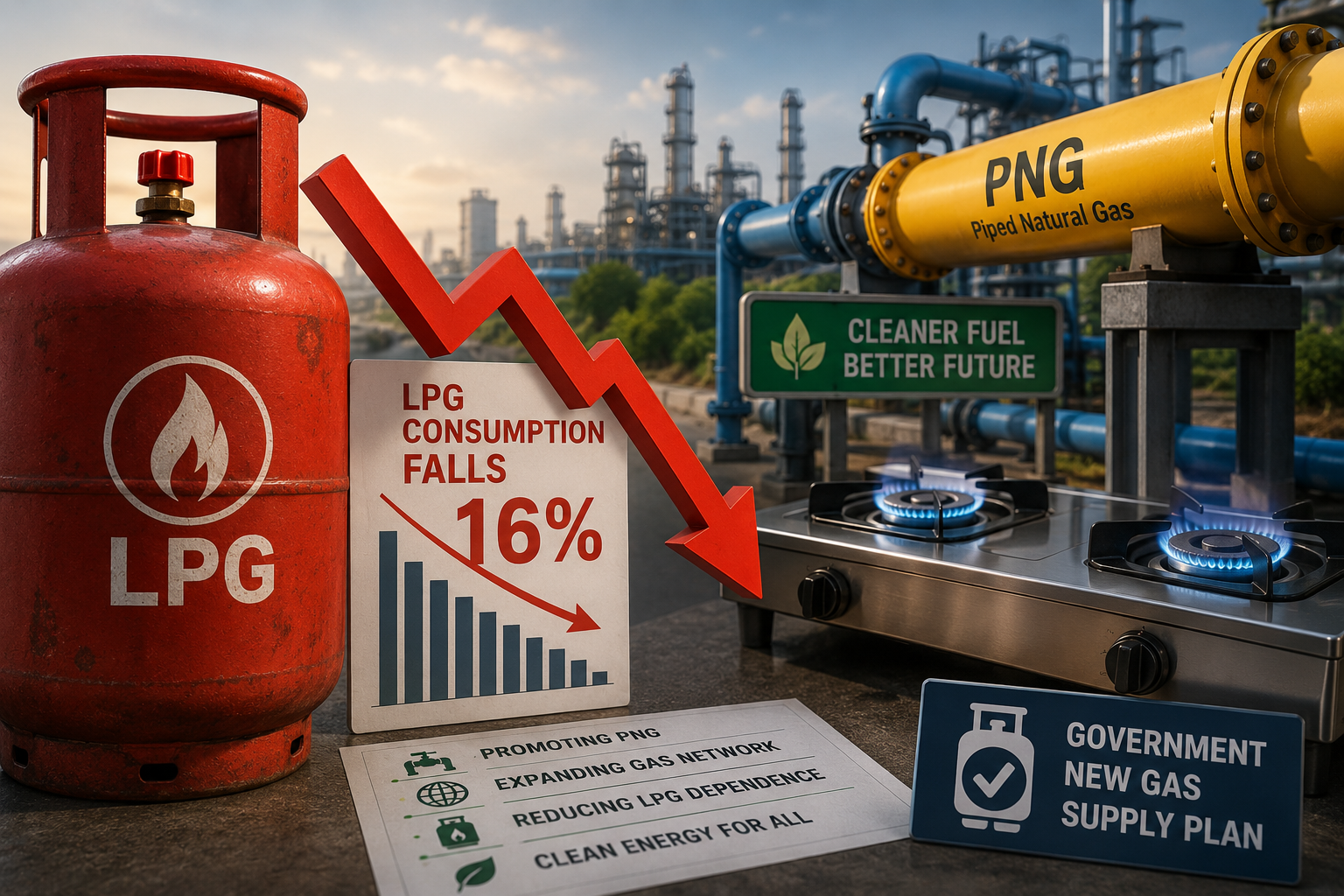
According to data from the Petroleum Planning and Analysis Cell (PPAC), LPG consumption in India declined by around 16% year-on-year to 11.3 million tonnes during April-August 2026. Consumption stood at about 13.4 million tonnes during the corresponding period of the previous financial year.
The decline comes after months of disruption in global energy markets caused by the West Asia conflict and pressure on supplies moving through the Strait of Hormuz.
At the same time, India has been changing where it buys LPG from, with the United States emerging as an increasingly important supplier after disruption affected traditional Gulf supply routes.
So, does this mean LPG cylinders are going away? Not immediately. However, the combination of falling consumption, expansion of city gas infrastructure and diversification of imports suggests India's cooking-fuel landscape could gradually become more diverse.
LPG Consumption Falls to 11.3 Million Tonnes
The biggest development is the sharp decline in LPG consumption.
During April-August 2026, India consumed approximately 11.3 million tonnes of LPG, compared with 13.4 million tonnes in the same period a year earlier.
That represents a decline of around 15.9%, or roughly 16%, on a year-on-year basis.
The downward trend was also visible in August.
LPG consumption during August 2026 stood at approximately 2.4 million tonnes, compared with about 2.9 million tonnes in August 2025, translating into a decline of around 16%.
The figures are particularly significant because LPG remains one of India's most widely used household cooking fuels.
Why Has LPG Consumption Declined?
There is no single reason behind the decline.
One important factor has been the disruption to international LPG supplies following the West Asia conflict.
India has historically depended substantially on imported LPG to meet domestic requirements. A large proportion of these imports traditionally originated in Gulf countries and moved through the Strait of Hormuz.
Disruptions to this important shipping route created supply challenges earlier in 2026 and pushed India to explore alternative sources.
At the same time, the government has stepped up efforts to encourage the use of PNG in areas where city gas distribution networks are already available.
The combination of these developments is changing the country's cooking-gas market.
Government Wants More Households to Consider PNG
The Petroleum Ministry has asked states and Union Territories to provide administrative support for accelerating the transition of eligible households from LPG cylinders to PNG.
The idea is particularly relevant in cities and districts where pipelines and city gas infrastructure are already available.
States have also been asked to provide district-level coordination and facilitate cooperation among local administrations, city gas distributors and oil marketing companies.
The objective is not simply to replace one cooking fuel with another overnight.
Rather, expanding PNG use in suitable areas can reduce the logistics involved in transporting, storing and delivering millions of LPG cylinders.
District-Level Officers Could Help Speed Up Transition
The Centre has sought stronger administrative coordination at the district level.
The Petroleum Ministry has asked states and Union Territories to facilitate the appointment of nodal officers who can coordinate with gas distribution companies and oil marketing companies.
This could help address practical problems involved in expanding household PNG connections.
For example, city gas companies may need coordination for pipeline infrastructure, local permissions, consumer awareness and connections in residential areas.
Stronger cooperation between district administrations and gas distributors could accelerate the process.
Why Is PNG Being Promoted?
Piped Natural Gas is delivered directly to homes through a pipeline network.
Unlike LPG, consumers do not need to book a cylinder, wait for delivery and replace an empty cylinder with a full one.
PNG also eliminates much of the cylinder transportation and distribution infrastructure required for conventional LPG supply.
The Petroleum Ministry has described PNG as a cleaner, safer and more efficient cooking fuel and sees it as having a role in India's broader energy transition.
However, PNG is not available everywhere.
Its expansion depends on the availability of city gas distribution infrastructure. Rural areas and locations without pipelines are therefore likely to remain dependent on LPG cylinders for the foreseeable future.
Does This Mean LPG Cylinders Will Disappear?
No.
The decline in consumption should not be interpreted as an announcement that LPG cylinders are being discontinued.
India has hundreds of millions of domestic LPG connections, and cylinders remain essential in areas where piped gas infrastructure is unavailable.
LPG is particularly important in rural and semi-urban regions because cylinders can be transported to places where building a pipeline network may not yet be economically or practically feasible.
The more likely scenario is that the cooking-gas market becomes increasingly divided between LPG and PNG.
Urban households with access to city gas networks may gradually move towards PNG, while LPG continues to play a major role across the rest of the country.
West Asia Crisis Exposed India's LPG Import Dependence
The push for diversification has also been influenced by India's dependence on imported LPG.
India historically imported around 60% of its LPG requirements.
Before the recent disruptions, approximately 90% of imported LPG came from Gulf suppliers through the Strait of Hormuz.
This concentration created a significant vulnerability.
When shipping through Hormuz was disrupted by the West Asia conflict, LPG cargo movements were affected and India had to look more aggressively towards alternative suppliers.
The situation demonstrated why depending heavily on one geographic region for a critical household fuel can create energy-security risks.
US Emerges as an Important LPG Supplier
One of the biggest changes has occurred in India's LPG import basket.
The United States has emerged as a major alternative supplier as India works to reduce its dependence on Gulf shipments.
Commodity analytics data cited in recent reports showed that the US supplied approximately 276,000 tonnes of LPG to India during August 2026.
By comparison, imports from the UAE during the month were around 68,000 tonnes.
The numbers show how dramatically sourcing patterns have changed following the disruption in the Strait of Hormuz.
However, Gulf countries remain important suppliers and their share could increase again as supply conditions improve.
Gulf Suppliers Are Beginning to Return
The shift towards US supplies does not mean India is abandoning traditional Gulf suppliers.
More recent trade data indicate that Gulf producers have started regaining some of their market share.
The UAE and Kuwait, among others, increased LPG shipments as supply conditions improved.
This means India's long-term strategy may not be about replacing Gulf LPG with American LPG.
Instead, the objective is likely to be diversification.
Buying from several regions can reduce the risk of a future geopolitical event or shipping disruption affecting a large portion of India's cooking-gas supply.
Why the Strait of Hormuz Matters So Much
The Strait of Hormuz is one of the world's most strategically important energy shipping routes.
A substantial volume of crude oil, natural gas and LPG exports from the Gulf moves through this narrow waterway.
India's dependence on LPG shipments originating in countries such as the UAE, Qatar, Saudi Arabia and Kuwait meant that disruption in the region could directly affect supply.
The 2026 West Asia crisis demonstrated that vulnerability.
Even if enough LPG is eventually available globally, disrupted shipping routes can delay cargoes, increase transportation costs and push international prices higher.
LPG Prices Also Faced International Pressure
Supply disruption was accompanied by a significant increase in international LPG benchmarks earlier in 2026.
Government data released in June showed that the benchmark price for the propane-butane blend relevant to India had risen sharply following the Hormuz disruption.
The government and public-sector oil marketing companies absorbed a substantial portion of the increase rather than passing the full international cost directly to domestic consumers.
This highlighted another problem with heavy import dependence: geopolitical disruptions can affect not only physical availability but also the cost of supplying each cylinder.
Petrol and Diesel Demand Moves in the Opposite Direction
Interestingly, the decline in LPG consumption did not reflect a broad fall in petroleum-product demand.
Petrol and diesel consumption actually increased during April-August 2026.
Petrol consumption rose approximately 6.4% to 18.9 million tonnes, compared with 17.8 million tonnes during the corresponding period a year earlier.
Diesel demand increased about 4.3% to 40.5 million tonnes, from 38.9 million tonnes.
In August alone, petrol consumption increased 7.9% year-on-year to approximately 3.8 million tonnes, while diesel consumption rose 6.4% to around 7 million tonnes.
This makes the decline in LPG particularly notable because other major transport fuels recorded higher consumption.
What Does the Government's PNG Plan Mean for Consumers?
For households, the impact will largely depend on location.
If PNG infrastructure is available in a residential area, consumers could increasingly be encouraged to take a piped gas connection.
PNG offers the convenience of continuous supply without cylinder booking and delivery.
For households outside city gas distribution networks, however, LPG cylinders will continue to be essential.
Consumers should therefore not interpret the government's PNG push as a nationwide withdrawal of LPG services.
The transition will depend on pipeline availability, local infrastructure and consumer adoption.
India's Cooking Gas Strategy Is Becoming More Diverse
The latest developments point towards two parallel changes.
First, India is attempting to diversify how cooking gas reaches consumers by expanding PNG alongside the existing LPG cylinder network.
Second, the country is diversifying where imported LPG comes from by increasing supplies from countries outside its traditional Gulf sources.
Both changes are connected to energy security.
A broader domestic distribution system reduces dependence on cylinder logistics in cities, while a broader international supplier base reduces dependence on a single geographic region.
What Happens Next?
The April-August decline in LPG consumption is significant, but it is too early to conclude that India is moving rapidly away from cylinders altogether.
Future consumption will depend on several factors, including the pace of PNG connections, LPG availability, international prices, domestic production and demand from households as well as commercial users.
Developments in the Strait of Hormuz and Red Sea will also remain important for India's import strategy.
Even if tensions ease, refiners and oil marketing companies may continue buying LPG from a wider group of suppliers rather than returning completely to the previous sourcing pattern.
Bottom Line
India's LPG consumption dropped approximately 16% year-on-year to 11.3 million tonnes during April-August 2026, compared with 13.4 million tonnes during the same period of the previous financial year.
The decline comes against the backdrop of supply disruptions caused by the West Asia conflict and a stronger government push to expand PNG use in areas where pipeline infrastructure is available.
At the same time, India's international sourcing strategy is changing. The country, which historically depended heavily on Gulf suppliers for imported LPG, has significantly increased supplies from the United States and other sources.
This does not mean LPG cylinders are about to disappear. They will remain an essential cooking fuel, particularly in areas without city gas networks.
What is changing is India's approach: more PNG connections where pipelines are available, continued LPG access where cylinders are necessary, and a more diversified international supply network to reduce future energy-security risks.