
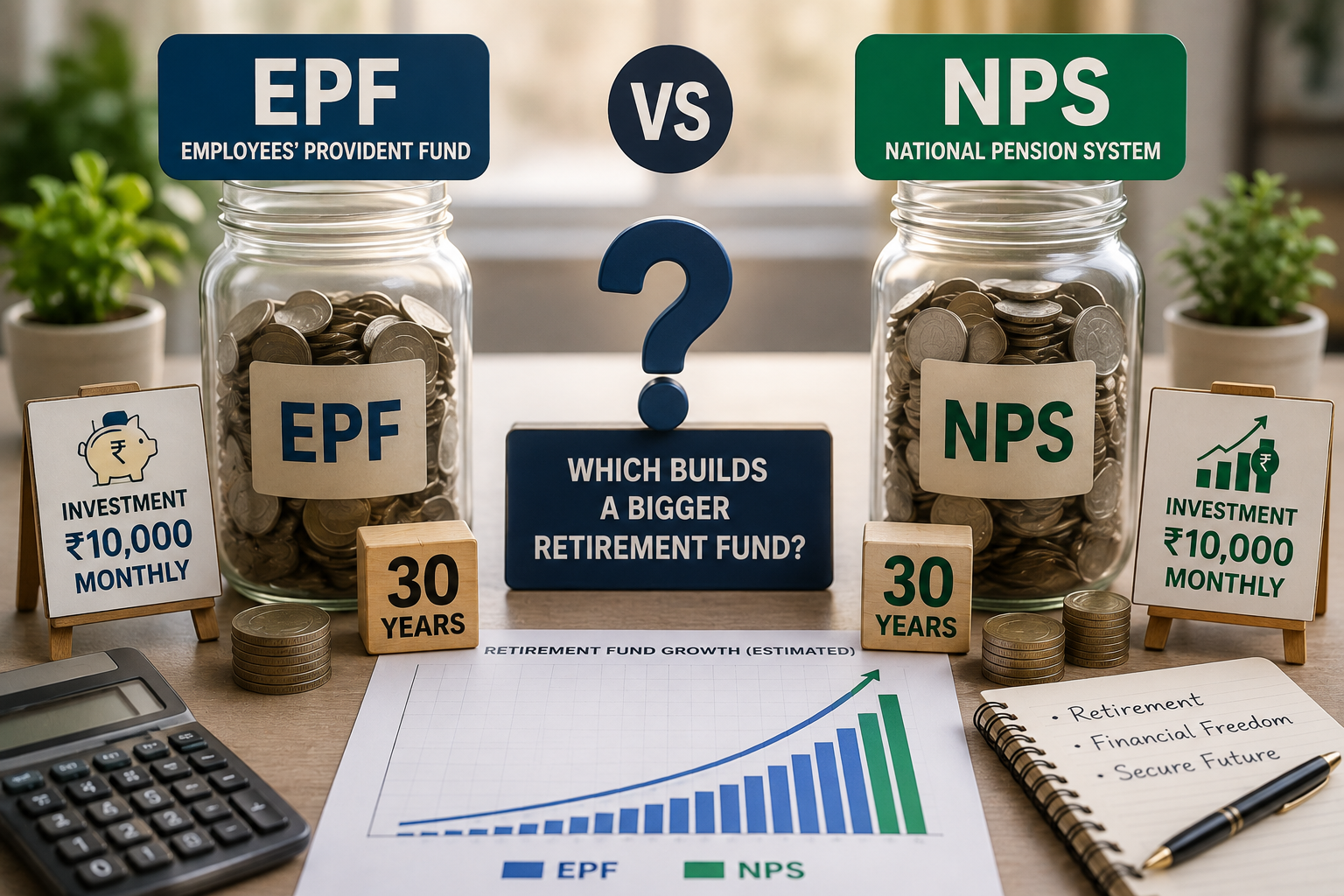
Building a large retirement corpus does not always require starting with a huge investment. Starting early, investing consistently and increasing contributions as income grows can make a substantial difference over three decades.
Consider a person who begins investing at the age of 30 with a monthly contribution of ₹10,000 and increases that contribution by 5% every year. If the investment continues until age 60, how much money could accumulate?
Under one illustrative calculation, the retirement corpus could reach around ₹4.44 crore through EPF and approximately ₹5.30 crore through NPS.
At first glance, NPS appears to build nearly ₹86 lakh more. But comparing the two only on the final corpus can be misleading. EPF and NPS work differently, their returns are generated differently, and their retirement withdrawal rules are not the same.
Here is a closer look at the calculation and the major differences investors should understand.
Starting With ₹10,000 a Month
For this illustration, assume that an individual starts investing ₹10,000 every month at age 30.
That means the contribution during the first year is:
₹10,000 × 12 = ₹1,20,000
Instead of keeping the monthly contribution fixed for the entire 30-year period, assume that it increases by 5% every year.
So the monthly contribution would gradually rise:
| Investment Year | Approx. Monthly Contribution |
|---|---|
| Year 1 | ₹10,000 |
| Year 2 | ₹10,500 |
| Year 3 | ₹11,025 |
| Year 4 | ₹11,576 |
| Year 5 | ₹12,155 |
| Year 10 | ₹15,513 |
| Year 20 | ₹25,270 |
| Year 30 | ₹41,161 |
This annual step-up is important because income generally increases over a person's career. Raising retirement contributions along with salary can significantly improve the final corpus.
How Much Would You Invest Over 30 Years?
If ₹10,000 per month is increased by 5% every year for 30 years, the total amount contributed would be approximately ₹79.73 lakh.
The remaining corpus would come from the returns generated on those contributions and the effect of long-term compounding.
This is where the assumed rate of return becomes crucial.
A small difference in annual returns can translate into a very large difference after 30 years.
How EPF Can Build Around ₹4.44 Crore
Employees' Provident Fund, or EPF, is primarily a retirement savings mechanism for eligible salaried employees.
For the purpose of this illustration, assume an EPF-like annual return of around 8.25% over the entire investment period.
If contributions start at ₹10,000 per month, increase by 5% annually and continue for 30 years, the accumulated corpus can reach approximately:
₹4.44 crore
The calculation is illustrative because the EPF interest rate is not permanently fixed at 8.25% for 30 years.
The interest rate is declared for each financial year and can change in the future.
Therefore, ₹4.44 crore should be viewed as a projection based on an assumed long-term rate rather than a guaranteed maturity amount.
How NPS Can Reach Around ₹5.30 Crore
Now consider the same contribution pattern under the National Pension System.
Assume that the investment begins at ₹10,000 per month, increases by 5% every year and continues for 30 years.
Unlike EPF, NPS investments can have exposure to market-linked assets such as equities, corporate debt and government securities.
If the portfolio generates a higher long-term return, the final corpus can potentially be larger.
Under an illustrative long-term return assumption of roughly 9% to 10%, depending on contribution timing and calculation methodology, the accumulated NPS corpus could be around:
₹5.30 crore
This would put the projected NPS corpus approximately ₹86 lakh above the EPF illustration.
However, NPS returns are market-linked. The ₹5.30 crore figure is therefore an estimate, not an assured return.
EPF vs NPS: The ₹86 Lakh Difference
Based on these illustrative figures:
| Particular | EPF | NPS |
|---|---|---|
| Starting monthly investment | ₹10,000 | ₹10,000 |
| Annual increase | 5% | 5% |
| Investment period | 30 years | 30 years |
| Starting age | 30 | 30 |
| Retirement age | 60 | 60 |
| Estimated corpus | ₹4.44 crore | ₹5.30 crore |
| Approx. difference | — | ₹86 lakh more |
The comparison shows the potential impact of even a modest difference in long-term returns.
Over one or two years, the difference may appear small. Over three decades, compounding magnifies it substantially.
Why Could NPS Build a Larger Corpus?
The biggest reason is the possibility of equity exposure.
NPS subscribers can allocate part of their retirement money to equities, subject to applicable rules and investment choices.
Equities can potentially deliver higher returns over long investment periods, although they also involve greater market volatility.
EPF, by comparison, follows a different structure and does not provide the employee with the same type of direct market-linked asset allocation.
This can make EPF relatively predictable from an employee's perspective, while NPS offers greater potential for market-driven growth.
But higher return potential also comes with higher uncertainty.
EPF Returns Are Not Fixed Forever
One common mistake while calculating a 20- or 30-year EPF corpus is assuming that today's interest rate will continue throughout the entire period.
That cannot be known in advance.
The EPF interest rate is decided for individual financial years. Future rates may be higher or lower depending on the decisions applicable at that time.
Therefore, calculations using an 8.25% rate for 30 years are useful for understanding the power of compounding, but they should not be treated as a promise of the final amount.
The actual corpus will depend on the interest rates credited during the investor's working years.
NPS Returns Are Market-Linked
The uncertainty works differently in NPS.
NPS does not offer a fixed annual interest rate comparable to a conventional guaranteed-return product.
Returns depend on the performance of the underlying investments.
A portfolio with higher equity exposure can experience significant fluctuations along the way. Returns can be strong in some years and weak or even negative during periods of market decline.
Over a 30-year horizon, investors generally have more time to absorb short-term market volatility, but that still does not guarantee a particular return.
So, a projection of ₹5.30 crore should not be interpreted as a guaranteed maturity value.
The Power of Increasing Investment by 5% Every Year
One of the most important lessons from this comparison is not simply EPF versus NPS.
It is the impact of increasing contributions every year.
If an investor keeps contributing only ₹10,000 every month for the entire 30 years, the total amount invested would be:
₹10,000 × 12 × 30 = ₹36 lakh
But with a 5% annual increase, total contributions over the same period rise to roughly ₹79.73 lakh.
That additional investment, combined with compounding, can dramatically increase the retirement corpus.
This strategy can be particularly practical for salaried professionals whose incomes increase gradually during their careers.
Starting Early Makes a Huge Difference
Age is another major factor.
An investor beginning at 30 has three decades before reaching 60.
Money invested during the early years gets considerably more time to compound than contributions made closer to retirement.
Delaying retirement planning by five or ten years can therefore require much larger monthly investments to target the same final corpus.
The key advantage of starting at 30 is not merely contributing for more years—it is giving the earliest contributions decades to generate returns on previously accumulated returns.
EPF and NPS Are Not Exact Substitutes
It is also important to understand that EPF and NPS are not identical investment products where an individual simply chooses one and ignores the other.
EPF is an employment-linked retirement savings arrangement applicable to eligible employees and establishments.
Contributions are governed by EPF rules and are linked to eligible salary components.
NPS, meanwhile, is a pension-focused investment system that allows subscribers to build a market-linked retirement corpus.
Depending on eligibility and employment structure, an individual may have both EPF and NPS as part of a broader retirement strategy.
What Happens to NPS Money at Retirement?
The final NPS corpus also should not be confused with the amount that automatically lands in a subscriber's bank account at retirement.
NPS has specific exit rules.
Depending on the applicable regulations and circumstances at the time of retirement, a portion of the accumulated corpus may have to be used to purchase an annuity, while the permitted balance can be withdrawn as a lump sum.
The annuity is designed to provide pension income after retirement.
Therefore, if an NPS calculator shows a corpus of ₹5.30 crore, investors should separately consider how much may be available as a lump sum and how much would be used for generating pension income under the rules applicable at the time of exit.
Tax Treatment Also Matters
Tax benefits can influence the effective value of retirement investments.
EPF and NPS have different tax provisions relating to contributions, accumulation and withdrawals.
These rules can also depend on factors such as employer contributions, the investor's tax regime, contribution levels and prevailing income-tax regulations.
Tax rules may change substantially during a 30-year investment horizon.
For this reason, investors should avoid selecting a retirement product purely on the basis of today's tax benefits.
Which Is Better: EPF or NPS?
There is no single answer for every investor.
Someone who values an employment-linked retirement structure and comparatively greater predictability may place significant importance on EPF.
An investor with a long investment horizon who is comfortable with market fluctuations may use NPS to gain exposure to growth-oriented assets such as equities.
For many salaried employees, the more useful question may not be “EPF or NPS?” but rather “How should EPF and NPS fit together in my retirement portfolio?”
Using more than one retirement vehicle can provide a combination of stability, diversification and long-term growth potential.
Don't Choose Only by Looking at ₹4.44 Crore vs ₹5.30 Crore
The difference between the two projected amounts is eye-catching.
But the comparison is based on assumptions.
Actual EPF returns over the next 30 years are unknown, while NPS market returns cannot be predicted in advance.
Inflation also matters.
₹5 crore three decades from now will not have the same purchasing power as ₹5 crore today. A sound retirement plan should therefore focus not only on reaching a large nominal corpus but also on whether that amount can support the desired lifestyle after adjusting for inflation.
Bottom Line
If a 30-year-old starts investing ₹10,000 per month, increases the contribution by 5% every year and continues until age 60, the total contribution over 30 years would be roughly ₹79.73 lakh.
Under illustrative long-term assumptions, the corpus could grow to around ₹4.44 crore in an EPF-style calculation and approximately ₹5.30 crore under an NPS market-linked projection.
That represents a potential difference of around ₹86 lakh in favour of NPS.
However, the comparison should not be interpreted as a guaranteed outcome. EPF interest rates can change from year to year, while NPS returns depend on market performance and asset allocation.
The bigger takeaway is the power of starting retirement planning early, remaining invested for decades and increasing contributions as income rises. A ₹10,000 monthly starting point may appear modest, but combined with a 5% annual step-up and 30 years of compounding, it has the potential to build a substantial retirement fund.