Technology
Soft Blocking Is Gen Z’s New Social Media Trend: What It Means and Why People Are Using It
Social media has made it easier than ever to connect with people, but ending or reducing those connections can sometimes be awkward. Blocking someone on Instagram, Facebook or another platform can feel too direct, particularly when the person is a friend, colleague, former partner or someone you may still meet in real life.
That is where “soft blocking” comes in.
The term is increasingly used to describe a less confrontational way of creating distance from someone online. Instead of completely blocking another person, users quietly change the digital relationship so they see less of each other's activity.
Soft blocking has gained particular attention among Gen Z users, who often navigate friendships, dating, professional relationships and social circles across several digital platforms at once.
But what exactly does soft blocking mean, how is it different from regular blocking, and how can someone do it on social media?
What Is Soft Blocking?
Soft blocking is an informal social-media term rather than the name of one universal feature.
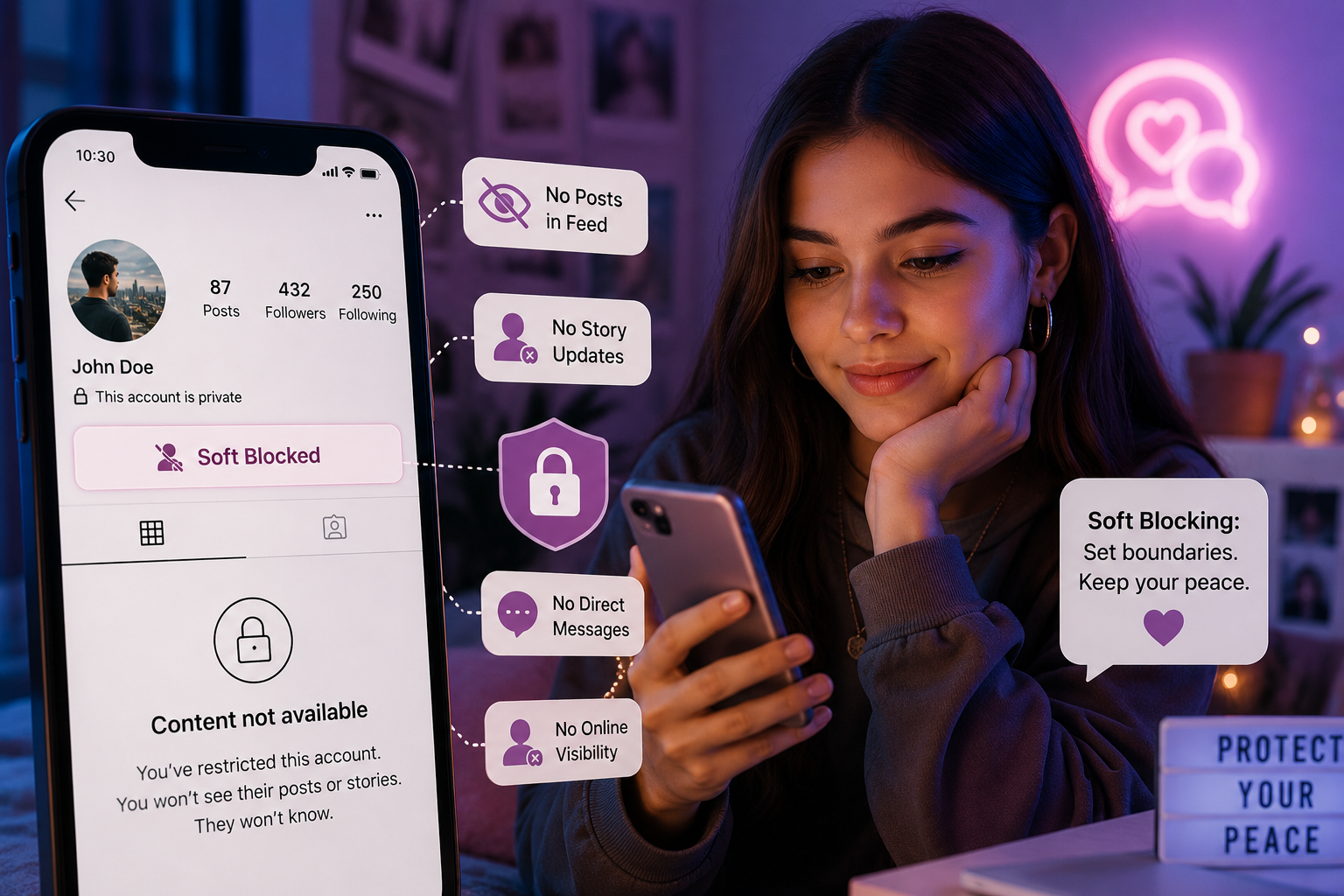
In simple terms, it means reducing someone's access to your social-media activity or limiting your interaction with them without permanently blocking their account.
Depending on the platform, this can involve removing someone from your followers, unfollowing them, muting their posts or stories, restricting interactions or adjusting privacy settings.
The basic idea is simple: you create digital distance without using the more obvious “Block” button.
For example, suppose you no longer want a particular person regularly viewing your Instagram posts or Stories. Instead of blocking that account completely, you might remove the person from your followers and unfollow them.
The connection becomes weaker without the dramatic finality associated with a traditional block.
Why Is Soft Blocking Becoming Popular?
Social-media relationships can be complicated.
People may want to distance themselves from someone without creating an argument or sending a strong signal that the relationship has ended.
A direct block can be immediately noticeable. If the blocked person searches for the account, tries to view the profile or attempts certain interactions, they may realise what has happened.
Soft blocking provides a subtler alternative.
For younger social-media users in particular, online connections can include classmates, colleagues, former friends, ex-partners, distant relatives and people met casually through social networks.
Not every uncomfortable connection requires a complete block.
Sometimes users simply want fewer interactions, greater privacy or a cleaner social-media feed.
How Does Soft Blocking Work on Instagram?
Instagram users can create a soft-block-like effect in several ways.
One common approach is to remove a person from the followers list.
If your account is private, removing someone means that person will generally need to send another follow request before being able to see private posts again.
A user can also unfollow the other person's account so their posts stop appearing regularly in the feed.
Another option is Mute.
Muting someone can reduce how often you see their posts, Stories or other updates without necessarily notifying them that you have done so.
Instagram also provides a Restrict feature that can limit certain interactions without using a full block.
These tools serve different purposes, but they can all be used to create more distance between two accounts.
Soft Blocking Is Different From Muting
Although the terms are sometimes used interchangeably in casual conversations, soft blocking and muting are not necessarily the same thing.
Muting mainly changes what you see.
If you mute someone's posts or Stories, you can remain connected to that person while reducing their content in your feed.
Soft blocking usually implies a broader attempt to weaken or reduce the online connection.
For instance, removing someone as a follower and then unfollowing them changes the relationship between the two accounts more significantly than simply muting their posts.
How Is Soft Blocking Different From a Full Block?
A traditional block creates a much stronger barrier between two accounts.
Depending on the social-media platform, blocking can prevent someone from viewing a profile, following the account, sending messages or interacting with content.
Soft blocking is less absolute.
The other person may still be able to find your account or interact with public content, depending on your privacy settings and the platform involved.
The key difference is therefore the degree of separation.
Blocking is designed to create a clear digital boundary.
Soft blocking is generally about quietly reducing contact without completely cutting off access.
Why Would Someone Soft Block a Friend?
Soft blocking does not always mean that two people have had a serious disagreement.
Sometimes social circles simply change.
A person may no longer be close to a former classmate or colleague but may not feel that blocking them is necessary.
Others may want to reduce interactions with someone who constantly replies to Stories, comments on posts or sends unwanted messages.
Soft blocking can also be used when a user wants to reorganise their social-media circle and keep personal updates visible only to people they currently interact with.
In these situations, the intention may be less about confrontation and more about controlling personal digital space.
Dating and Breakups Can Also Lead to Soft Blocking
The trend is also associated with modern dating culture.
After a relationship or talking stage ends, some people may not want to see an ex-partner's updates every day. At the same time, they may consider a full block unnecessarily harsh.
Unfollowing, removing the person as a follower or muting their content can create some distance.
This allows users to reduce reminders of the relationship without necessarily shutting down every possible channel of communication.
However, there is no universal social rule about what soft blocking means. One person may view it simply as privacy management, while another may interpret it as a clear sign that someone wants distance.
Can Someone Know That You Soft Blocked Them?
It depends on what action you take and which platform you use.
Social-media platforms do not generally have a button explicitly labelled “Soft Block,” so there is no single notification associated with the practice.
If you simply mute someone's posts, the action may be difficult for them to notice.
Removing someone from your followers may also not generate an obvious alert on some platforms, although the person could eventually discover that they are no longer following you.
Similarly, if you unfollow someone, they may notice by checking their follower or following lists.
So, soft blocking can be discreet, but it is not necessarily invisible.
Is Soft Blocking the Same on Every Social Network?
No.
The term describes a social behaviour rather than one standard technical function.
Different platforms provide different privacy and interaction controls.
On one platform, users may remove followers. On another, they may mute or restrict an account. Some services provide controls over who can reply, comment, tag or send messages.
As a result, the exact method of soft blocking depends on the platform and what type of interaction the user wants to reduce.
Users should review the privacy and audience controls available in each app before changing their settings.
When Is a Full Block More Appropriate?
Soft blocking can be useful when the goal is simply to reduce ordinary social interaction, but it is not a substitute for stronger safety tools.
If someone is repeatedly harassing you, sending abusive messages, impersonating you, threatening you or persistently contacting you after being asked to stop, stronger measures may be more appropriate.
In such circumstances, blocking and reporting tools can provide clearer boundaries.
Users can also review their account privacy settings and limit who is allowed to contact, mention or tag them.
Soft blocking is therefore best understood as a social-management technique rather than a security measure.
Why Gen Z Relates to the Soft-Blocking Trend
For Gen Z, social media is often deeply integrated into everyday relationships.
Friendships can continue through Stories, likes, comments and direct messages even when people rarely meet offline.
That can make digital boundaries important.
Soft blocking gives users another way to decide who remains part of their everyday online environment without necessarily making a dramatic announcement about it.
It reflects a broader change in how people manage digital relationships: being connected to someone online does not necessarily mean wanting constant access to their updates—or giving them constant access to yours.
Bottom Line
Soft blocking is becoming a widely discussed way of creating distance from someone on social media without completely blocking their account.
It can involve removing someone from your followers, unfollowing them, muting their content, restricting interactions or changing privacy settings, depending on the platform and the desired level of separation.
The main difference between soft blocking and traditional blocking is intensity. A full block creates a clear digital barrier, while soft blocking generally reduces interaction more quietly.
For Gen Z users managing friendships, dating relationships, former colleagues and changing social circles online, that flexibility can make soft blocking an appealing option.
However, it is important to remember that “soft block” is an informal internet term, not a universal feature offered by every social-media platform. The actual tools and privacy effects vary between apps.