Cooking Oil and Heart Health: The amount and type of fat in your daily diet can have an important impact on cardiovascular health. Indian cooking often involves oil in vegetables, curries, tadka, parathas, snacks and fried foods, making it surprisingly easy to consume more fat than intended.
However, completely eliminating oil is neither necessary nor generally recommended. Dietary fats perform important functions in the body, including helping absorb fat-soluble vitamins. The practical goal is to use oil in moderation while also paying attention to fats coming from packaged foods, fried snacks, butter, ghee and other sources.
So, how much cooking oil should a person or family ideally use in a month?
How Much Oil Is Reasonable Per Person?
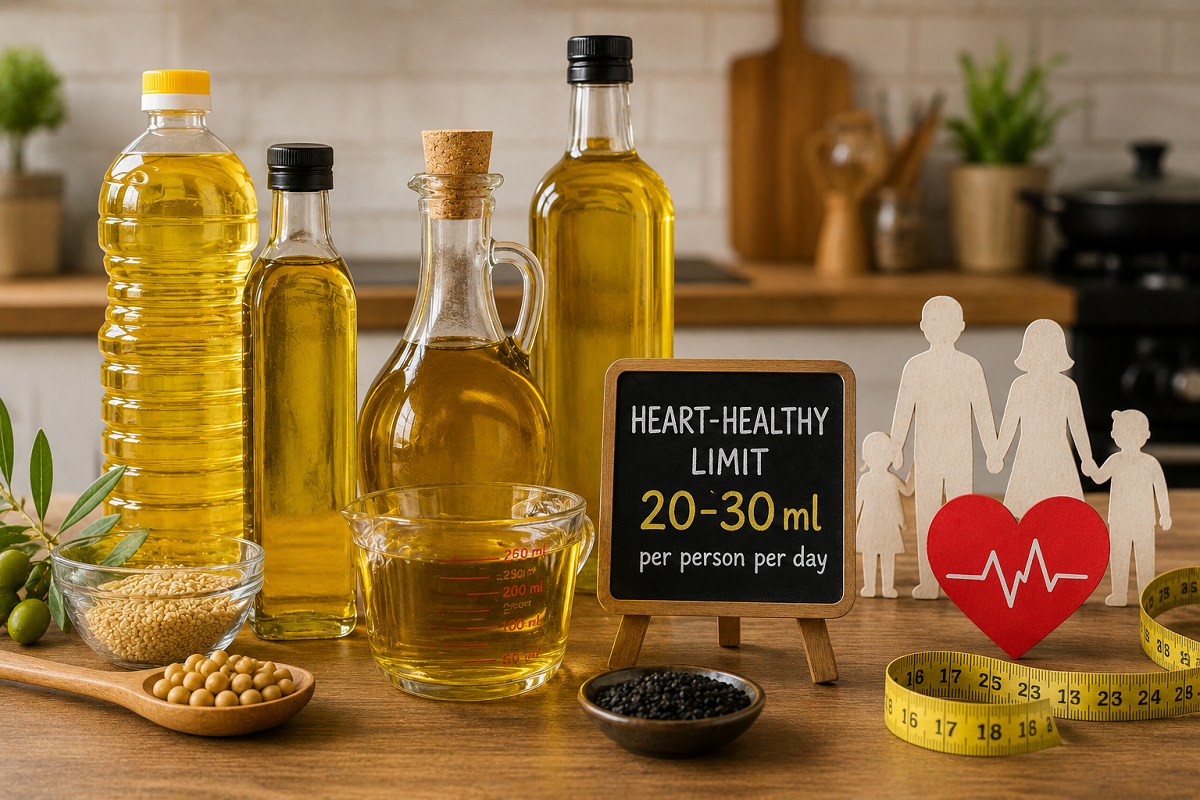
A useful practical target for many adults is to keep visible cooking fats around 20-30 grams per person per day, depending on total calorie needs, physical activity and the rest of the diet.
This includes not only cooking oil but also other visible fats such as ghee and butter.
At 25 grams per day, for example, one person would consume approximately 750 grams of visible fat in a month.
For a family of four, that works out to roughly 3 kg per month if each person consumes around 25 grams daily.
| Family Size | Approximate Monthly Amount at 25 g/Person/Day |
|---|---|
| 1 person | 750 g |
| 2 people | 1.5 kg |
| 3 people | 2.25 kg |
| 4 people | 3 kg |
| 5 people | 3.75 kg |
These numbers are a practical illustration rather than a universal prescription. Children, older adults and people with different calorie requirements will not necessarily need the same amount.
Remember: Oil Is Not the Only Source of Fat
One common mistake is counting only the oil poured into the cooking pan.
Fat is also present naturally in foods such as nuts, seeds, dairy products, eggs, meat and fish. Additional visible or processed fats can come from ghee, butter, bakery products, namkeen, chips, biscuits, fast food and restaurant meals.
Therefore, using 25 grams of cooking oil every day does not automatically mean the overall diet contains an appropriate amount of fat.
If someone frequently consumes fried and packaged foods, reducing the amount of visible cooking oil may be necessary to keep total fat and calorie intake under control.
Which Cooking Oil Is Better for the Heart?
Instead of focusing only on quantity, the type of fat also matters.
Oils rich in unsaturated fats can be preferable to diets dominated by saturated or trans fats. Depending on cooking style, commonly used options may include mustard, groundnut, sesame, rice bran, soybean or other vegetable oils.
There is no need to assume that one particular oil is a magical protection against heart disease.
A balanced diet, appropriate portion sizes and limiting highly processed and deep-fried foods matter more than simply switching from one cooking oil to another.
Be Careful With Ghee and Butter
Ghee and butter are often considered traditional or natural foods, but that does not mean they can be consumed without limits.
They are rich in saturated fat and are calorie-dense. If you use ghee regularly, it should be counted as part of your overall visible-fat intake rather than treated separately from cooking oil.
For example, consuming oil for cooking and then adding generous quantities of ghee to rotis, dal and rice can substantially increase total fat intake.
Deep-Fried Food Can Quickly Increase Oil Consumption
Samosas, pakoras, puris, kachoris, bhaturas, French fries and similar foods can absorb significant amounts of oil during cooking.
Even when the amount of oil used for regular meals seems reasonable, frequent fried foods can push overall fat and calorie intake much higher.
Try using cooking methods such as steaming, grilling, roasting, boiling or sautéing with smaller quantities of oil more frequently.
Using a measuring spoon instead of pouring oil directly from the bottle can also make it easier to understand how much your household actually consumes.
Don't Repeatedly Heat the Same Oil
Another useful kitchen habit is to avoid repeatedly heating and reusing cooking oil, particularly oil that has already been subjected to prolonged high-temperature frying.
Repeated heating can degrade the quality of the oil and produce undesirable compounds.
Instead of filling a large pan with oil and repeatedly using the same batch for frying, prepare smaller quantities and limit deep-frying whenever possible.
Can Controlling Oil Prevent a Heart Attack?
Reducing excessive oil and unhealthy fat consumption can support cardiovascular health, but there is no specific monthly quantity of oil that can guarantee protection from a heart attack.
Heart-attack risk depends on several factors, including blood pressure, cholesterol, diabetes, smoking, physical activity, body weight, age, family history and overall dietary pattern.
Therefore, controlling oil consumption should be viewed as one part of a broader heart-healthy lifestyle.
A diet rich in vegetables, fruits, whole grains, pulses, nuts and other minimally processed foods, combined with regular physical activity and appropriate health screening, is more meaningful than focusing on oil alone.
A Simple Way to Monitor Your Family's Oil Intake
If your household wants to keep track of oil consumption, note how many litres or kilograms of cooking oil, ghee and butter are purchased at the beginning of each month.
Divide the total amount by the number of family members and the number of days.
For example, if four adults consume around 3 kg of visible cooking fats in 30 days, the average comes to approximately 25 grams per person per day.
This simple calculation can reveal whether the household is using substantially more oil than expected.
Ultimately, moderation matters. Rather than eliminating oil entirely, use measured quantities, minimise deep-fried and ultra-processed foods, choose healthier sources of fat and consider the overall quality of the diet.
People with high cholesterol, diabetes, heart disease or other medical conditions should follow individual dietary advice from their doctor or a registered dietitian, as their recommended fat intake may differ.