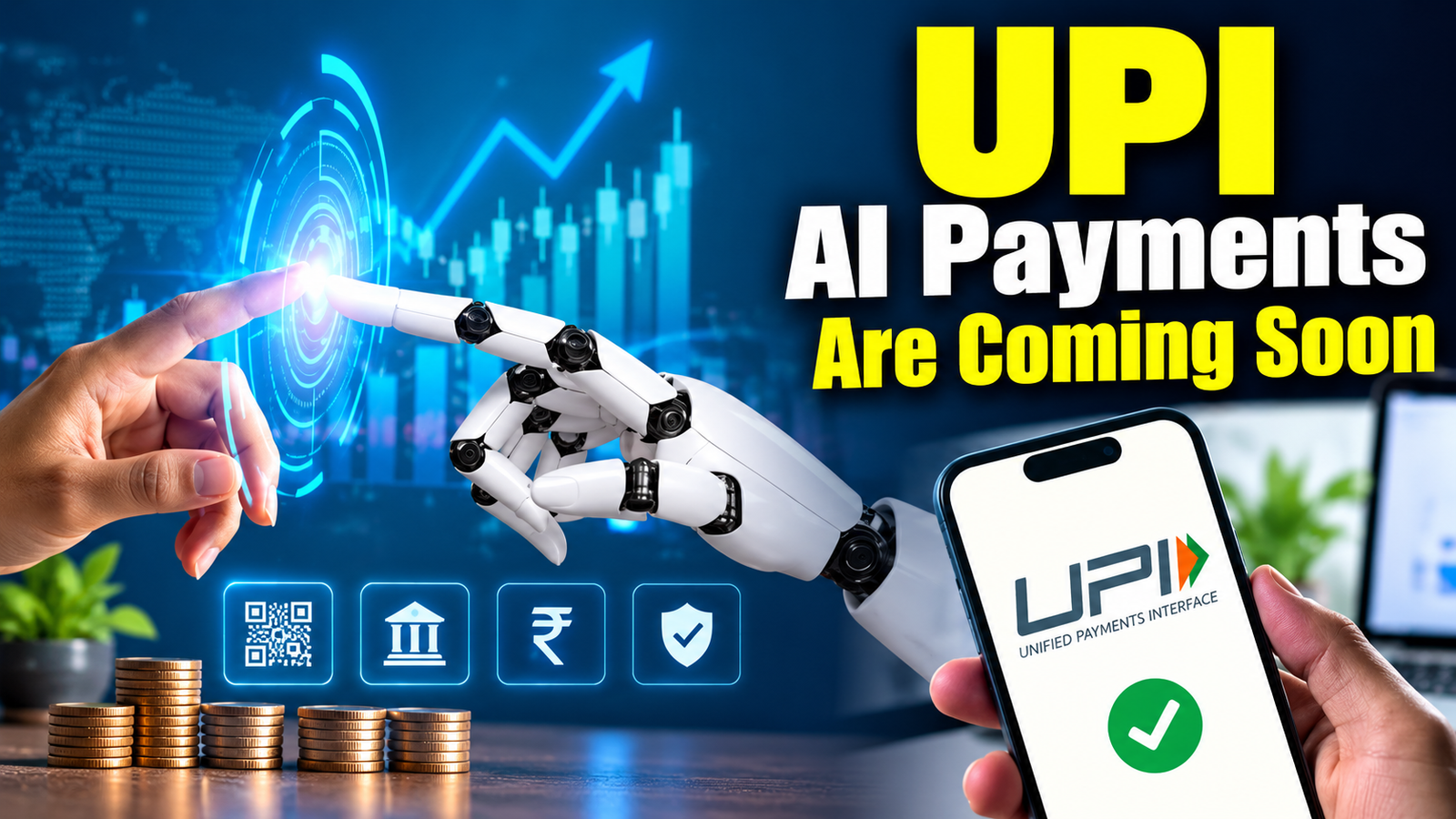
Imagine telling an AI assistant to recharge your mobile every month, pay your electricity bill before the due date or purchase routine household items—and allowing it to complete the UPI payment on your behalf.
Such a system could make digital payments significantly more automated, but it also raises serious questions about security, authorisation and responsibility when something goes wrong.
The National Payments Corporation of India (NPCI) is reportedly working on a framework that could eventually allow authorised AI agents to carry out certain payments for users. However, the proposed rollout has been put on hold for now as the focus shifts toward regulatory clearance and stronger safeguards for users.
The idea is to ensure that an AI error, unauthorised instruction or cyberattack does not put a user's money at unnecessary risk.
How Could AI-Based UPI Payments Work?
At present, users generally initiate or authorise their UPI transactions through supported payment mechanisms. The proposed AI-based framework could take automation a step further by allowing an AI agent to act within permissions granted in advance by the user.
For example, a user could potentially instruct an authorised AI assistant to recharge a mobile connection every month or make certain recurring payments.
Instead of manually initiating each transaction, the AI agent could act according to predefined instructions and limits.
The proposed approach is being associated with UAP, under which AI agents could potentially perform selected low-value or routine transactions on behalf of users.
However, such a system would need clearly defined limits. An AI agent cannot simply be given unrestricted access to a user's bank account without adequate controls over what it can pay, how much it can spend and when it must seek fresh approval.
Why Has NPCI Put the Rollout on Hold?
Security is one of the biggest concerns surrounding payments initiated by autonomous or semi-autonomous AI systems.
Unlike a conventional automated instruction that simply follows a predetermined rule, an AI agent may interpret requests and make decisions based on the information available to it.
That creates new questions for the payments ecosystem.
What happens if the AI misunderstands an instruction? What if it transfers the wrong amount? What if a malicious actor manipulates the AI agent? And who should bear responsibility if an AI-initiated transaction causes financial loss?
These questions need to be addressed before such technology can be deployed widely.
The decision to pause the proposed rollout therefore provides time to develop safeguards and obtain the necessary regulatory clarity.
NPCI Could Create a Registry for AI Agents
One of the important security measures under consideration is reportedly a registry for AI agents participating in the UPI ecosystem.
Such a mechanism could help establish the identity of an AI agent before it is allowed to interact with payment infrastructure.
Identification becomes particularly important in an ecosystem where numerous AI assistants could eventually be developed by different companies.
A structured registry could potentially help the payment ecosystem distinguish authorised agents from unknown or potentially malicious systems. It could also support monitoring and accountability.
The broader framework would need strong mechanisms for identification, authentication, authorisation and transaction monitoring.
Why 'Rogue AI' Is a Concern for Digital Payments
Giving an AI system the ability to move money creates a different risk profile from simply using AI to answer questions or recommend products.
Consider a hypothetical example. A user authorises an AI assistant to make payments of up to ₹1,000 for a particular purpose. Due to a software error, manipulated instruction or cyberattack, the agent attempts to send ₹10,000 instead.
A secure payment framework should ideally prevent the transaction from exceeding the user's authorised limit.
This is why spending caps, transaction permissions and other safeguards could become essential if AI agents are eventually allowed to initiate UPI payments.
The possibility of a compromised or improperly functioning AI agent—sometimes described broadly as a rogue AI risk—also means the system needs mechanisms to detect and stop abnormal activity.
Who Will Be Responsible If AI Makes a Wrong Payment?
Liability could be one of the most difficult issues to resolve.
Traditional digital payment disputes already involve defined participants such as the customer, bank, merchant and payment application. Adding an AI agent creates another layer.
If an AI system incorrectly interprets a user's instruction and makes the wrong payment, responsibility would need to be clearly established.
Depending on how the final framework is designed, questions could arise over the roles of the AI developer, payment application, bank, service provider and user.
Clear dispute-resolution and liability rules would therefore be important before AI agents are given meaningful payment capabilities.
User Authorisation Will Be Crucial
AI-powered UPI payments would also require clear boundaries around user consent.
A customer should be able to understand exactly what authority is being granted to an AI agent. That could include the type of transaction permitted, maximum amount, frequency and duration of the authorisation.
Users would also need an easy way to revoke or modify permissions.
For higher-risk transactions, additional user confirmation could potentially provide another layer of protection, depending on the final rules adopted by the payments ecosystem.
AI Payments Could Bring Convenience, But Security Comes First
Allowing AI assistants to handle repetitive payments could eventually make UPI even more convenient. Routine tasks such as recharges and recurring bills are obvious examples where controlled automation may save users time.
But the ability to recommend a payment and the ability to actually move money are fundamentally different levels of responsibility.
Before AI agents are connected more deeply with UPI payments, regulators and payment-system operators need to address authentication, spending limits, fraud prevention, monitoring, user consent and liability.
For now, the proposed AI-driven UPI framework remains a developing initiative rather than a payment feature consumers can freely use. The current pause indicates that stronger safeguards and regulatory clarity are being prioritised before AI agents are allowed to take a more active role in moving users' money.