
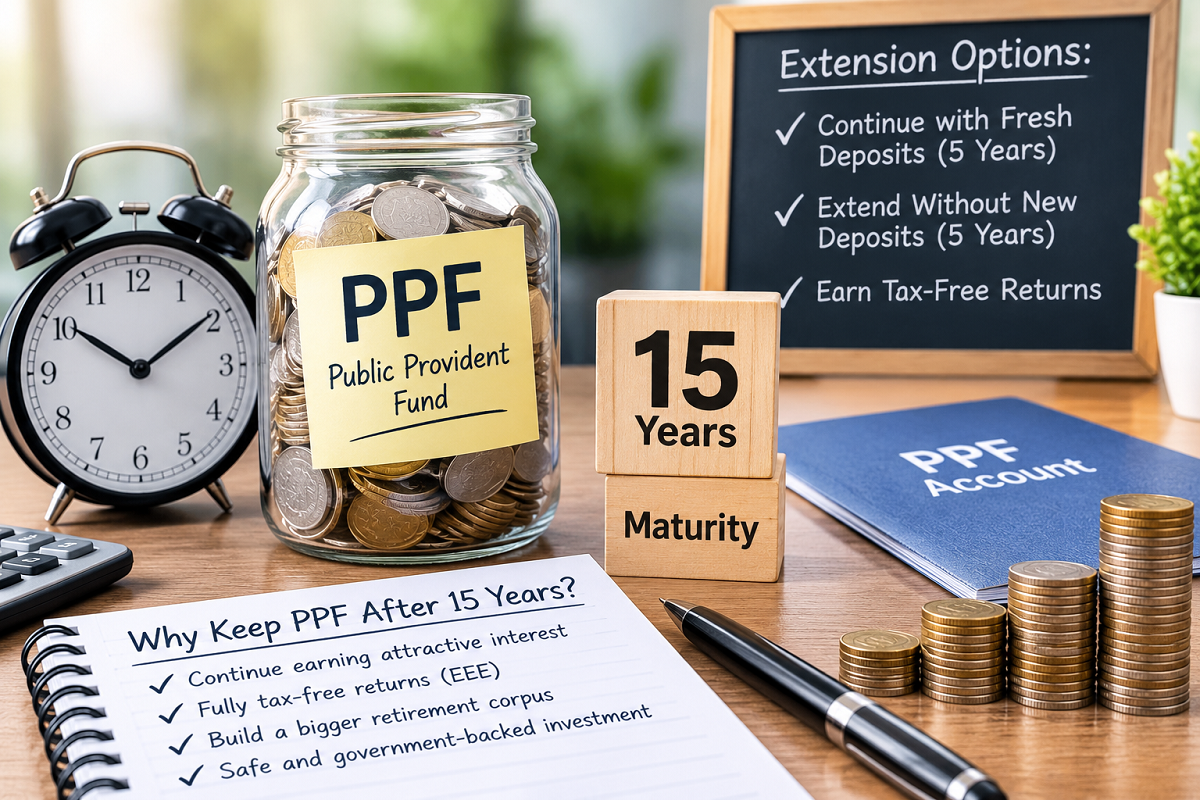
PPF Maturity Rules: Completing 15 years in a Public Provident Fund (PPF) does not mean you necessarily have to close the account and withdraw the entire corpus. Investors who want to continue using PPF for long-term savings can keep the account running after maturity, subject to the applicable extension rules.
This option can be particularly useful for people who do not immediately need their maturity proceeds and want to continue earning interest under the PPF framework.
However, there is an important distinction to understand. After maturity, a PPF account can broadly be continued with fresh contributions or without making further deposits. The rules governing deposits and withdrawals differ between these two choices.
Understanding them before the maturity deadline can prevent mistakes and help investors decide what to do with their accumulated corpus.
What Happens When a PPF Account Completes 15 Years?
PPF is a long-term government-backed small savings scheme with an original maturity period of 15 years, calculated according to the scheme's prescribed rules.
Once this period is completed, the account holder is not forced to immediately withdraw the entire amount.
Depending on the applicable rules, an investor can withdraw the maturity proceeds or continue the account.
For those who choose to remain invested, there are two important routes:
- Continue the PPF account with fresh contributions
- Continue the account without making additional contributions
The choice can significantly affect how the account operates after maturity.
Option 1: Extend PPF With Fresh Contributions
Investors who want to continue depositing money into their PPF account after maturity can opt for an extension in blocks of five years.
This option allows the account holder to continue contributing during the extended period while the accumulated balance remains invested.
The decision to extend with contributions needs to be communicated within the period prescribed under PPF rules. Investors should complete the required extension formalities with their bank or post office rather than simply continuing to deposit money without checking the account's status.
This is particularly important because deposits made without following the applicable extension procedure may create complications.
Investors should therefore contact the institution maintaining their PPF account as maturity approaches and confirm the latest extension process and form requirements.
Why the One-Year Window Is Important
For investors choosing an extension with fresh deposits, the timing of the request is crucial.
The option generally needs to be exercised within one year from the maturity of the account, in accordance with the prescribed PPF procedure.
Missing this window can affect the account holder's ability to continue making qualifying contributions during the extended period.
This is why investors should not wait several years after maturity and then assume they can simply restart annual PPF contributions.
If your PPF has recently matured and you want to continue depositing money, checking the account status with your bank or post office should be a priority.
Option 2: Continue PPF Without Making New Deposits
There is another alternative for investors who do not want to contribute fresh money but also do not need to withdraw the matured corpus.
The account can be continued without further contributions, subject to PPF rules.
In this situation, the existing balance can continue earning interest at the applicable PPF rate while remaining in the account.
This gives investors an opportunity to keep their accumulated savings within the PPF framework without committing to further annual deposits.
Withdrawal flexibility is also available under the rules applicable to an account continued without contributions.
PPF Extension With vs Without Contributions
The basic difference between the two options can be understood as follows:
| Feature | Extension With Contributions | Continuation Without Contributions |
|---|---|---|
| Fresh deposits | Allowed after exercising the prescribed option | Not made |
| Extension structure | Five-year blocks | Balance can remain invested under applicable rules |
| Existing corpus earns interest | Yes, at the applicable rate | Yes, at the applicable rate |
| Formal action | Extension option must be exercised within the prescribed period | Different continuation rules apply |
| Withdrawals | Subject to extended-account limits | Subject to applicable withdrawal rules |
| Suitable for | Investors who want to keep saving through PPF | Investors who want the existing corpus to continue earning |
Account holders should confirm the latest operational rules with their bank, post office or official small-savings guidelines before submitting a request.
Can You Withdraw Money During the Five-Year Extension?
Extending a PPF account does not necessarily mean the entire corpus becomes locked for another five years without access.
Withdrawals are permitted during the extended period, but the conditions depend on whether the account has been extended with contributions or continued without fresh deposits.
For an extension with contributions, withdrawal limits apply to the extended block. Therefore, investors planning to use part of the corpus for retirement, education, marriage or another major financial goal should understand the withdrawal restrictions before opting for a fresh five-year extension.
Why Some Investors May Prefer Not to Withdraw at Maturity
One reason investors may choose to continue their PPF account is the combination of long-term compounding and tax treatment available under prevailing rules.
If a person has accumulated a substantial PPF corpus over 15 years and does not immediately need the money, leaving the amount invested can allow interest to continue accumulating.
For example, a large maturity corpus can itself generate a meaningful amount of annual interest even without additional deposits. That interest can then become part of the balance on which future interest is calculated, subject to the applicable scheme rules and rates.
This compounding effect can become significant over another five or ten years.
When Could Withdrawing the PPF Corpus Make Sense?
Extension is not automatically the right choice for every investor.
Someone who needs money for a major financial goal—such as children's higher education, a house purchase, marriage expenses or retirement needs—may prefer to use part or all of the matured corpus.
An investor may also decide that their asset allocation has become too conservative and move some money into other investments.
However, investments offering potentially higher returns may also involve greater risk. The decision should therefore be based on financial goals, investment horizon and risk tolerance rather than returns alone.
Should You Extend Your PPF After 15 Years?
For investors who value capital protection, long-term savings discipline and the prevailing tax benefits of PPF, continuing the account after maturity can be worth considering.
Those who still have several years before retirement may choose the contribution-based extension to continue building their corpus.
People who no longer want to make fresh deposits but also do not require the accumulated money immediately can consider leaving the matured balance invested under the continuation-without-contribution option.
The most important point is to make the decision deliberately rather than ignoring the account after maturity.
If you intend to continue contributing after the initial 15-year period, pay particular attention to the prescribed one-year window for exercising the extension option. Checking the latest procedure with the bank or post office maintaining the account can help prevent avoidable errors.
Disclaimer: This article is for general informational purposes and does not constitute financial or tax advice. PPF interest rates, tax treatment, extension procedures and withdrawal rules are subject to government regulations and may change. Investors should verify the latest official rules before taking any financial decision.