Driving Licence New Rules 2026: The central government is considering several important changes to driving licences in India. These proposals could affect both existing licence holders and people planning to apply for a new driving licence.
According to a report dated October 24, 2026, the Ministry of Road Transport and Highways (MoRTH) has prepared draft amendments covering driving licence design, identity verification, supporting documents and learner training requirements.
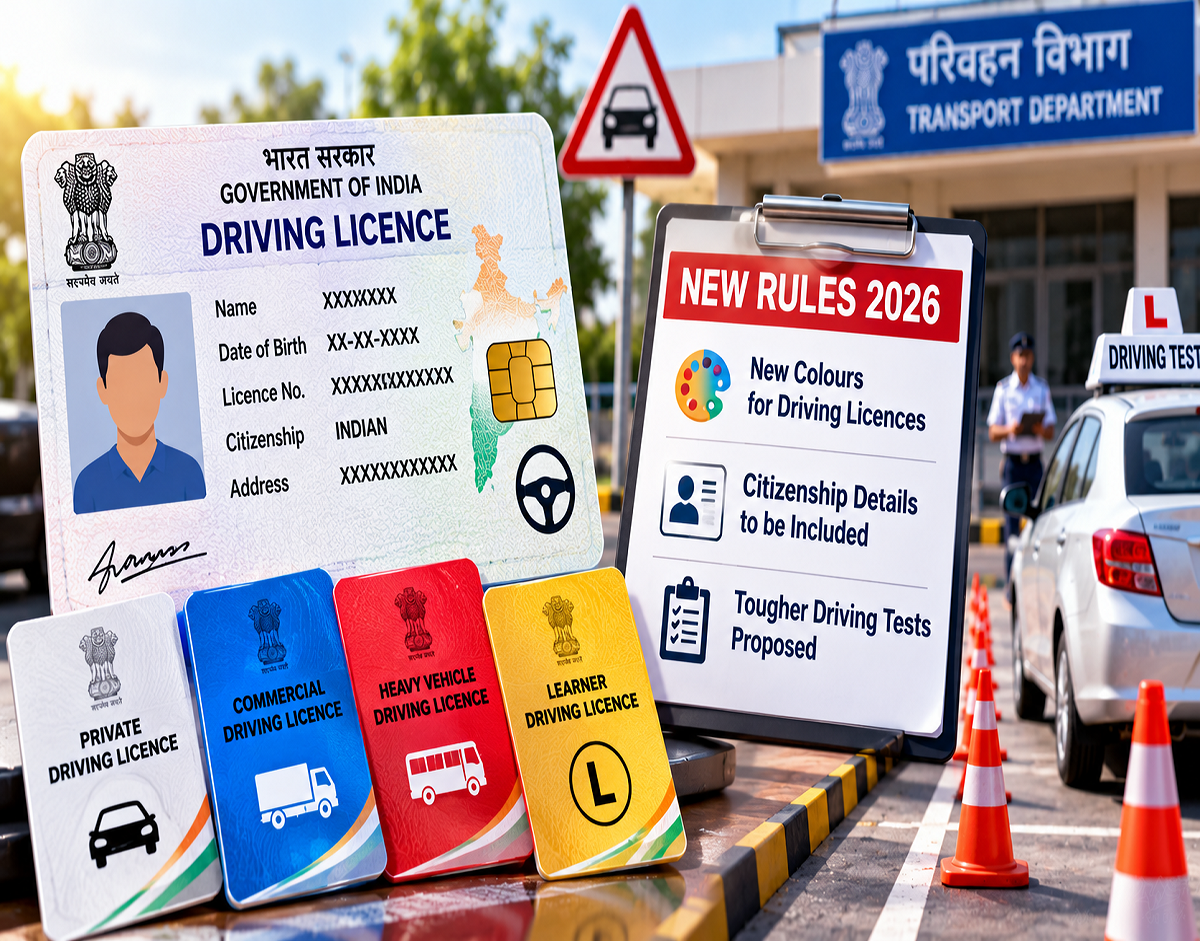
One of the most noticeable proposals is the introduction of different driving licence colours or formats for Indian citizens and foreign nationals. The draft also reportedly proposes including citizenship information on the licence.
Other suggested changes include adding emergency contact details, tightening document verification and increasing the passing requirement for a safe driving tutorial test.
However, these changes are proposals, not confirmed rules currently in force. Their implementation will depend on the government's final notification.
Driving Licences May Have Different Colours
The draft reportedly proposes separate colour schemes or formats for driving licences issued to Indian citizens and foreign nationals.
The objective is to make it easier for authorised officials to distinguish between the categories of licence holders.
Currently, driving licences generally display information such as the holder's name, photograph, address, date of birth, licence number and authorised vehicle categories.
Under the proposed system, citizenship information may become an additional field.
The report suggests that licence appearance could also vary depending on whether the holder is an Indian citizen or a foreign national.
However, the government has not specified the final colours in the information provided.
Therefore, reports claiming that Indian or foreign licence holders will receive a particular colour should not be treated as confirmed.
Citizenship Details May Be Added to Driving Licences
Another major proposal involves displaying the licence holder's citizenship status.
According to the report, the government wants to strengthen identity verification and reduce opportunities for document misuse.
Adding citizenship information could help authorities distinguish between different categories of licence holders.
However, a driving licence is primarily a document authorising an individual to operate specified motor vehicles. It should not be treated as conclusive proof of citizenship unless applicable law expressly provides otherwise.
The final rules would need to clarify how citizenship information is verified, displayed and updated.
Existing licence holders should not assume that they must immediately replace their documents.
No compulsory replacement deadline has been established in the supplied report.
Blood Group and Emergency Contact Details May Be Included
The draft also reportedly proposes additional personal information on driving licences.
This could include the licence holder's blood group, mobile number and emergency contact details.
The purpose is to improve access to relevant information following road accidents or other emergencies.
For example, emergency contact information could help authorities reach a driver's family members more quickly.
Similarly, a recorded blood group may provide useful preliminary information to emergency responders.
However, medical professionals must still follow appropriate blood compatibility testing and transfusion procedures rather than relying solely on a blood group printed on an identity document.
The final proposal would also need to address how personal information is collected, verified, protected and updated.
Affidavits May No Longer Be Accepted as Proof
The government is also reportedly reviewing the documents accepted during driving licence applications.
According to the source, the draft proposes removing the option of using certain magistrate- or notary-attested affidavits as proof of age or address.
The concern is that affidavits may be misused to provide incorrect personal information.
If the proposal is approved, applicants may have to rely more heavily on recognised documentary evidence.
This could help authorities verify age and residential information more consistently.
However, the existing documentation rules will continue to apply until the proposed amendments are formally notified and brought into force.
Documents Proposed for Age and Address Verification
The report identifies several documents that may be recognised under the proposed verification framework.
| Purpose | Documents Mentioned in the Proposal |
|---|---|
| Age verification | Passport |
| Age verification | Birth certificate |
| Age verification | School board mark sheet |
| Address verification | Aadhaar card |
| Address verification | Voter ID card |
| Address verification | E-ration card |
| Address verification | Recent electricity bill |
| Address verification | Recent gas bill |
The report mentions electricity and gas bills issued within the previous three months as potential address documents.
The final list of accepted documents, their validity requirements and any exemptions must be checked against the official rules once notified.
Applicants should also remember that the documents required for learner's licences, permanent driving licences, renewals and other services may differ.
Learner's Licence Test May Become Tougher
Another important proposal concerns the safe driving tutorial and its assessment.
According to the report, the government is considering increasing the minimum passing score from 60% to 75%.
If implemented, applicants would need to demonstrate a higher level of understanding to meet the revised requirement.
The proposed change appears intended to encourage better knowledge of road safety and responsible driving practices.
However, the report does not establish that every learner's licence examination across India will immediately adopt a 75% passing threshold.
The precise test affected, its applicability and the implementation date will depend on the final notification.
Online Safe Driving Tutorial May Last at Least 30 Minutes
The draft also reportedly proposes a minimum duration of 30 minutes for the online safe driving tutorial.
Such training could help applicants become familiar with traffic regulations, road signs and safe driving practices before progressing through the licensing process.
Topics may include road discipline, pedestrian safety, traffic signals and the responsibilities of vehicle drivers.
However, the detailed tutorial syllabus and technical requirements have not been established in the supplied report.
Applicants should continue following the existing learner's licence procedures until the authorities officially announce any changes.
Driving Licence Rules 2026: Old System vs Proposed Changes
The following table summarises the main proposals mentioned in the report.
| Feature | Existing or Reported Arrangement | Proposed Change |
|---|---|---|
| Licence appearance | Standardised licence formats | Different colours or formats based on citizenship category |
| Citizenship details | Not generally displayed as a separate field | Citizenship information may be included |
| Emergency information | Availability varies by format and records | Blood group and emergency contact details proposed |
| Age and address proof | Documents accepted under existing rules, including certain affidavit provisions | Tighter verification and possible removal of affidavit option |
| Safe driving tutorial assessment | Reported passing requirement of 60% | Proposed increase to 75% |
| Tutorial duration | Existing applicable requirements | Minimum 30-minute online tutorial proposed |
The comparison reflects the proposals described in the supplied report. Final requirements may differ.
Will Existing Driving Licences Become Invalid?
There is no basis in the supplied report to conclude that existing driving licences will automatically become invalid because of the proposed changes.
A valid driving licence generally remains subject to its existing validity period and applicable legal requirements.
If the government introduces a redesigned licence format, it may separately clarify whether existing licence holders need to update or replace their documents.
Until such instructions are issued, motorists should avoid unnecessary replacement applications based solely on social media claims.
They should continue carrying or presenting a valid driving licence in an accepted format while driving.
How to Apply for a Driving Licence Online
People planning to obtain a driving licence can use the official Parivahan services portal.
The general process includes visiting the portal, selecting the relevant state, choosing the appropriate licence service and completing the required application steps.
Applicants may need to provide personal information, upload supporting documents, pay applicable fees and complete the required tests.
The exact process can vary according to the state, vehicle category and type of licence.
For official services, applicants can visit the Sarathi Parivahan portal.
Consumers should avoid unofficial websites claiming to issue government driving licences without the prescribed verification or testing process.
When Will the New Driving Licence Rules Start?
The supplied October 24 report does not provide a confirmed implementation date.
It describes the changes as part of a draft proposal issued by the Ministry of Road Transport and Highways.
A draft amendment is not the same as a final enforceable rule.
Before the new requirements become applicable, the government must complete the relevant rulemaking process and publish the necessary final notification.
The implementation date may also differ across provisions if the final rules provide separate commencement arrangements.
Therefore, applicants should continue following the existing official licensing requirements until further notice.
Final Takeaway
The government is considering changes that could make driving licences more informative and strengthen the verification process.
The proposals reportedly include separate licence colours or formats for Indian citizens and foreign nationals, citizenship details, emergency contact information, stricter document requirements and a higher safe driving tutorial passing score.
These measures are intended to improve identity verification and road safety.
For now, the proposed changes should not be treated as mandatory new rules. Existing and prospective licence holders should monitor official announcements from MoRTH and the Parivahan portal for confirmed details.
Disclaimer: This article is based on the supplied October 24, 2026 report. The draft amendments, proposed document requirements, revised test thresholds and implementation schedule have not been independently verified against the original government notification. Readers should consult official MoRTH and Parivahan sources before taking action.