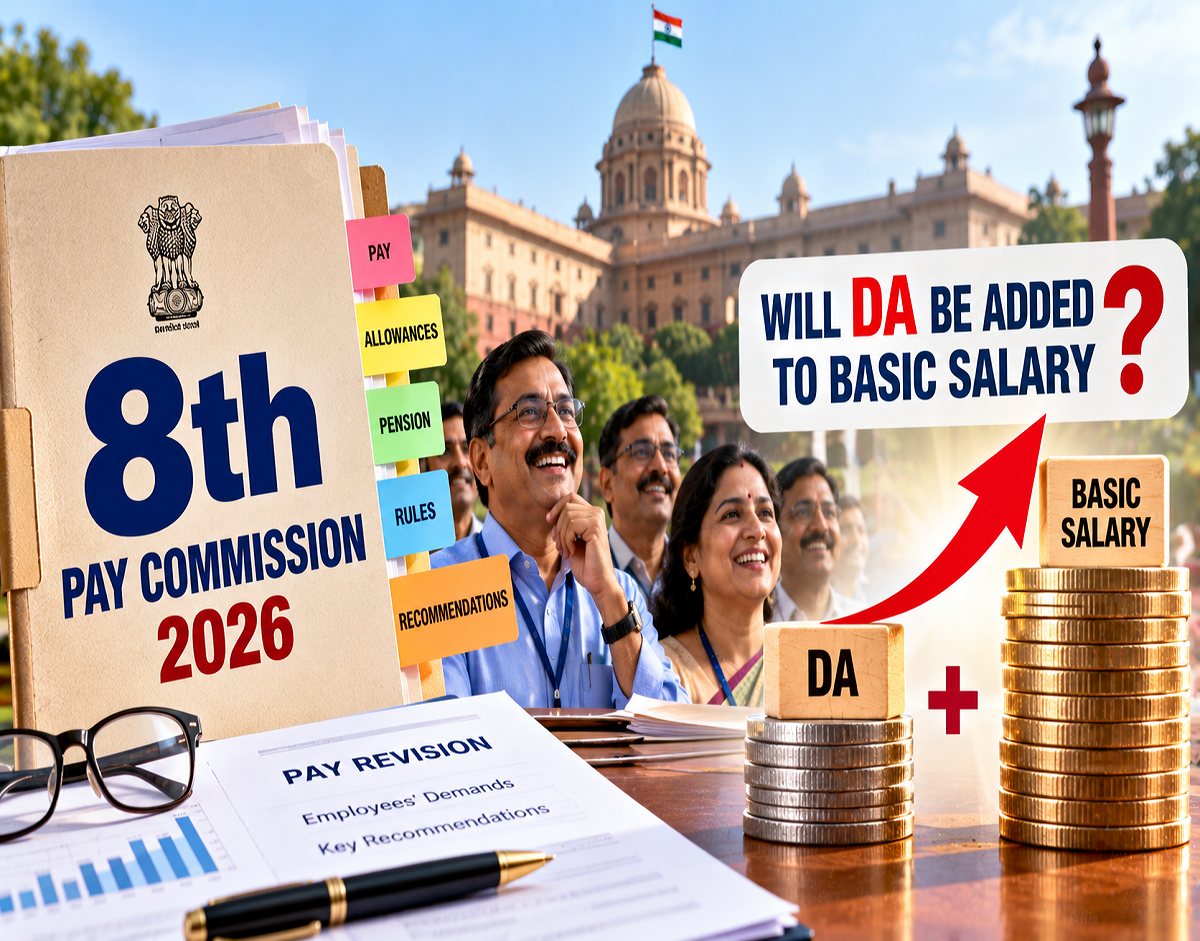
8th Pay Commission Latest News, October 24, 2026: Central government employees and pensioners are closely watching the Eighth Pay Commission as discussions over salaries, pensions and allowances continue. The latest round of meetings with employee organisations reportedly concluded in Mumbai on October 23, bringing fresh attention to demands for changes in the way government salaries are calculated.
One of the major issues raised by employee unions is whether Dearness Allowance (DA) should become part of basic salary after reaching a specified percentage. Pensioners' organisations have also called for changes in Dearness Relief (DR) calculations and more frequent revisions to protect retirement income against inflation.
According to the latest report, the Commission held discussions with employee representatives in Mumbai on October 22 and 23. Similar consultations had reportedly taken place in Delhi, Ladakh, Kolkata and Bengaluru.
The Commission, chaired by Justice Ranjana Prakash Desai, is examining suggestions concerning basic pay, fitment factors, allowances and pension-related benefits.
However, no final decision has been announced on merging DA with basic salary. The proposals remain demands submitted by employee and pensioner organisations.
8th Pay Commission Meeting: What Happened in Mumbai?
The latest round of discussions reportedly took place over two days, October 22 and 23, 2026.
Representatives of employee organisations presented suggestions concerning the salary structure applicable to central government employees.
Among the important subjects were the fitment factor, minimum basic salary, Dearness Allowance, pension calculations and the treatment of inflation-related benefits.
Employee representatives are seeking a compensation system that better reflects rising household expenses and changing economic conditions.
The Commission is expected to examine these suggestions alongside financial, administrative and policy considerations.
However, consultations do not automatically mean that the demands have been accepted.
The Commission must assess the proposals and prepare its recommendations before the government decides which changes to implement.
Will DA Be Merged With Basic Salary?
The possibility of combining Dearness Allowance with basic pay has become a major topic of discussion.
DA is currently calculated as a percentage of an employee's basic salary.
For example, if an employee earns ₹30,000 in basic pay and receives DA at 60%, the allowance amounts to ₹18,000.
The employee's combined basic pay and DA would therefore be ₹48,000.
However, the official basic salary would remain ₹30,000 because DA is treated as a separate component.
Under a merger arrangement, a specified portion of DA could be incorporated into basic pay.
Such a change could affect the calculation of other salary components, depending on the rules adopted.
Employee organisations argue that this approach could provide a more realistic salary base during periods of prolonged inflation.
But the Commission has not yet recommended or approved a DA merger.
Postal Employees Demand DA Merger at 25%
According to the report, the Federation of National Postal Organisations (FNPO) has proposed an important change to the existing DA system.
The organisation wants DA to be merged with basic salary once it exceeds 25%.
This differs from earlier arrangements associated with a 50% threshold.
The proposal reflects concerns that inflation-related allowances should not remain permanently separate from basic pay.
If the Commission considers such a system, it would need to determine how the revised basic salary would affect future DA calculations and other allowances.
It would also need to examine the financial implications for the government.
At present, the 25% threshold is an employee organisation's demand, not an approved rule.
What Would Happen if DA Were Added to Basic Pay?
A DA merger could change the structure of an employee's salary even if the immediate total of basic pay and DA remains unchanged.
Consider an employee receiving ₹30,000 in basic salary and DA at 60%.
Example: Basic Salary and DA Merger
Current basic salary
₹30,000
DA at 60%
₹18,000
Combined amount before any merger
₹48,000
A hypothetical full merger could make ₹48,000 the revised basic pay, with DA rebased according to new rules. This would not automatically mean an immediate ₹18,000 salary increase.
The key issue is how the government would treat the merged amount when calculating future allowances and retirement benefits.
For instance, some allowances are linked to basic pay. A higher basic pay figure could therefore influence those components if the applicable rules permit.
However, any merger would likely involve adjustments to the DA calculation base and other pay rules.
Therefore, it would be incorrect to assume that combining DA with basic salary automatically doubles an employee's earnings or adds the entire DA amount again.
The actual benefit would depend on the final pay structure.
Pensioners Want Dearness Relief Reviewed Every Three Months
Pensioner organisations have also submitted suggestions concerning the frequency of inflation-related adjustments.
According to the report, Bharat Pensioners Samaj has requested that DA and DR be reviewed every three months rather than twice annually.
Under the existing central government system, DA and DR are generally revised with effect from January and July, subject to government approval.
Pensioners argue that a six-month gap between revisions can create difficulties when prices rise rapidly.
More frequent adjustments could potentially help retirement income respond sooner to changes in living costs.
However, quarterly revisions would also require changes to administrative procedures and payment calculations.
The Commission will need to examine whether such a system is practical and financially sustainable.
Demand to Merge DR With Basic Pension
Another proposal concerns the treatment of Dearness Relief for pensioners.
Similar to the demand involving serving employees, pensioners' representatives have suggested that DR should be incorporated into basic pension after reaching a specified threshold.
Currently, DR is calculated separately as a percentage of eligible basic pension.
A merger could potentially alter the base used for future pension-related calculations.
However, the outcome would depend on how the government designs any revised pension framework.
The report does not establish that the Commission has accepted this demand.
Pensioners should therefore continue relying on the existing notified DR rules until an official decision is announced.
What Did the 5th Pay Commission Recommend?
The history of earlier Pay Commissions helps explain why the DA merger issue has returned to the discussion.
The Fifth Central Pay Commission supported the concept of converting part of DA into Dearness Pay after inflation crossed a specified threshold.
The approach was intended to prevent the salary structure from becoming disconnected from rising prices.
Under the subsequent arrangements associated with this framework, 50% DA was merged with basic pay as Dearness Pay for specified purposes.
This had implications for the calculation of certain allowances and retirement-related benefits.
The Fifth Pay Commission also emphasised inflation protection for employees across different pay levels.
Its approach remains an important reference point for employee organisations advocating a fresh DA merger.
Why Did the 6th Pay Commission Reject Automatic DA Merger?
The Sixth Central Pay Commission took a different position.
It did not recommend continuing the practice of automatically merging DA with basic salary whenever the allowance reached a specified level.
The Commission favoured a revised pay structure with inflation compensation provided through periodic DA adjustments.
It also retained the established system of half-yearly DA revisions rather than introducing quarterly adjustments.
The reasoning was that the revised compensation structure could address inflation without repeatedly merging DA into basic pay.
This approach helped shape the system that followed.
What Was the 7th Pay Commission's Approach?
The Seventh Central Pay Commission largely continued the existing approach to Dearness Allowance.
It did not recommend introducing an automatic DA merger mechanism during the pay commission period.
Instead, DA remained a separate inflation-linked component of compensation.
The Seventh Pay Commission introduced a fitment factor of 2.57 for the transition to the revised pay structure.
This factor was used to determine revised basic pay under the new pay matrix, subject to the applicable rules.
The minimum basic pay for central government employees was fixed at ₹18,000 under the Seventh Pay Commission framework.
The Eighth Pay Commission is now examining whether the next compensation structure requires significant changes.
How Have Previous Pay Commissions Handled DA?
| Pay Commission | Approach to Dearness Allowance |
|---|---|
| 5th Pay Commission | Supported a Dearness Pay mechanism linked to the 50% DA threshold |
| 6th Pay Commission | Did not recommend automatic DA merger; retained half-yearly revisions |
| 7th Pay Commission | Continued DA as a separate inflation-linked allowance |
| 8th Pay Commission | Reviewing demands for merger thresholds and more frequent revisions; no final recommendation announced |
The comparison shows that the treatment of DA has changed across different Pay Commission periods.
The final approach adopted by the Eighth Pay Commission will depend on its assessment and the government's subsequent decisions.
Employee Organisations Seek Review of the AICPI-IW Formula
The report also mentions demands to review the All-India Consumer Price Index for Industrial Workers (AICPI-IW).
This index plays an important role in the calculation of DA for central government employees.
It measures changes in the prices of goods and services relevant to the consumption patterns of industrial worker households.
Employee representatives want the Commission to examine whether the existing calculation system adequately reflects present-day household expenses.
A review could consider issues such as the consumption basket, inflation measurement and the relationship between price movements and allowance revisions.
However, changing the DA formula would require careful technical evaluation.
The Commission has not announced any approved replacement formula in the supplied report.
Will the 8th Pay Commission Increase Basic Salary?
Basic salary revision is another important issue under consideration.
Employee organisations have been seeking improvements in the fitment factor and minimum pay structure.
The fitment factor is used to convert an existing basic salary into a revised pay level under a new pay framework.
For illustration, consider an employee whose existing basic pay is ₹18,000.
| Illustrative Fitment Factor | Calculated Revised Basic Pay |
|---|---|
| 2.00 | ₹36,000 |
| 2.28 | ₹41,040 |
| 2.57 | ₹46,260 |
| 2.86 | ₹51,480 |
| 3.00 | ₹54,000 |
| 3.83 | ₹68,940 |
These calculations are mathematical examples only.
They do not represent officially approved Eighth Pay Commission salary figures.
The final basic pay would depend on the recommended fitment factor, pay matrix design, applicable rounding rules and the government's decision.
Importantly, a new pay structure typically involves resetting DA and revising other salary components. Therefore, multiplying basic salary by a proposed fitment factor does not establish the final increase in take-home pay.
What Happens After the Pay Commission Meetings?
Following consultations with employee organisations, the Commission is expected to continue evaluating the suggestions it has received.
The process may include reviewing salary data, pension expenditure, inflation trends and representations from different employee groups.
The Commission must balance employee expectations with the financial implications of implementing a revised pay structure.
Once its recommendations are finalised, they will be submitted to the government for consideration.
The government will then decide which recommendations to accept, modify or reject.
The timing of implementation, arrears and revised salary payments will depend on subsequent official decisions.
Final Takeaway
The latest Eighth Pay Commission discussions have brought renewed attention to demands for changes in basic salary, Dearness Allowance and pension calculations.
Employee organisations are seeking a DA merger mechanism, while pensioners' representatives want more frequent DA and DR revisions.
The FNPO has reportedly proposed merging DA with basic salary once it exceeds 25%, while Bharat Pensioners Samaj has called for quarterly allowance reviews and changes to the treatment of Dearness Relief.
However, the Eighth Pay Commission has not announced a final decision on DA merger, fitment factor or revised basic salary.
Central government employees and pensioners should wait for the Commission's formal recommendations and the government's official approval before treating any proposed benefit as confirmed.
Disclaimer: This article is based on the supplied October 24, 2026 report. The demands discussed are proposals attributed to employee and pensioner organisations, not approved government rules. Salary examples are illustrative and do not represent confirmed Eighth Pay Commission recommendations.