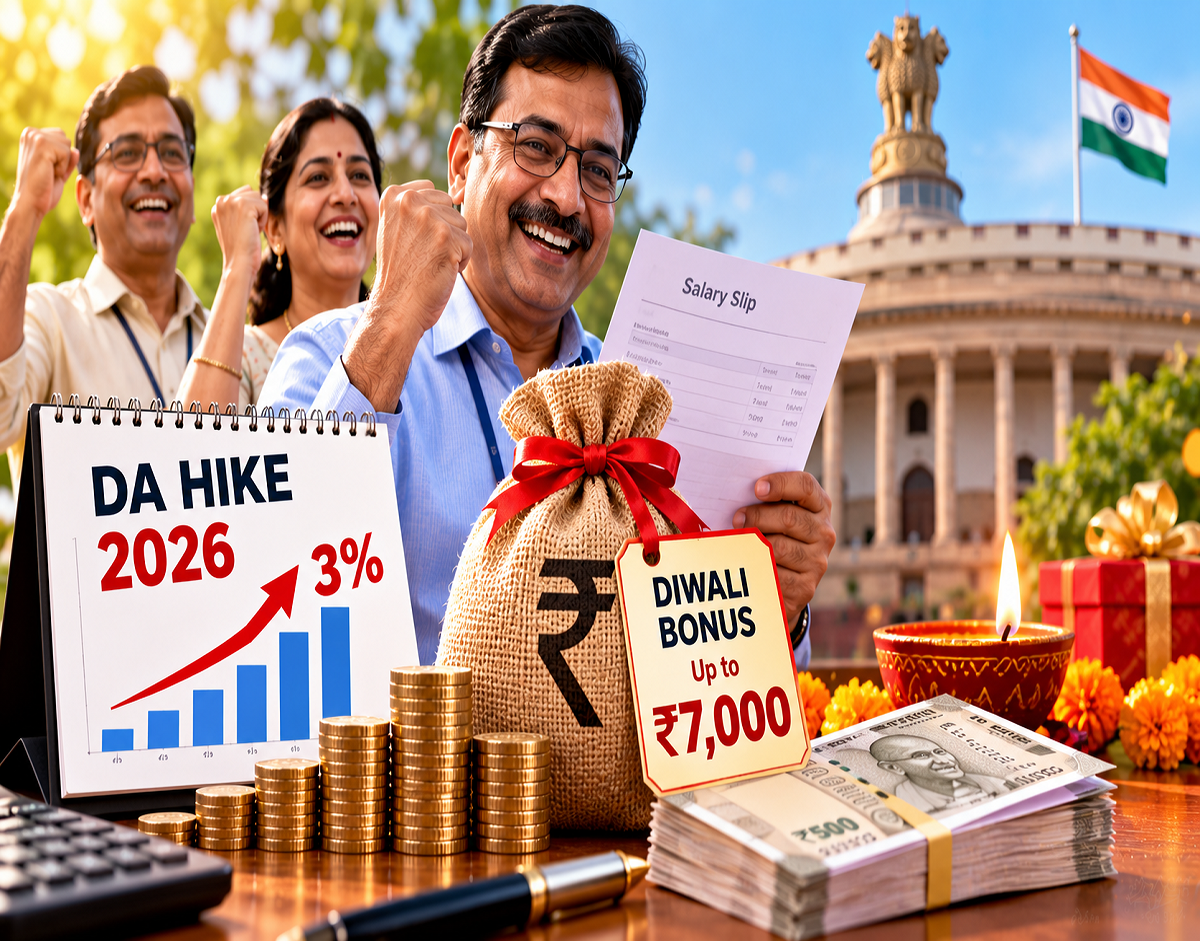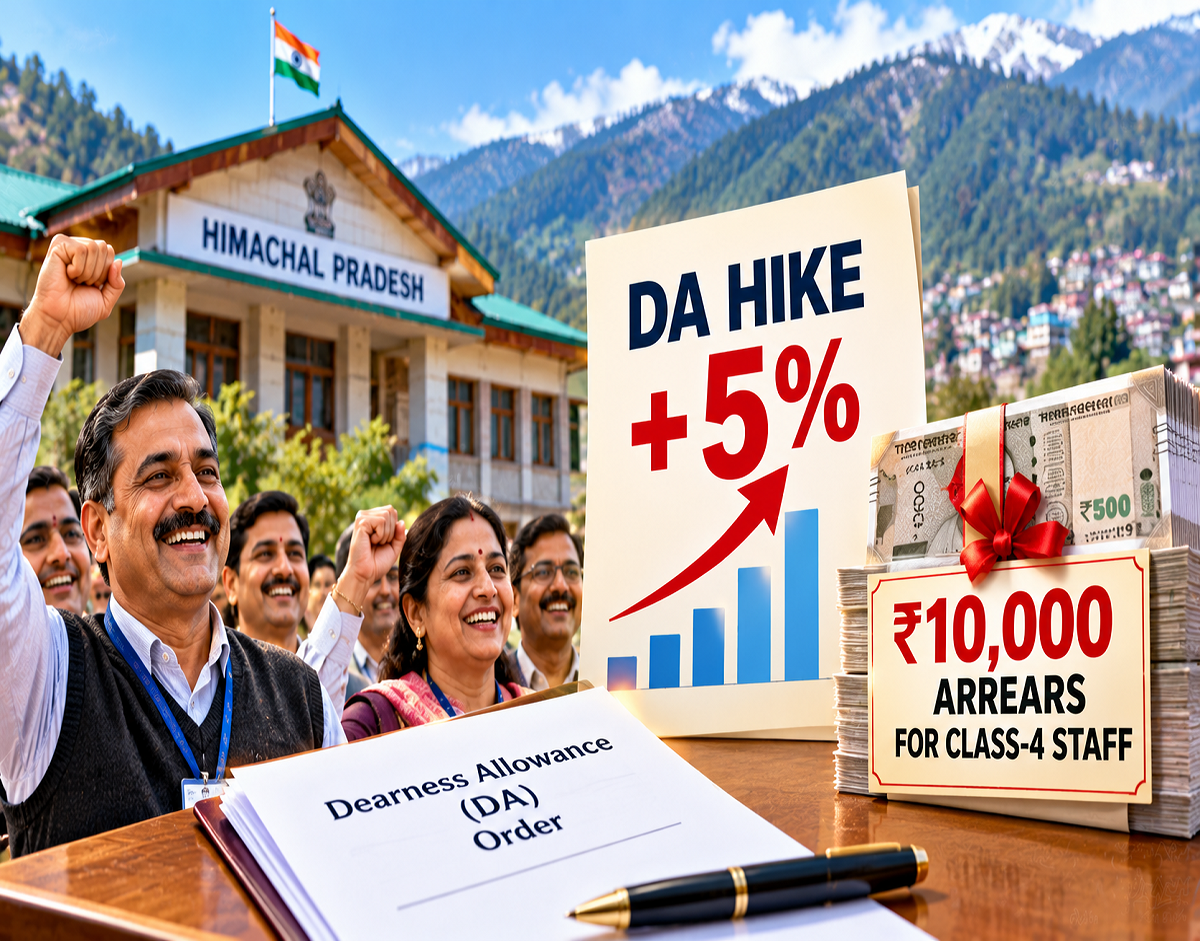
DA Hike Latest News, October 24, 2026: Government employees and pensioners in Himachal Pradesh have received encouraging news ahead of the festive season. Chief Minister Sukhvinder Singh Sukhu has reportedly announced a 5% increase in Dearness Allowance (DA), along with additional financial relief for eligible Class-4 employees.
According to a report published on October 24, the state government's decision is expected to benefit approximately 2.75 lakh employees and pensioners.
The announcement also includes a reported payment of ₹10,000 towards pending pay and pension revision arrears for eligible Class-4 employees. The amount is expected to be transferred directly into their bank accounts on November 1, 2026.
The government has presented these measures as an effort to provide financial support to employees and retirees amid rising household expenses.
However, the detailed implementation conditions, revised DA rates and payment schedule should be checked against the official Himachal Pradesh government notification.
Himachal Pradesh Announces 5% DA Increase
The Himachal Pradesh government has reportedly approved a five-percentage-point increase in Dearness Allowance for eligible state employees and pensioners.
Chief Minister Sukhvinder Singh Sukhu announced the decision on Friday, October 23, according to the supplied report.
The increase is intended to provide additional financial support to government employees and pensioners who are managing higher living costs.
Dearness Allowance is a component of government employee compensation designed to help offset the impact of inflation.
For pensioners, the corresponding benefit is generally known as Dearness Relief (DR).
The actual increase in monthly payments depends on the employee's basic salary or the pensioner's basic pension, as well as the effective date and conditions specified in the relevant order.
How Will the 5% DA Increase Be Calculated?
According to the report, the announced increase consists of two components.
The Chief Minister reportedly explained that four percentage points relate to the current year's allowance revision, while the remaining one percentage point concerns an earlier pending adjustment.
Together, these components account for the reported five-percentage-point increase.
However, the exact effective dates of the two components have not been established in the supplied report.
Employees should therefore avoid assuming that the entire increase will apply retrospectively from the same date.
The official government order will be important for understanding the revised DA rate, eligibility and arrears calculation.
DA Hike Salary Calculation: How Much Will Employees Benefit?
A five-percentage-point DA increase can provide meaningful additional monthly income.
For example, an employee with a basic salary of ₹30,000 would receive ₹1,500 more per month if the full five-percentage-point increase applies to that salary.
Similarly, an employee with a basic salary of ₹50,000 would receive an additional ₹2,500 per month.
The following table illustrates the potential benefit.
| Basic Monthly Salary | Additional DA at 5% |
|---|---|
| ₹18,000 | ₹900 |
| ₹20,000 | ₹1,000 |
| ₹25,000 | ₹1,250 |
| ₹30,000 | ₹1,500 |
| ₹40,000 | ₹2,000 |
| ₹50,000 | ₹2,500 |
| ₹56,100 | ₹2,805 |
| ₹75,000 | ₹3,750 |
| ₹1,00,000 | ₹5,000 |
These calculations show the effect of a five-percentage-point increase on basic pay. Actual payments will depend on the final government order and applicable eligibility rules.
The benefit for pensioners would be calculated according to the revised Dearness Relief provisions, where applicable.
Class-4 Employees to Receive ₹10,000 Arrears
Apart from the DA increase, the state government has reportedly announced additional relief for eligible Class-4 employees.
According to the report, these employees will receive ₹10,000 towards outstanding pay and pension revision arrears.
The amount is expected to be credited directly to eligible beneficiaries' bank accounts.
The proposed payment date is November 1, 2026.
This separate arrears payment could help qualifying employees manage household and festive expenses.
However, it is important to distinguish this payment from the DA revision.
The ₹10,000 amount described in the report relates to pending pay and pension revision dues. It should not automatically be described as a Diwali bonus or as the DA arrears payable to every government employee.
The final order should clarify the eligible categories and payment conditions.
When Will Employees Receive the ₹10,000 Payment?
The report identifies November 1 as the expected payment date for the announced arrears.
If the payment is processed according to the reported schedule, eligible beneficiaries may receive the amount directly in their registered bank accounts.
However, the supplied information does not establish whether all eligible employees will receive the payment on the same day.
Government payments may depend on departmental processing, treasury instructions and banking arrangements.
Employees should verify the payment schedule through their departmental accounts office or the relevant government notification.
They should also ensure that their bank account information is correctly recorded in official salary or pension systems.
Around 2.75 Lakh Employees and Pensioners May Benefit
The announcement is expected to affect a substantial number of people associated with the Himachal Pradesh government.
According to the report, approximately 2.75 lakh employees and pensioners are expected to benefit from the allowance-related decision.
The financial impact could extend beyond individual beneficiaries.
Additional salary and pension payments may support household spending, particularly in areas where government employment forms an important part of the local economy.
However, the report does not provide a detailed breakdown of how many beneficiaries are serving employees and how many are pensioners.
It also does not specify the total additional expenditure arising from the latest DA revision.
These details may become clearer when the government publishes its implementation order.
What Is the Difference Between DA and DR?
Dearness Allowance and Dearness Relief are closely related but apply to different categories of beneficiaries.
DA is generally paid to serving government employees as a percentage of their basic salary.
DR is generally paid to eligible pensioners as a percentage of their basic pension.
Both are intended to help reduce the impact of inflation on household finances.
| Feature | Dearness Allowance (DA) | Dearness Relief (DR) |
|---|---|---|
| Beneficiaries | Serving government employees | Eligible pensioners and family pensioners |
| Calculation basis | Basic salary | Basic pension |
| Purpose | Offset rising living costs | Offset inflation's impact on pensions |
| Payment | Along with salary | Along with pension |
The exact rates and eligibility conditions depend on the relevant government orders.
Himachal Pradesh Government Also Discusses Financial Challenges
Alongside the employee-related announcements, Chief Minister Sukhu reportedly addressed concerns about the state's financial position.
According to the report, he rejected claims that Himachal Pradesh's outstanding debt had reached ₹1.20 lakh crore.
Instead, he stated that the state's debt was approximately ₹99,000 crore.
The Chief Minister also acknowledged that the state was facing financial pressure because of changes affecting revenue support.
He referred to the discontinuation of the Revenue Deficit Grant as a significant challenge.
Revenue Deficit Grants are intended to support eligible states in meeting revenue expenditure requirements when their assessed revenue receipts are insufficient.
Changes in such support can create additional pressure on state budgets.
However, the debt figures and fiscal claims cited in the report should be evaluated against official state budget documents and finance accounts.
Government Focuses on Controlling Expenditure
The Chief Minister reportedly stated that the government was taking measures to maintain fiscal discipline.
These measures include efforts to control expenditure and manage available financial resources more efficiently.
The report also refers to the state's use of interest-free loans to support its financial requirements.
Such measures may help address certain funding needs, but they do not eliminate broader concerns about long-term debt and revenue expenditure.
Balancing employee benefits with fiscal sustainability remains an important challenge for state governments.
The latest DA decision comes against this broader financial background.
Health and Education Self-Reliance Target for 2030
The report also highlights the Chief Minister's statement regarding the state's long-term development priorities.
According to the supplied information, the Himachal Pradesh government aims to strengthen its health and education sectors and achieve greater self-sufficiency by 2030.
The government has presented these sectors as important areas for future development.
However, the report does not provide specific budget allocations, programme milestones or measurable targets associated with this statement.
Further official announcements would be needed to assess how these goals will be implemented.
How Can Himachal Employees Check the DA Hike Order?
Employees and pensioners should verify the announcement through official state government channels.
The Himachal Pradesh government website provides access to government departments and official information.
Once the detailed DA order is published, beneficiaries should check the revised allowance rate, effective date, arrears provisions and payment instructions.
Serving employees can also contact their departmental drawing and disbursing officer.
Pensioners may seek clarification through the relevant treasury or pension disbursing authority.
These sources can provide more reliable information than unofficial social media messages.
Final Takeaway
Himachal Pradesh government employees and pensioners are expected to benefit from a reported five-percentage-point increase in Dearness Allowance and corresponding relief.
The announcement, attributed to Chief Minister Sukhvinder Singh Sukhu, could affect approximately 2.75 lakh beneficiaries.
Eligible Class-4 employees are also expected to receive ₹10,000 towards pending pay and pension revision arrears, with November 1 mentioned as the proposed payment date.
The decision comes at a time when the state government is also managing financial pressures and working to control expenditure.
Employees should check the official government order for the revised DA rate, eligibility conditions and confirmed payment dates.
Disclaimer: This article is based on the supplied October 24, 2026 report. The detailed DA implementation order, beneficiary eligibility and November 1 arrears payment schedule have not been independently verified. Salary calculations are illustrative and may differ from actual payments.