Technology
5 Things You Should Avoid Asking ChatGPT: From Hacking Requests to Sharing Private Information
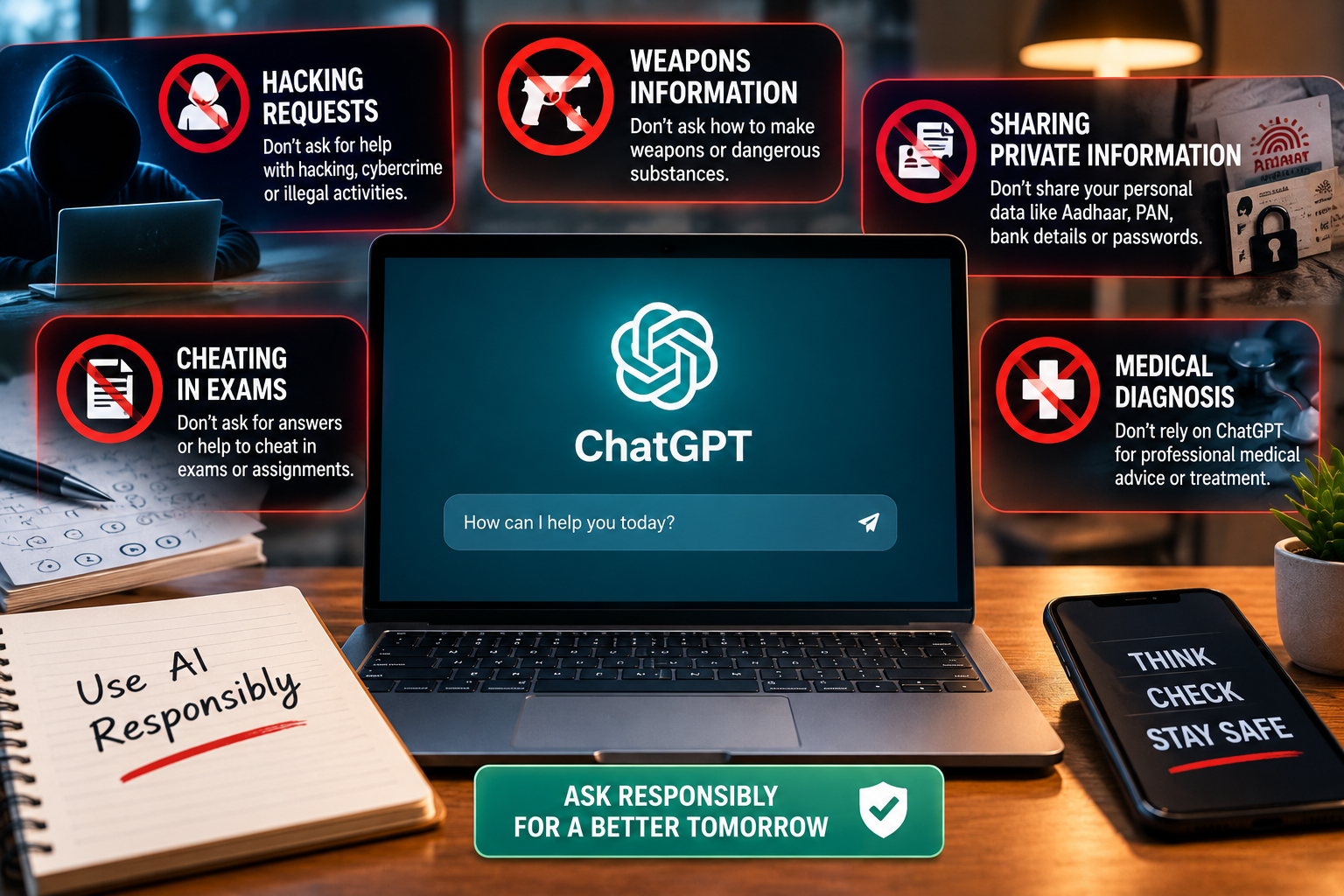
ChatGPT has become a widely used artificial intelligence assistant for everyday tasks. People use AI chatbots to draft emails, understand complicated topics, brainstorm ideas, learn new skills, plan meals and get help with writing or research.
But an AI assistant is not designed to fulfil every possible request. Some prompts involve illegal activity, privacy violations, dangerous instructions or academic misconduct. In such situations, ChatGPT may refuse to provide instructions or may instead offer safer information.
Understanding these boundaries can help users get more value from AI while avoiding requests that could cause harm or create legal, privacy or academic problems.
Here are five types of questions users should think carefully about before asking an AI chatbot.
1. Asking ChatGPT to Hack Someone's Instagram or Other Account
A request such as, "Can you hack my friend's Instagram account?" crosses an important cybersecurity boundary.
Whether the target is an Instagram profile, email account, computer, smartphone or another online service, gaining unauthorised access to someone else's account or device can violate the law.
ChatGPT should not provide actionable instructions intended to steal passwords, bypass authentication, deploy malicious software or break into another person's account.
There is, however, an important distinction between malicious hacking and legitimate cybersecurity assistance.
If you have lost access to your own account, AI can help explain legitimate account-recovery steps. Similarly, cybersecurity students and professionals can use AI to learn defensive security concepts, understand vulnerabilities and improve systems when working within authorised environments.
The purpose and context of the request matter.
2. Asking AI to Predict the Name of Your Future Spouse
Artificial intelligence can analyse information, explain concepts and generate creative responses, but it cannot know future personal events with certainty.
For example, ChatGPT cannot reliably tell you the name of the person you will marry or predict exactly when you will meet your future partner.
AI-generated answers to such questions should not be treated as factual predictions.
For entertainment, an AI assistant can create fictional quizzes, playful compatibility games or explain traditional horoscope concepts. But these activities should be distinguished from evidence-based predictions about someone's future.
Users should be particularly cautious about making major financial, relationship or life decisions based solely on supposedly certain AI predictions.
3. Using ChatGPT to Secretly Complete Exams
AI can be an effective educational tool when it is used to support learning.
Students can ask ChatGPT to explain difficult concepts, generate practice questions, review their reasoning, create revision plans or provide feedback on drafts.
Using an AI chatbot to secretly answer questions during an examination, however, may violate the rules of a school, college, university or testing organisation.
The same concern can apply to assignments when students are required to submit their own independent work.
Instead of asking AI to complete assessed work dishonestly, students can use it as a tutor. For example, asking, "Explain this maths concept step by step and then give me three similar problems to solve myself" turns AI into a learning aid rather than a substitute for the student's work.
Institutional policies on AI use differ, so students should check the rules that apply to their course or examination.
4. Asking for Instructions to Build a Bomb or Harm Someone
Requests seeking practical instructions to construct explosives, dangerous weapons or carry out serious violence are fundamentally different from ordinary informational questions.
ChatGPT is designed to restrict assistance that would meaningfully enable people to injure others or carry out dangerous illegal activities.
That does not mean every discussion involving weapons, explosions or violence is prohibited.
For example, users may ask about the history of explosives, how emergency services respond to bomb threats, general safety precautions, or the scientific principles behind combustion in an appropriate educational context.
The boundary becomes particularly important when someone requests operational instructions that could facilitate real-world harm.
It is also misleading to assume that simply typing a prohibited question automatically means a user will be reported to local police or sent to jail. Whether conduct has legal consequences depends on what the person actually does, the circumstances and the laws that apply.
5. Asking ChatGPT to Reveal Someone's Private Information
AI should not be used as a tool to expose sensitive personal information.
Requests seeking another person's private home address, banking credentials, passwords or similarly sensitive information can create serious privacy and security risks.
Even when fragments of personal information appear somewhere online, combining or disclosing them in ways that facilitate harassment, identity theft, financial fraud or other harm can be dangerous.
If you need to contact someone legitimately, publicly available professional channels are generally a more appropriate route.
Users should also apply the same privacy principle to themselves.
Avoid unnecessarily entering passwords, OTPs, PINs, complete banking credentials or other highly sensitive authentication information into an AI conversation.
What Can You Safely Ask ChatGPT Instead?
The restrictions above do not prevent users from asking about cybersecurity, education, privacy or potentially sensitive subjects altogether. Context and purpose are important.
You can ask for help recovering your own account through legitimate methods, learn how to protect yourself from phishing, understand cybersecurity concepts, prepare for an examination, improve an assignment within your institution's rules or learn how to keep personal data safer online.
AI is most useful when it helps users understand a subject, solve legitimate problems and make informed decisions.
The simplest rule is to avoid treating an AI chatbot as a shortcut for breaking into accounts, exposing another person's private information, cheating on assessments or obtaining instructions designed to cause serious harm. Used responsibly, the same technology can instead be a powerful tool for learning, productivity, creativity and digital safety.
Make the headline more newsworthyAdd a quick safety checklist