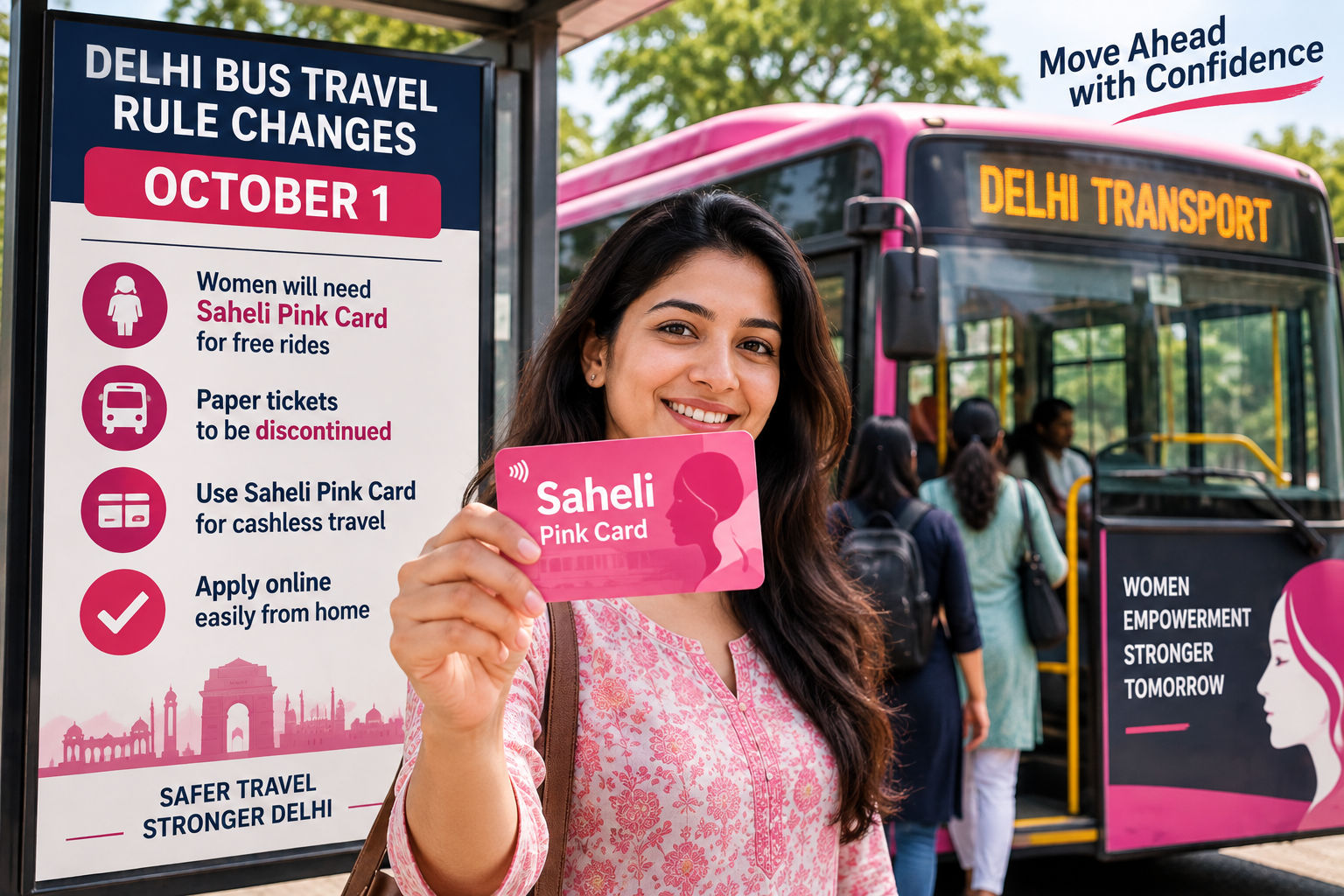
Women using Delhi's public buses for free travel will need to follow a new system from October 1, 2026. The existing pink paper ticket facility is set to end after September 30, and eligible passengers will instead have to use the Saheli Pink Smart Card to claim free bus journeys.
Under the revised arrangement, women travelling on eligible DTC and cluster bus services will need to tap their Saheli Pink Smart Card on the electronic ticketing machine inside the bus. Those who do not have the required card will have to purchase a regular ticket and pay the applicable fare.
The smart-card system is intended to replace the earlier paper-based arrangement and make free-travel verification digital.
According to the information shared by Delhi Chief Minister Rekha Gupta, more than 18.5 lakh Saheli Pink Smart Cards have already been issued. The scheme was launched on March 2, 2026.
Pink Paper Tickets to Stop From October 1
Until now, eligible women passengers could use the pink paper-ticket system for free travel on covered bus services.
That arrangement is scheduled to end on September 30, 2026. From the following day, October 1, the Saheli Pink Smart Card will become necessary for passengers seeking the free-travel benefit.
The card will have to be tapped on the electronic ticketing machine while travelling.
This does not mean that a woman without the card will be prevented from boarding a bus. Instead, she would need to buy a normal ticket and pay the prescribed fare if she does not have the Saheli Pink Smart Card required to claim the free journey.
Who Can Apply for a Saheli Pink Smart Card?
According to the scheme details, women and transgender residents of Delhi aged five years or above can apply for the card.
Applicants need an Aadhaar card along with an active mobile number linked to Aadhaar. The mobile connection is important because OTP-based verification forms part of the registration process.
The card is issued free of cost for the first time.
However, cardholders should keep it safe after issuance. If the card is lost or damaged and needs to be replaced, a ₹59 replacement charge applies, according to the details provided.
Once issued, the Saheli Pink Smart Card remains valid for five years from its date of issuance.
How to Apply for Saheli Pink Card Offline
Passengers who prefer an in-person application can visit an authorised DTC centre or the relevant DM or SDM office.
At the application point, the applicant can provide the required details, including their name, Aadhaar information and mobile number, to the authorised FOS agent.
An OTP is then sent to the registered mobile number for verification.
According to the scheme information, once verification is successfully completed, the card can be issued on the same day through the offline process, subject to successful processing.
Applicants should ensure that the mobile number linked to their Aadhaar is active before beginning the process to avoid verification problems.
How to Apply for Saheli Pink Smart Card Online
An online application facility is also available for people who do not want to begin the registration process by visiting an office.
Applicants can use the MufinPay portal or app and enter the required mobile number and Aadhaar details.
The applicant then completes OTP verification. After successful submission, a QR acknowledgement can be downloaded.
The physical smart card can subsequently be collected from an authorised DTC centre using the prescribed process.
Passengers planning to use free bus travel after September 30 should consider completing the process before the new requirement takes effect rather than waiting until October 1.
Can the Pink Card Be Used in Delhi Metro?
The Saheli Pink Smart Card has functionality beyond bus travel, but there is an important distinction.
The free-travel benefit applies to eligible DTC and cluster bus journeys. The card can also function as a common mobility card for travel on services such as Delhi Metro and Rapid Rail/RRTS, but those journeys are not automatically free under the women's bus-travel benefit.
For Metro or RRTS travel, passengers need to add money to the card and pay the applicable fare.
According to the provided instructions, users can scan the QR code printed on the back of the card using UPI to recharge it. The balance can then be activated by tapping the card at an add-value machine at a Metro station.
Passengers should therefore avoid confusing the card's wider mobility functionality with the free-bus scheme.
Delhi to Add 150 More Electric Buses
Delhi is also expanding its electric public-transport fleet.
Transport Minister Pankaj Kumar Singh has announced plans to introduce 150 additional electric buses next month as part of efforts to expand cleaner public transport.
According to the information provided, around 5,088 electric buses are currently being operated from 40 depots across Delhi.
Infrastructure is also being expanded to improve connectivity in rural and outer Delhi. A new depot with capacity for 250 buses is being developed at Daurala, while another facility with capacity for 500 buses is being developed at Jhuljhuli.
Additional depot and charging infrastructure is also being developed under programmes including the PM E-DRIVE scheme and the National Electric Bus Programme.
What Women Passengers Should Remember Before October 1
The most important deadline is September 30, 2026, when the existing pink paper-ticket arrangement is scheduled to end.
From October 1, eligible women seeking free travel on covered Delhi bus services will need the Saheli Pink Smart Card and must tap it on the electronic ticketing machine.
Delhi residents aged five years and above who meet the eligibility requirements can apply using their Aadhaar details and Aadhaar-linked mobile number. The first card is free, it remains valid for five years, and a ₹59 fee applies if a replacement is required because the original card is lost or damaged.
Passengers who regularly depend on the free-bus facility should complete their application in advance so that they are ready when the paper-ticket system is discontinued.