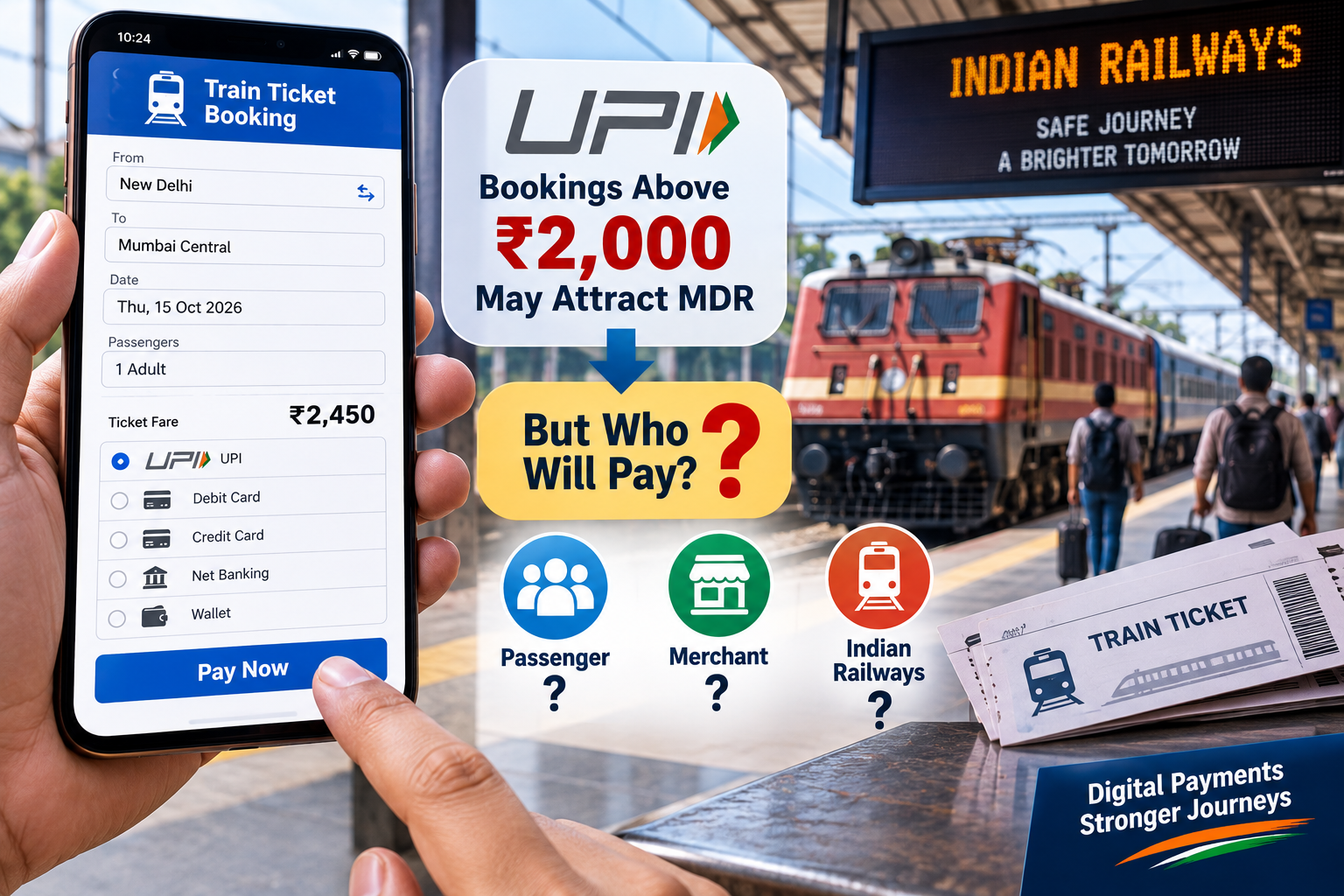
Railway passengers who use UPI to book train tickets may be wondering whether an upcoming change in Merchant Discount Rate (MDR) rules will make their journeys more expensive. The concern mainly relates to UPI transactions exceeding ₹2,000 and whether the additional payment-processing cost will eventually be passed on to passengers.
According to the details provided, the revised MDR framework is scheduled to take effect from October 15, 2026. UPI transactions of up to ₹2,000 will not attract MDR under the reported arrangement, while eligible merchant transactions above that amount can come under the new charging structure.
However, passengers should understand an important distinction: MDR is a merchant-side payment-processing charge and is not supposed to be collected separately from the customer in the circumstances described.
For railway ticket bookings, a special flat MDR structure has reportedly been prescribed.
What Is MDR on a UPI Transaction?
MDR, or Merchant Discount Rate, is a payment-processing charge associated with digital transactions.
In simple terms, it relates to the cost of processing a payment made by a customer to a merchant through a supported digital payment system.
This is different from a fee that a customer is automatically required to pay on top of the value of the purchase.
The upcoming framework has attracted attention because of the reported distinction between UPI payments up to ₹2,000 and transactions exceeding that amount.
For railway passengers, this naturally raises a question: if a family books tickets worth ₹5,000 or ₹10,000 using UPI, will the ticket suddenly become more expensive?
According to the information provided by the Railways, passengers should not have to pay the MDR separately.
₹5 MDR Reported for Railway Ticket Payments
Railway ticketing has reportedly been placed in a special category under the new MDR framework.
According to the details provided, a flat MDR of ₹5 will apply to qualifying UPI payments made for railway ticket bookings.
Railway ticketing is said to have been grouped with sectors such as telecommunications, insurance, fuel and utility payments for the purpose of this special charging arrangement.
The important point for passengers is that this ₹5 is not meant to be added to their ticket bill as an additional passenger charge.
The cost is to be handled on the merchant side under the applicable payment arrangement.
Will a ₹10,000 Railway Booking Become More Expensive?
Consider a simple example.
Suppose a passenger books railway tickets with a total payable value of ₹10,000 and chooses UPI as the payment method.
Under the reported framework, the passenger would continue to pay the applicable booking amount and existing charges that normally form part of the railway transaction.
An additional ₹5 MDR should not simply be added to the passenger's bill because UPI was used.
Therefore, a ₹10,000 payment should not automatically become ₹10,005 merely because of the new MDR arrangement.
Any existing IRCTC or railway booking charges applicable to the transaction are separate from this MDR issue and would continue to be governed by their respective rules.
Who Will Bear the MDR Cost?
The key distinction is between the customer and the merchant.
According to the information provided, the government has indicated that the MDR burden is to remain on the merchant side and should not be recovered from customers as a separate charge.
In the railway-ticketing context, the ₹5 processing cost would therefore be dealt with by the entities involved on the merchant/payment side rather than being imposed directly on the passenger as an additional UPI fee.
The Finance Ministry has also reportedly advised banks to ensure that merchants do not transfer this charge to consumers.
For passengers, this means the payment method should not by itself create an additional MDR line item merely because the transaction value exceeds ₹2,000.
What Happens to UPI Payments Up to ₹2,000?
Under the reported rules scheduled for October 15, UPI merchant transactions of up to ₹2,000 will remain outside the MDR charge.
The revised charging arrangement becomes relevant for qualifying transactions above that threshold.
However, the ₹2,000 threshold should not be misunderstood as a rule saying customers themselves must pay extra whenever they make a larger UPI transaction.
The threshold relates to how MDR applies within the payment ecosystem.
Should Passengers Stop Using UPI for Expensive Tickets?
Based on the information currently provided, there is no reason for railway passengers to avoid UPI solely because their ticket booking exceeds ₹2,000.
If a family books multiple tickets and the transaction reaches ₹8,000, ₹10,000 or another amount above the threshold, the passenger should still pay the railway booking amount and other legitimately applicable existing charges.
The reported ₹5 MDR is not supposed to become a separate surcharge collected from the traveller.
Passengers should nevertheless check the final payment screen before confirming a booking. The amount displayed there provides the clearest breakdown of the fare and any applicable booking or payment-related charges.
What Railway Passengers Should Remember From October 15
The most important point is that the introduction of MDR on certain UPI transactions does not automatically mean railway fares are increasing.
The reported change concerns the payment-processing framework rather than the underlying train fare.
For qualifying railway-ticket UPI transactions, a flat ₹5 MDR has been reported, but that amount is intended to be borne on the merchant side rather than collected as an additional charge from passengers.
So, if you book a train ticket costing more than ₹2,000 through UPI after the new framework takes effect, do not assume that the ticket itself has become more expensive. Check the final fare breakdown carefully and distinguish existing railway or booking charges from the merchant-side MDR applicable to the digital payment.