
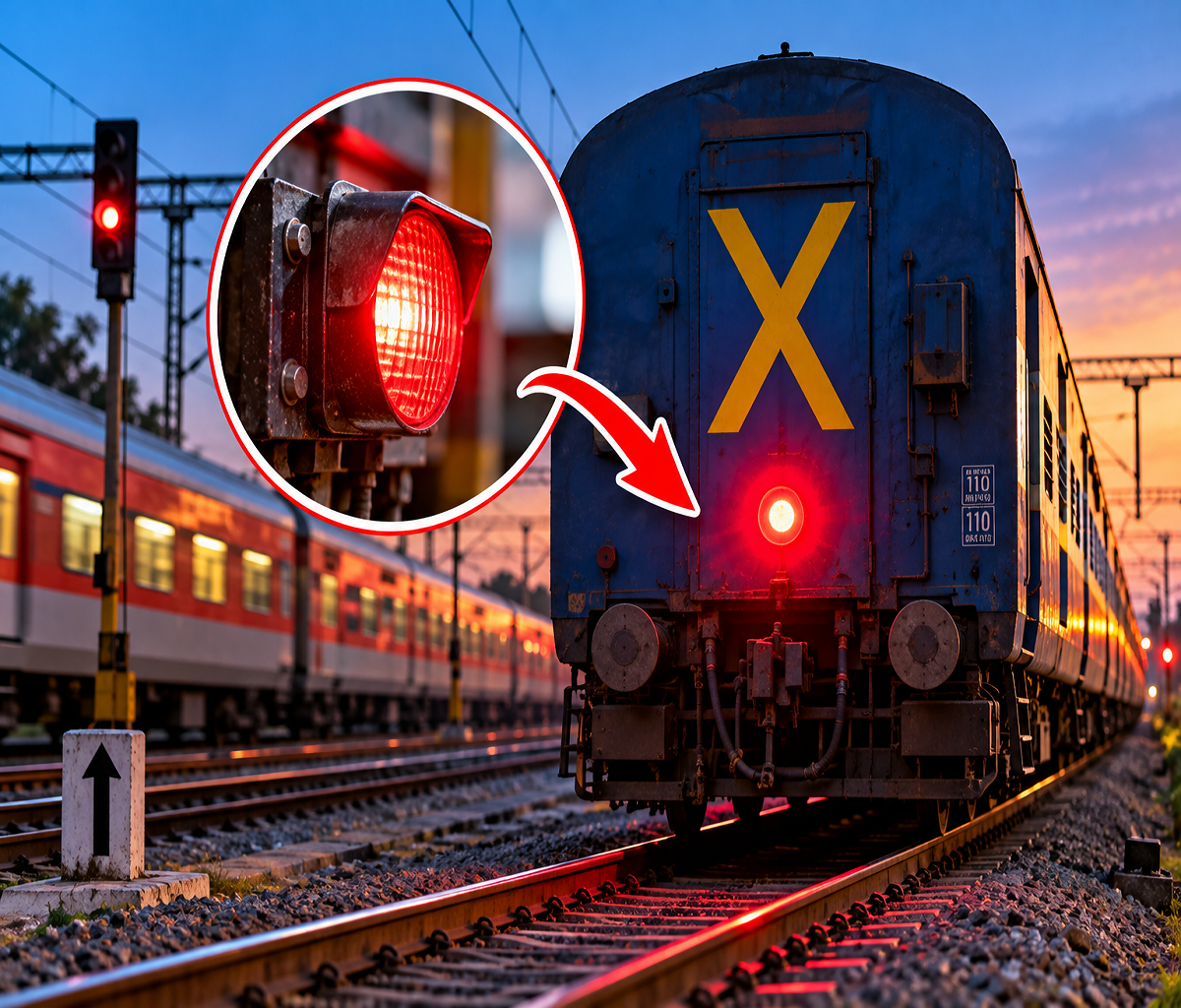
Anyone who regularly watches trains pass through a railway station may have noticed a small red light at the rear of a train. It may appear to be a simple identification light, but it forms an important part of the railway's safety arrangements.
The red light at the end of a train helps railway personnel identify the rear of the train and forms part of the system used to ensure safe railway operations.
The issue has received fresh attention after the Railway Board issued directions concerning this arrangement on freight trains, with the supplied report saying that rules and responsibilities surrounding the system are being tightened.
But why is a red light placed at the rear of a train, and why does such a seemingly small feature matter so much? Here's what passengers should understand.
Why Is There a Red Light at the End of a Train?
The red light seen at the back of a train is not merely decorative.
Its presence is connected with railway safety and helps indicate the rear end of a train. For railway personnel responsible for managing train movements, identifying where a train ends is an important part of operational safety.
This becomes particularly significant because a railway network may have multiple trains operating over different sections and routes.
A clear rear-end indication therefore forms part of the broader arrangements used by the railway system to manage train movements safely.
Why Is Red Used?
Red is widely associated with caution, stopping and safety warnings in transport systems.
On a train, the red light at the rear provides a clear visual indication of the train's trailing end.
For an ordinary passenger standing at a station, it might simply look like a small light disappearing into the distance as the train leaves. From an operational perspective, however, it serves a safety-related purpose.
Railway Board Issues Fresh Direction
The supplied report says the Railway Board has now issued directions concerning the rear-light arrangement on freight trains.
The move is aimed at making the rules and responsibilities associated with this safety arrangement stricter.
Freight trains are an important part of railway operations, carrying goods across long distances. Ensuring that prescribed safety arrangements are followed properly is therefore important for their movement across the railway network.
The latest direction highlights the importance the railway administration places on maintaining rear-end safety indications on freight trains.
A Small Light With an Important Role
Passengers often notice many signs, lights and markings on trains without knowing their operational purpose.
The red light at the rear is one such feature.
It may be physically small compared with the length of a train, but it serves as an indication associated with the train's rear end and the railway's safety procedures.
Railway operations depend on multiple safety systems working together. Visual indications such as rear lights form one part of that larger framework.
Why Freight Trains Are in Focus
The latest Railway Board direction referred to in the supplied information specifically brings attention to freight trains.
Unlike a passenger train, where passengers may naturally focus on coaches, platforms and station announcements, freight operations take place largely outside public attention.
However, freight trains operate across the same broader railway network, making compliance with operational safety requirements equally important.
The Railway Board's direction regarding the rear-light arrangement therefore puts renewed emphasis on following the prescribed system and clearly defining responsibility for it.
Red Light Is More Than a Train Identifier
It would be easy to assume that the light exists simply to help people identify the back of a train.
Its function goes beyond casual identification.
The supplied information specifically connects the red rear light with the railway's safety system. This is why rules surrounding its use matter from an operational perspective.
For railway personnel, clear visual indications are among the various measures used in managing railway movements and maintaining safety.
Railway Safety Depends on Multiple Measures
A train journey may appear straightforward to a passenger: the train arrives, passengers board, and it leaves for the next station.
Behind this process, however, railway operations depend on a wide range of procedures and safety arrangements.
Signals, operating instructions and visual indications all have specific functions within this larger system.
The red light visible at the rear of a train is one of the smaller but recognisable elements passengers can observe themselves.
What Has Changed?
The important development highlighted in the supplied report is not that trains have suddenly started using red lights at the rear.
Such rear-end indication is already part of railway operations.
Instead, the latest development concerns the Railway Board's directions for freight trains, with the report saying that the rules and responsibility related to this arrangement are being made stricter.
The distinction is important because the red light itself is not being presented as a newly introduced feature.
Next Time You See a Train, Look at Its Rear
The next time a train leaves a station, the small red light visible at its rear may have more meaning than it did before.
Rather than being an ordinary decorative light, it serves as a rear-end indication connected to railway safety.
The Railway Board's latest directions concerning freight trains have once again highlighted the importance of this arrangement and the responsibility associated with maintaining it correctly.
Note: The supplied excerpt states that the Railway Board has issued new directions regarding the rear-light arrangement and responsibilities on freight trains, but it does not provide the complete text of the Railway Board order or its detailed technical requirements. Those details have therefore not been added without source support.