Trending
PM Surya Ghar Yojana: Get Up to ₹78,000 Rooftop Solar Subsidy; Check Eligibility and Apply Online
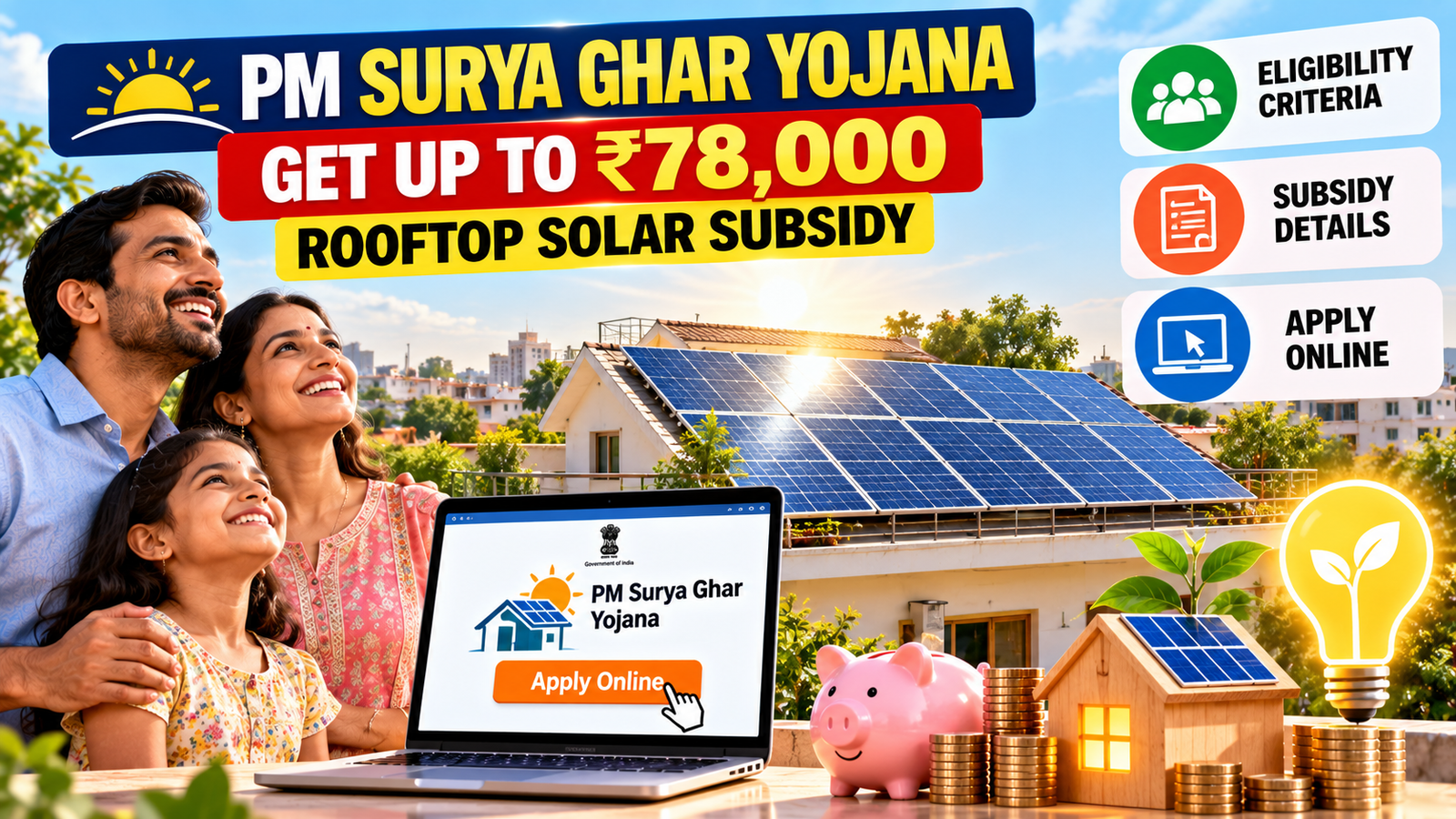
Households looking to reduce their electricity bills can take advantage of the PM Surya Ghar: Muft Bijli Yojana, a Central Government initiative designed to encourage residential rooftop solar installations across India.
Under the scheme, eligible households can receive financial assistance for installing rooftop solar systems. Depending on the capacity of the system, the Central subsidy can go up to ₹78,000 for residential households, according to the subsidy structure cited in the supplied information.
The programme has been designed around the objective of helping households generate their own electricity through solar power, with the broader goal associated with providing the benefit of up to 300 units of electricity per month through rooftop solar.
However, consumers should understand that this does not necessarily mean every registered household automatically receives 300 units of grid electricity free each month. Actual solar generation and electricity-bill savings depend on factors such as system capacity, sunlight, household consumption and the applicable net-metering arrangement.
How Much Subsidy Is Available Under PM Surya Ghar?
The subsidy amount primarily depends on the capacity of the rooftop solar installation.
According to the scheme structure cited in the supplied information:
| Rooftop Solar Capacity | Central Subsidy |
|---|---|
| 1 kW | ₹30,000 |
| 2 kW | ₹60,000 |
| 3 kW | ₹78,000 |
| Above 3 kW | Central subsidy capped at ₹78,000 |
Therefore, installing a system larger than 3 kW does not automatically increase the standard Central subsidy beyond ₹78,000 under this structure.
Consumers should calculate the appropriate system size based on their electricity consumption, available rooftop space and budget.
Can the Subsidy Reach ₹98,000?
The supplied information mentions that financial assistance could reach around ₹98,000 in certain states or eligible categories when additional support is combined with the Central subsidy.
This should not be interpreted as a universal ₹98,000 benefit available to every applicant.
Any additional assistance would depend on the state, local programme or other applicable support available to that household.
Applicants should therefore verify whether their state provides any additional rooftop-solar incentive before calculating the total subsidy.
What Does '300 Units Free Electricity' Actually Mean?
The phrase "300 units free electricity" is widely associated with PM Surya Ghar, but it is important to understand how rooftop solar works.
The scheme helps households install solar panels that generate electricity from sunlight.
If the rooftop system generates enough electricity to cover a large part of the household's monthly consumption, the amount payable to the electricity distribution company can decline substantially.
However, actual generation is not identical for every home.
It depends on factors such as:
- Solar-system capacity
- Available sunlight
- Rooftop orientation and shading
- Seasonal conditions
- Household electricity consumption
- Performance of the installed equipment
- Net-metering and billing arrangements
Therefore, households should not assume that registering for the scheme automatically guarantees a zero electricity bill every month.
Who Can Apply for PM Surya Ghar Yojana?
The scheme is aimed at eligible residential households seeking to install rooftop solar systems.
According to the eligibility information supplied with the article, an applicant should be an Indian citizen and have a suitable residential property where rooftop solar panels can be installed.
A valid electricity connection is also required.
The rooftop must have sufficient usable space for the proposed solar system, and technical feasibility will need to be established before installation.
Applicants should check the latest eligibility conditions on the official PM Surya Ghar portal because scheme requirements and state-level implementation details can be updated.
How Much Rooftop Space Do You Need?
The amount of space required depends on the size and type of solar installation.
A larger-capacity system generally requires more usable rooftop area.
However, simply having a large roof does not guarantee that the entire area is suitable.
Nearby buildings, trees, water tanks and other structures can create shadows that reduce solar-panel output.
Before choosing a system, households should have the site assessed for factors such as orientation, shading, structural suitability and available installation area.
How to Apply for PM Surya Ghar Yojana Online
The application process has been designed to be completed largely online.
Applicants should begin by visiting the official PM Surya Ghar portal and registering themselves.
During registration, they will generally need to select their:
State → Electricity Distribution Company (DISCOM) → Consumer Account Number
Applicants will also need to provide their mobile number and other required information.
After successful registration, they can log in and submit the application for a residential rooftop solar system.
Step 1: Register on the Official Portal
The first step is to create an account using the required electricity-consumer information.
Applicants should make sure that the consumer number and electricity-connection details are entered correctly.
Incorrect details can delay verification by the DISCOM.
Consumers should use only the official government portal for the application and avoid websites or agents falsely promising guaranteed approval in exchange for upfront payments.
Step 2: Apply for Rooftop Solar
After registration, the consumer can log in and submit the rooftop-solar application.
The application should contain the information requested about the electricity connection and proposed installation.
The DISCOM then examines whether the rooftop-solar connection is technically feasible at the location.
Applicants should generally wait for the required approval before proceeding according to the prescribed installation process.
Step 3: Get Technical Feasibility Approval
Technical feasibility is an important stage.
The electricity distribution company examines whether the proposed rooftop-solar installation can be integrated with the existing electricity connection and local distribution infrastructure.
Once the necessary feasibility approval is obtained, the applicant can proceed with installation according to the scheme's requirements.
Step 4: Select an Authorised Vendor
After receiving the required approval, the consumer can choose an eligible or registered vendor according to the scheme process.
Applicants should compare equipment specifications, warranties, installation quality and after-sales support instead of choosing solely on the basis of the lowest quoted price.
The performance of a rooftop-solar system depends heavily on equipment quality and correct installation.
Step 5: Install the Solar System
The selected vendor installs the rooftop-solar system according to the approved capacity and applicable technical requirements.
Consumers should retain invoices, installation documents, warranty information and other relevant records.
These documents may be useful during subsequent inspection, commissioning and subsidy processing.
Step 6: Net Meter and Inspection
After installation, the process moves toward metering, inspection and commissioning.
A net meter can record electricity exchanged between the household and the grid according to the applicable arrangement.
When rooftop solar generates electricity, the household can consume that power. The applicable metering framework accounts for electricity imported from and exported to the grid according to prevailing regulations.
The DISCOM completes the required inspection and commissioning process.
Step 7: Submit Bank Details for Subsidy
Once the installation and commissioning requirements have been successfully completed, the applicant needs to provide the required bank-account information through the prescribed process.
The subsidy is transferred directly to the eligible beneficiary's bank account through Direct Benefit Transfer (DBT) after successful verification.
The supplied information states that the subsidy can be credited within around 30 days after the required commissioning process and submission of bank details, subject to successful verification and processing.
Applicants should treat this as the expected processing framework rather than a guarantee that every payment will arrive on exactly the same day.
Documents and Details You Should Keep Ready
Applicants may need several pieces of information during registration, installation and subsidy processing.
These can include:
- Electricity consumer/account number
- Mobile number
- Email address, where required
- Identity details
- Residential electricity connection information
- Bank-account details for subsidy transfer
- Rooftop-solar installation documents
- Vendor and commissioning information
The exact documentation should be checked on the portal when submitting the application.
How Much Can You Save on Electricity?
There is no single savings figure that applies to every household.
Consider two homes with the same rooftop-solar capacity. One household may consume most of its electricity during the daytime, while another may have a different usage pattern.
Solar generation can also vary by geography, season and weather.
Consequently, the electricity-bill reduction will depend on both how much power the system generates and how much electricity the household consumes.
This is why consumers should calculate their typical electricity usage before deciding the appropriate rooftop-solar capacity.
Don't Install a Bigger System Only for the Subsidy
Consumers should avoid choosing system capacity simply because a higher subsidy is available.
The right capacity should reflect actual electricity consumption, rooftop availability and long-term requirements.
For example, a household with modest electricity consumption may not need the same system size as a home with multiple air conditioners and high daytime power usage.
A technical assessment can help determine a more appropriate capacity.
Be Careful of Fake PM Surya Ghar Agents
Government subsidy schemes can attract fraudsters claiming to offer guaranteed approvals or faster subsidy payments.
Applicants should not share OTPs, banking passwords, debit-card PINs or other confidential information with unknown callers.
Payments should only be made through legitimate channels associated with the approved installation process.
Consumers should also verify vendor details before signing agreements or transferring money.
PM Surya Ghar: Key Points to Remember
The scheme offers substantial financial support for residential rooftop solar, but households should understand the conditions before applying.
The standard Central subsidy structure cited provides ₹30,000 for 1 kW, ₹60,000 for 2 kW and up to ₹78,000 for 3 kW or higher eligible installations.
The widely cited benefit of up to 300 units per month is linked to the electricity that an appropriately sized rooftop-solar system can help households generate and offset. It should not be interpreted as an unconditional allocation of 300 free grid units to every applicant.
The actual benefit depends on the system installed, electricity consumption, solar generation and applicable billing arrangements.
For households with suitable rooftops and significant electricity consumption, the programme can reduce the upfront cost of adopting solar power and potentially lower electricity expenses over the long term.
Disclaimer: Subsidy amounts, eligibility requirements, additional state assistance, net-metering rules and processing timelines are subject to applicable government and DISCOM guidelines. Applicants should verify the latest terms on the official PM Surya Ghar portal before making an investment or selecting a vendor.