
Business
8th Pay Commission Update: ₹52,600 Minimum Pay Among Key Proposals Ahead of Bengaluru Talks
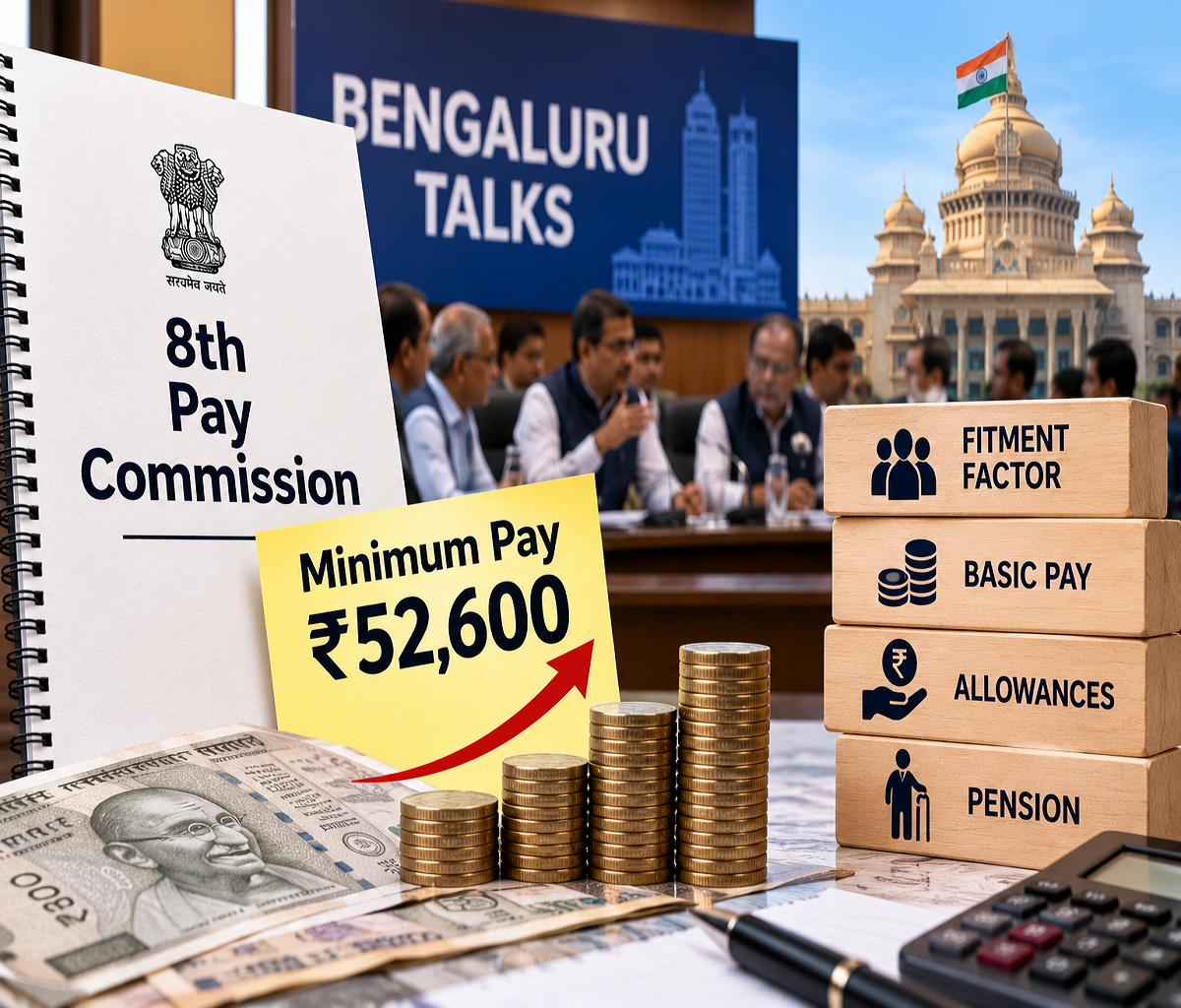
Central government employees and pensioners are closely watching developments around the 8th Pay Commission as discussions over the next salary and retirement-benefit structure gather momentum. Ahead of an upcoming meeting in Bengaluru, employee and pensioner organisations have put forward proposals covering minimum pay, fitment factors, annual increments, allowances and retirement security.
Among the figures attracting attention is a proposal to raise minimum pay to ₹52,600. Another notable demand calls for different fitment factors for different levels of employees, ranging from 2.92 to 4.38.
These figures, however, are proposals submitted by employee organisations. They have not been approved as the final salary or fitment-factor structure of the 8th Pay Commission.
The Bengaluru discussions are expected to provide another platform for stakeholders to raise their concerns, but employees should not expect every salary and pension issue to be finalised at a single meeting.
Two Railway Organisations Put Forward Proposals
Two organisations have been prominently mentioned in connection with the demands ahead of the Bengaluru discussions—the Indian Railways Technical Supervisors Association (IRTSA) and the Railway Senior Citizens Welfare Society (RSCWS).
While IRTSA has focused heavily on issues affecting serving employees, including pay and allowances, RSCWS has highlighted matters affecting pensioners and retirement security.
Taken together, their submissions show that basic pay, allowances and post-retirement benefits are likely to remain major areas of employee-side representations during the Commission's consultation process.
₹52,600 Minimum Pay Proposed
The first major proposal highlighted by IRTSA concerns minimum pay.
The organisation has sought a minimum pay of ₹52,600 under the new salary structure.
Minimum basic pay is particularly important because it can influence the overall pay matrix and several salary-linked benefits.
Employee groups want the new pay structure to take into account changes in living costs and other economic factors since the previous pay revision.
However, the ₹52,600 figure should not be interpreted as a confirmed minimum salary for central government employees.
It remains a demand placed before the Commission.
Different Fitment Factors Suggested for Different Levels
Fitment factor is another major issue being discussed.
Instead of seeking one identical fitment factor across the entire pay structure, IRTSA has proposed different multipliers according to employee levels.
The proposal mentioned in the report is:
| Pay Level | Fitment Factor Proposed by IRTSA |
|---|---|
| Level 1-5 | 2.92 |
| Level 6-8 | 3.50 |
| Level 9-12 | 3.80 |
| Level 13-16 | 4.09 |
| Level 17-18 | 4.38 |
Under this proposal, employees in higher pay levels would have a larger fitment multiplier.
Fitment factor is important because it can play a major role in determining how an employee's existing basic pay is converted into revised basic pay under a new pay structure.
But there is currently an important caveat: none of these level-wise fitment factors should be treated as an officially finalised 8th Pay Commission formula.
They are figures being advocated by an employee organisation.
5% Annual Increment Also Sought
IRTSA has also proposed a major change to annual salary increments.
The organisation wants employees to receive an annual increment of 5%.
Annual increments determine how basic pay progresses during an employee's service. A higher percentage can have a substantial cumulative impact over a long career.
It could also indirectly influence benefits that are calculated with reference to basic pay.
For employees, therefore, the annual increment formula will be another important aspect of the eventual pay revision.
The proposed 5% rate, however, remains an employee-side demand and is not an approved policy.
Separate Allowances for Difficult Working Conditions
Another demand focuses on employees whose jobs involve unusual working hours or difficult conditions.
IRTSA has called for appropriate allowances for employees engaged in night duty, overtime and risk-related work.
The proposal is based on the argument that employees performing specialised, risky or demanding duties should receive additional financial recognition.
Allowances can form an important part of an employee's overall compensation, particularly in departments where working conditions differ significantly from a normal office schedule.
How such allowances will ultimately be structured will depend on the recommendations made by the Commission and the government's decision on them.
Retirement Security Is Also a Major Issue
Salary revision is not the only concern being raised.
Employee organisations also want the new pay structure to provide stronger financial security after retirement.
A meaningful basic-pay component during service can have implications for several retirement-related calculations and benefits, depending on the applicable rules.
IRTSA has therefore highlighted the need for a compensation structure that provides employees with adequate financial protection not just during their working years but also after retirement.
What Has RSCWS Demanded?
The Railway Senior Citizens Welfare Society has raised a separate set of proposals with a stronger focus on retired employees.
One of its key demands is to strengthen the basic-pay component of the salary structure.
The organisation has also called for a better balance between basic pay and allowances.
This becomes relevant when components such as House Rent Allowance (HRA) and Travelling Allowance (TA) are periodically revised.
The pensioners' organisation wants the pay structure to avoid excessive dependence on allowances at the cost of meaningful basic pay.
HRA and TA Revision Also in Focus
RSCWS has sought periodic review of important allowances such as HRA and TA.
The organisation argues that allowances should remain responsive to changing costs rather than becoming outdated over time.
Inflation can gradually reduce the real value of a fixed allowance, which is why employee and pensioner organisations often seek periodic revision mechanisms.
The group has also asked for important allowances to be reviewed in line with inflation.
Hardship and Specialised Duties Need Review, Says Group
Compensation for specialised duties and hardship conditions is another issue highlighted by RSCWS.
Certain government jobs involve difficult environments, unusual working conditions or specialised responsibilities.
The organisation wants such duties to be reviewed appropriately while determining compensation.
This demand overlaps with the broader employee-side argument that the next pay structure should reflect not only designation and pay level but also the nature of work performed.
Will Bengaluru Meeting Decide the Final Fitment Factor?
The Bengaluru meeting is expected to keep issues such as salary revision, fitment factor, allowances and pension reforms in focus.
However, employees should be cautious about reports suggesting that a final salary multiplier will necessarily emerge immediately from the meeting.
The Pay Commission process involves consultation with different stakeholders, examination of representations and assessment of the financial implications of proposed changes.
A demand submitted by a union or pensioners' organisation does not become a government decision simply because it is discussed before the Commission.
Final Salary Structure Is Yet to Be Decided
This distinction is particularly important for employees trying to calculate their future salaries.
For example, the proposed 2.92 fitment factor for Levels 1-5 should not be used as though it were already confirmed.
The same applies to the proposed multipliers of 3.50, 3.80, 4.09 and 4.38 for higher levels.
Similarly, the demand for a ₹52,600 minimum pay and 5% annual increment remains part of employee-side representations.
Actual revised salaries can only become clearer after the Commission completes its work, submits recommendations and the government takes a formal decision.
What Are the Five Major Issues to Watch?
Ahead of the Bengaluru discussions, five broad issues stand out from the employee-side proposals: higher minimum pay, level-wise fitment factors, a higher annual increment, improved compensation for night/overtime/risk duties, and stronger retirement security.
Pensioner representatives have additionally emphasised stronger basic pay, regular HRA and TA revision, better recognition of hardship duties and inflation-linked review of essential allowances.
These proposals indicate the expectations being placed before the 8th Pay Commission, but they should not be confused with final recommendations or government-approved benefits.
For central government employees and pensioners, the most important developments will come when the Commission formally sets out its recommendations and the government subsequently announces which proposals it accepts.