
Business
Does Checking Your CIBIL Score Repeatedly Lower It? Know the Truth About Soft and Hard Enquiries
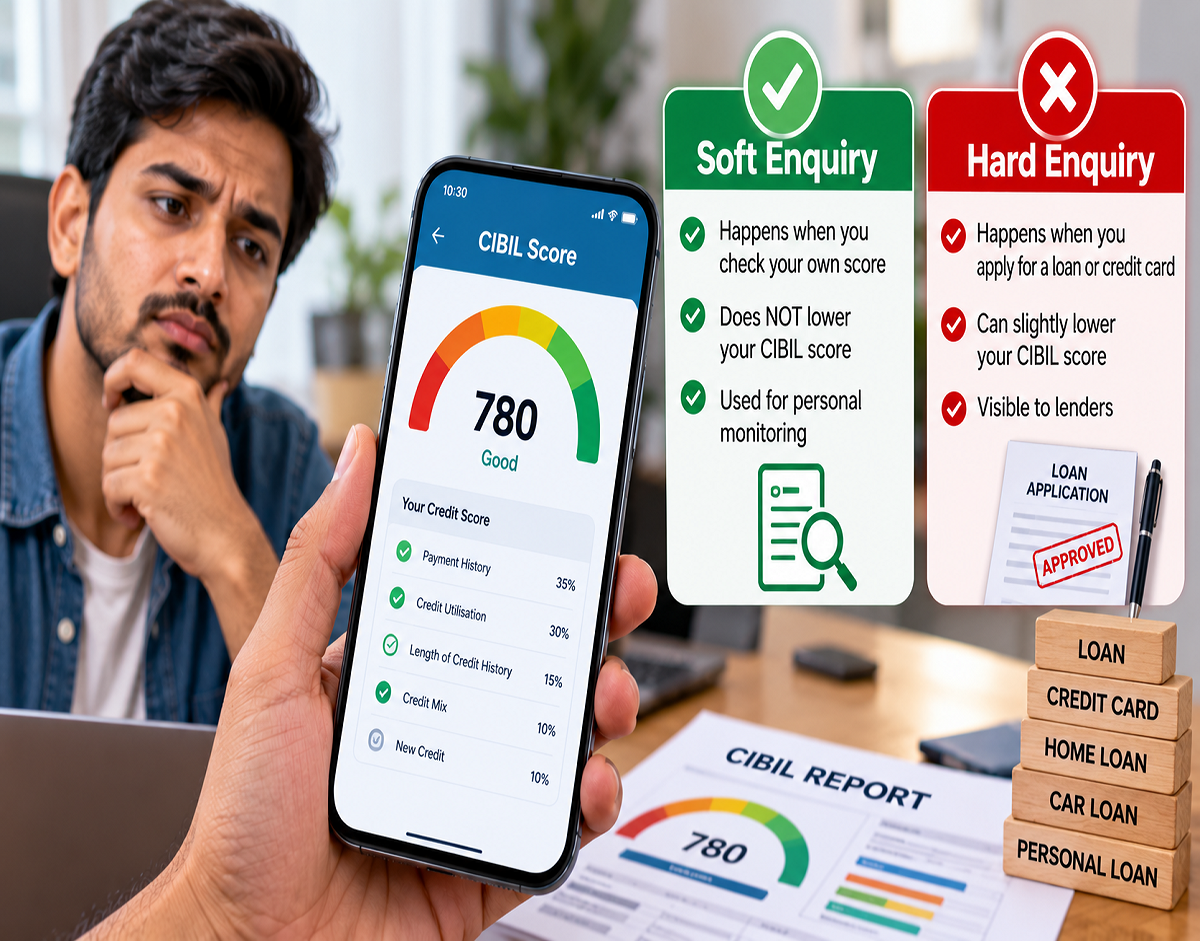
CIBIL Score Check: Many borrowers avoid checking their own credit score because they fear that looking at it repeatedly could reduce the score. However, checking your own credit report or CIBIL score generally does not lower your credit score.
The important distinction is between a soft enquiry and a hard enquiry.
When you check your own credit report, it is generally treated as a soft enquiry and does not negatively affect your score. A hard enquiry, on the other hand, can occur when a bank or another financial institution accesses your credit report while assessing an application for a loan, credit card or another credit product.
Multiple hard enquiries within a short period can potentially have an impact on your credit profile.
Does Checking Your Own CIBIL Score Reduce It?
No. Simply reviewing your own CIBIL score or credit report does not reduce the score.
Raj P. Narayanam, Executive Chairman of Zaggle, explained in the source report that when consumers access their own credit reports, the check is treated as a soft enquiry.
Soft enquiries do not affect the credit score.
This means you do not need to avoid checking your credit report simply because you are worried about losing points.
In fact, periodically reviewing your credit report can be a useful financial habit because it helps you understand your current credit position and identify potential errors.
What Is a Soft Enquiry?
A soft enquiry is a credit check that does not affect your credit score.
Checking your own credit report is one common example.
Since you are only reviewing your financial information and are not necessarily requesting a new loan or credit card, this type of enquiry does not indicate that you are trying to take on additional debt.
Therefore, people can periodically review their credit reports without worrying that the act of checking itself will damage their score.
This can be particularly useful before submitting a major loan application.
For example, if you are planning to apply for a home loan or vehicle loan, checking your report beforehand can help you identify whether your credit information appears accurate.
What Is a Hard Enquiry?
A hard enquiry is different.
When you apply for a new loan, credit card or another form of credit, the lender may obtain your credit report as part of its assessment process.
Such a lender-initiated check may be recorded as a hard enquiry.
Hard enquiries can be considered as one factor in a credit-scoring assessment because they are associated with applications for new credit.
One hard enquiry does not automatically mean that your credit score will fall sharply. The impact can vary depending on the individual's overall credit profile and the scoring model being used.
The greater concern arises when several applications generate multiple hard enquiries over a relatively short period.
Why Can Too Many Hard Enquiries Be a Problem?
Suppose a person applies for several credit cards and personal loans within a short period.
Different lenders may check that person's credit report while processing those applications, potentially creating several hard enquiries.
A pattern of frequent applications for new credit can indicate that the borrower is actively seeking additional borrowing.
Lenders may sometimes view such behaviour as a sign of higher credit dependence or so-called "credit-hungry" behaviour.
As a result, making unnecessary applications to multiple lenders within a short period may not be a good strategy, particularly when you are preparing to apply for an important loan.
This is different from simply checking your own CIBIL score multiple times.
Soft Enquiry vs Hard Enquiry: What's the Difference?
The easiest way to understand the distinction is to look at who is checking the report and why.
When you check your own credit report, it is generally a soft enquiry and does not hurt your score.
When a lender checks your credit history while evaluating a credit application, the enquiry may be recorded as a hard enquiry and can potentially influence the credit profile.
Therefore, consumers should not confuse regular self-monitoring with repeatedly applying for new loans or credit cards.
The two activities have very different implications.
Why Should You Check Your Credit Report?
A credit report works much like a financial report card for your borrowing history.
It can contain information related to existing and previous loans, credit cards, repayment behaviour and other credit-related records.
Reviewing this information periodically can help you understand how lenders may view your credit profile.
More importantly, it can help identify errors before they cause problems during a future credit application.
You May Spot a Loan You Never Took
One of the most important reasons to review your credit report is to detect unfamiliar accounts.
For example, you could discover a loan or credit card listed under your name that you do not recognise.
Such an entry should not be ignored.
It could result from incorrect reporting, a data mismatch or potentially unauthorised use of your identity or financial information.
Consumers who find unfamiliar credit accounts should investigate them promptly and raise a dispute with the relevant credit institution or credit bureau through the appropriate process.
Incorrect Payment Records Can Also Affect Your Profile
Errors do not always involve an entirely unfamiliar loan.
Your report could contain an incorrect personal detail, inaccurate account information or a payment status that does not match your records.
For example, a payment you made on time might incorrectly appear as delayed, or an account that has been closed may not be reflected correctly.
Checking your credit report periodically gives you an opportunity to identify such discrepancies and seek correction.
Keeping payment receipts, loan closure documents and relevant statements can also be helpful when raising a dispute.
Should You Check Your Score Before Applying for a Loan?
Checking your own credit report before applying for a major loan can be useful.
It allows you to review your existing credit obligations and verify whether the information in your report is accurate before a lender conducts its assessment.
If you discover a mistake, you may have an opportunity to initiate the correction process before submitting the loan application.
Consumers should also remember that a credit score is only one part of a lender's decision.
Banks and financial institutions can consider several other factors, including income, existing debt, repayment capacity, employment profile and their own lending policies.
Therefore, even a high CIBIL score does not automatically guarantee loan approval.
The Bottom Line
There is no need to avoid checking your own CIBIL score simply because you fear the score will decline.
A self-check is generally treated as a soft enquiry and does not negatively affect your credit score.
What borrowers should watch more carefully is the number of credit applications they submit within a short period. Applications for loans or credit cards may lead lenders to conduct hard enquiries, and several such enquiries can potentially affect the overall credit profile.
Regularly reviewing your credit report can instead be a useful financial habit. It can help you understand your credit position, catch incorrect information and identify unfamiliar loans or credit cards before they create bigger problems.