Business
RBI Hikes Repo Rate for First Time in Over 3 Years to 5.50%: What It Means for Your Home Loan EMI
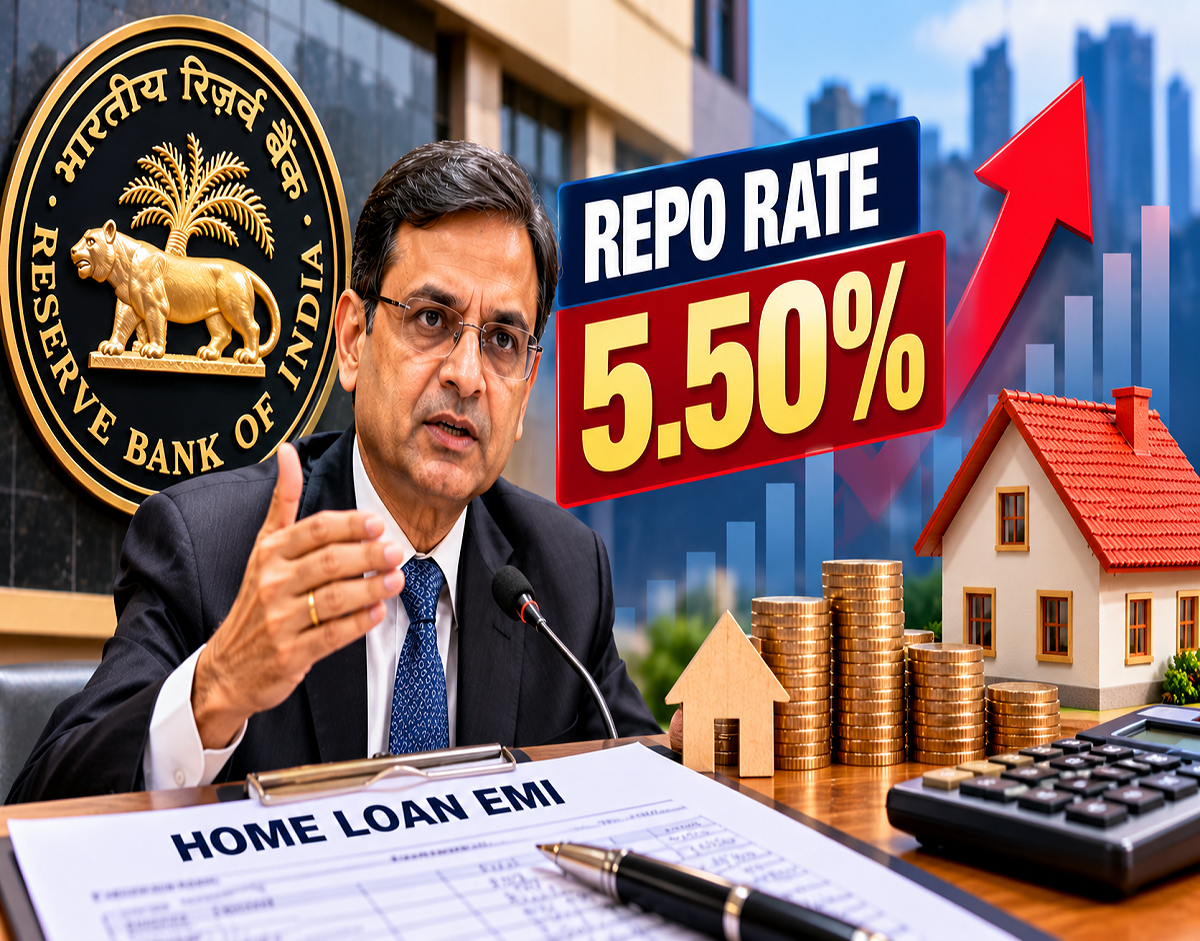
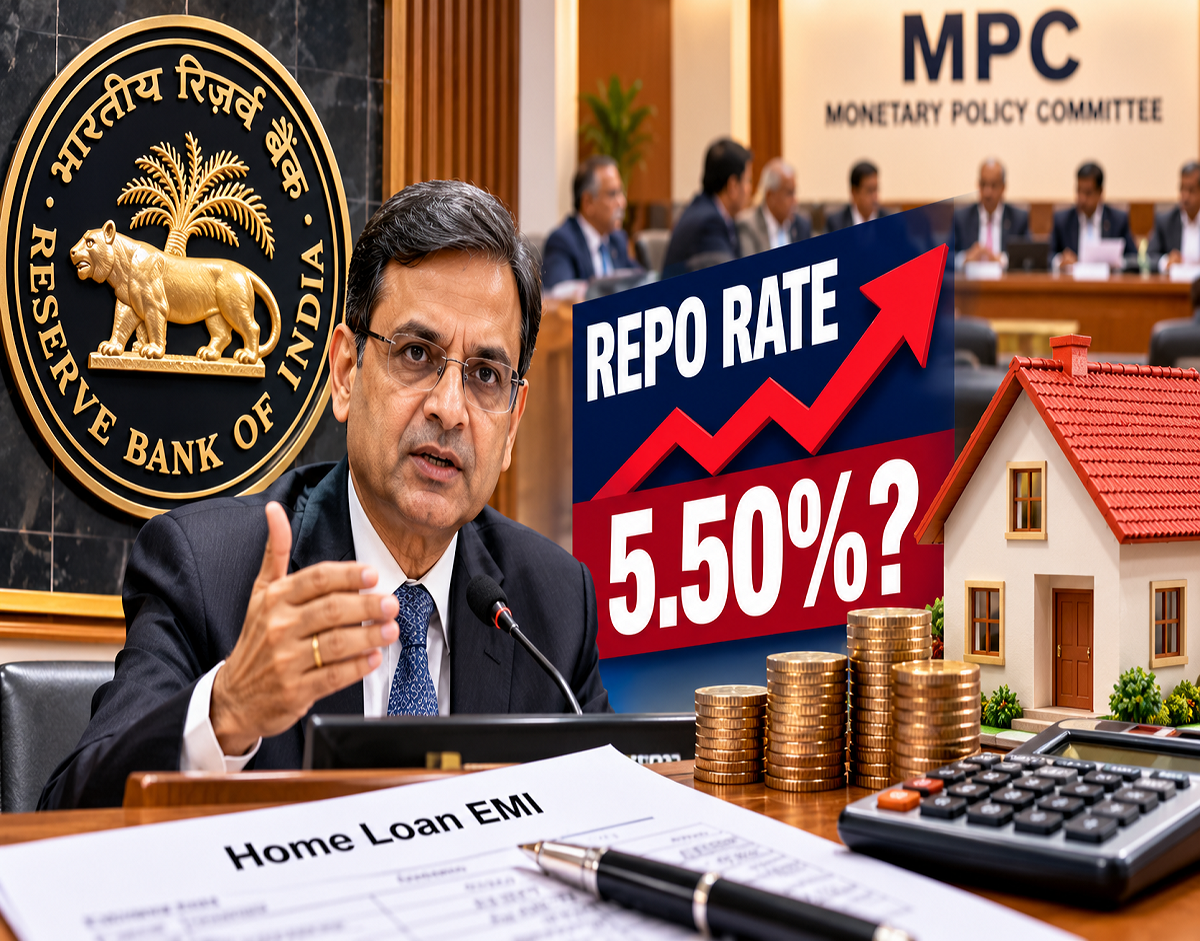
RBI Repo Rate Hike: The Reserve Bank of India (RBI) has increased the repo rate by 25 basis points, taking the key policy rate from 5.25% to 5.50%. The decision could eventually make home loans, auto loans and other floating-rate borrowings more expensive if banks and other lenders pass on the higher policy rate to customers.
The decision was announced following the latest meeting of the RBI's Monetary Policy Committee (MPC). RBI Governor Sanjay Malhotra said the committee unanimously decided to raise the policy repo rate after a detailed assessment of the prevailing macroeconomic and financial conditions.
The move is particularly significant because, according to the report, the RBI had last raised the repo rate in February 2023.
Several analysts had expected a 25-basis-point increase ahead of the October policy announcement.
RBI Raises Repo Rate From 5.25% to 5.50%
A basis point is equal to one-hundredth of a percentage point. Therefore, an increase of 25 basis points means a rise of 0.25 percentage point.
With the latest decision:
Previous repo rate: 5.25%
Increase: 25 basis points
New repo rate: 5.50%
The repo rate is one of the RBI's most important monetary-policy tools. It influences the cost at which banks obtain short-term funds from the central bank and can eventually affect interest rates across the financial system.
For borrowers, the immediate question is whether the increase will raise their monthly loan repayments.
The answer depends on the type of loan, the benchmark to which it is linked and when the lender resets the interest rate.
Will Your Home Loan EMI Increase?
Borrowers with floating-rate loans are more exposed to changes in policy rates than those with fixed-rate loans.
Many retail floating-rate loans are linked to external benchmarks. If a lender raises the applicable lending rate following the RBI's decision, borrowers could see either their EMI increase, loan tenure become longer, or a combination of both, depending on the loan agreement and lender's policy.
However, a 25-basis-point increase in the repo rate does not necessarily mean that every borrower's interest rate or EMI will rise immediately by exactly the same amount.
The timing and size of the impact depend on factors such as the benchmark, reset date, spread charged by the lender and remaining loan tenure.
New borrowers could also face higher lending rates if banks revise their loan pricing after the RBI decision.
Why Did RBI Increase the Repo Rate?
The latest rate increase comes as policymakers face renewed inflation-related risks.
According to the report, global geopolitical tensions have increased pressure on commodity and food prices, creating additional risks for India's retail inflation outlook.
Higher commodity prices can raise costs for businesses and households. Energy prices can also affect transportation, manufacturing and other parts of the economy.
By raising interest rates, the central bank can attempt to moderate demand and reduce inflationary pressure.
Higher borrowing costs generally discourage some borrowing and spending, which can help cool demand in the economy. However, monetary policy works with a lag, meaning its impact is not necessarily visible immediately.
What RBI Governor Said About the Economy
RBI Governor Sanjay Malhotra said India's economic growth continues to receive support from strong private consumption and investment activity.
High-frequency economic indicators suggest that activity maintained momentum during the second quarter, although there was some moderation compared with the first quarter, according to the assessment cited in the report.
Manufacturing activity has also remained resilient despite cost pressures.
Meanwhile, activity in the services sector continues to be strong and broad-based.
The RBI therefore faces the challenge of balancing economic growth with the need to control emerging inflationary pressures.
Rate Cut Unlikely in the Near Term
The RBI Governor also indicated that a reduction in interest rates may not be an immediate option under current conditions.
According to the report, Malhotra suggested that near-term policy choices could be limited to either raising rates further or keeping them unchanged, depending on how economic conditions evolve.
That does not mean another rate increase is guaranteed.
Future decisions will depend on incoming information on inflation, economic growth, global commodity prices, financial conditions and other domestic and international developments.
Borrowers should therefore avoid assuming that a fixed sequence of future rate hikes has already been decided.
What Is the Repo Rate?
The repo rate is the interest rate at which the Reserve Bank of India provides short-term funds to banks against eligible securities.
Changes in this rate can influence borrowing costs throughout the financial system.
When the repo rate rises, banks' funding conditions can become more expensive. Depending on market conditions and the structure of their lending products, banks may pass some of this increase on to borrowers by raising lending rates.
As a result, loans such as home loans, vehicle loans and certain other floating-rate credit products can become more expensive.
The opposite can happen when policy rates fall, although transmission to customers is not always immediate or identical across lenders.
What Is the Reverse Repo Rate?
The reverse repo concept broadly refers to the rate associated with the central bank absorbing liquidity from banks, although India's liquidity-management framework includes multiple policy instruments and facilities.
Its role differs from the repo rate, which directly serves as the key policy rate influencing monetary conditions.
For retail borrowers, the repo rate is generally the more closely watched number because changes can affect benchmark-linked lending rates.
How Does a Repo Rate Hike Control Inflation?
The RBI uses monetary policy to maintain price stability while keeping growth considerations in view.
When inflationary pressure becomes elevated, increasing policy rates can make borrowing more expensive.
Higher interest rates can reduce demand for loans and moderate discretionary spending and investment. Slower demand growth can, over time, help reduce pressure on prices.
However, rate increases cannot directly solve every source of inflation.
For example, inflation caused by international crude oil prices, geopolitical disruptions, food-supply shortages or other supply-side factors may not respond immediately to higher domestic interest rates.
What Should Home Loan Borrowers Do Now?
Existing borrowers should first check whether their loan carries a fixed or floating interest rate.
Those with floating-rate loans should identify the benchmark used by their lender and check the next interest-rate reset date. This can help determine when the latest RBI decision could affect their loan.
Borrowers can also check whether a rate increase would lead to a higher EMI or an extension of the repayment tenure.
For a long-term home loan, even a relatively small change in the interest rate can affect the total interest paid over the life of the loan.
At the same time, borrowers should not assume that their EMI will rise immediately simply because the RBI increased the repo rate.
RBI's Next Move Will Depend on Inflation and Growth
The increase to 5.50% marks an important shift in the RBI's policy direction after a long gap since the previous repo-rate hike cited in the report.
For consumers, the biggest impact is likely to be felt through borrowing costs if lenders transmit the higher rate.
Home loan, auto loan and other floating-rate borrowers should therefore keep an eye on communications from their banks regarding lending-rate revisions.
The RBI has not guaranteed another increase at the next meeting. Future policy decisions will depend on how inflation, growth, global commodity markets and financial conditions develop.
For now, the latest decision means India's key policy repo rate stands at 5.50% after a 25-basis-point increase, putting loan interest rates and EMIs firmly back in focus.