Technology
Want to Run a Refrigerator on Solar 24/7? Here’s the Panel, Battery and Inverter Capacity You Need
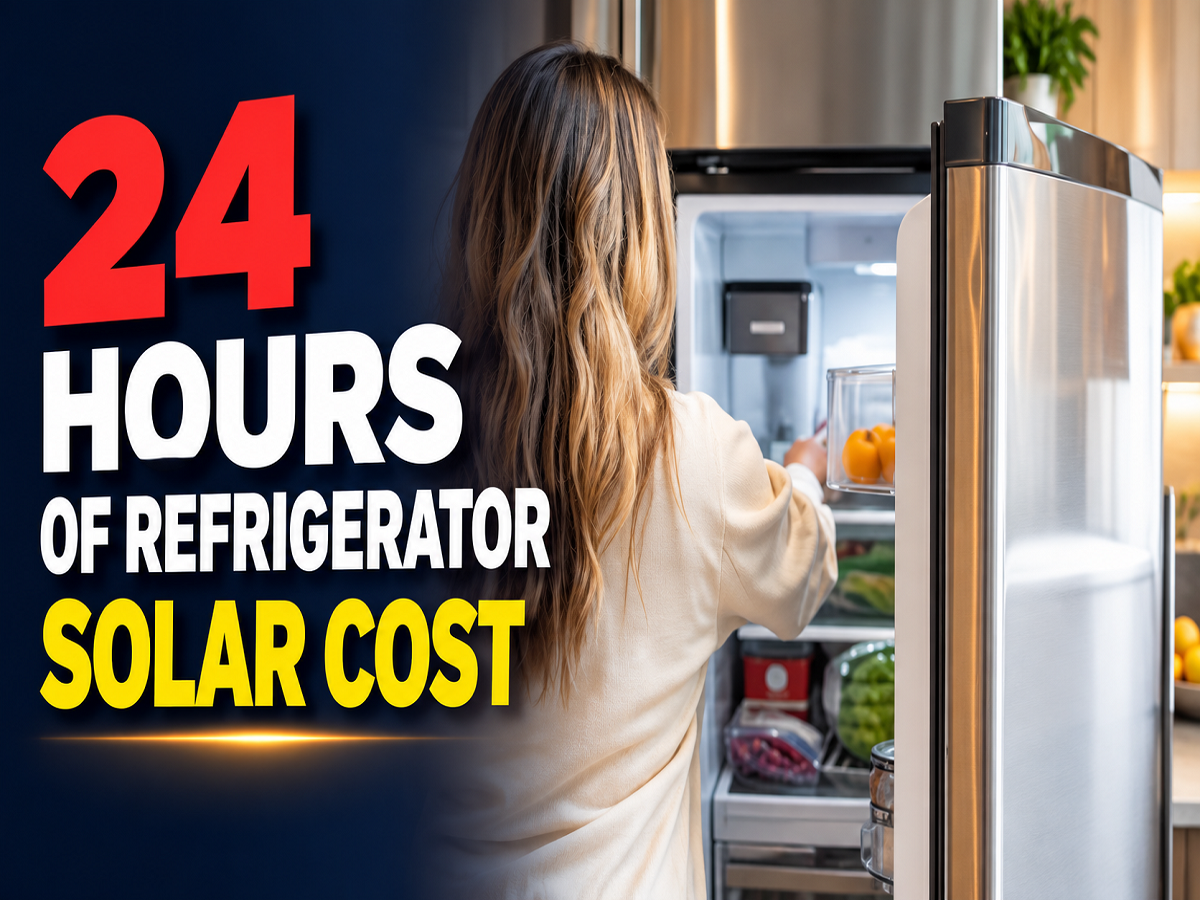
Running a refrigerator continuously with solar energy is possible, but installing one solar panel may not be enough. A dependable 24-hour system requires correctly sized solar panels, a battery, a charge controller and an inverter capable of handling the refrigerator’s compressor.
The right system cannot be selected only from the refrigerator’s storage capacity. Two models of the same size may consume very different amounts of electricity. The most reliable starting point is the appliance’s annual energy consumption, usually printed on its BEE energy label or mentioned in the product specifications.
Check the refrigerator’s annual electricity consumption
Refrigerators do not continuously draw their rated wattage. Their compressors switch on and off throughout the day to maintain the selected temperature. Actual consumption changes with room temperature, door-opening frequency, thermostat setting, food load and the appliance’s efficiency.
Check the refrigerator’s BEE label for annual electricity consumption in kWh per year, also commonly understood as electricity units per year. The BEE Standards and Labelling programme allows consumers to compare the energy efficiency of different appliances.
To estimate daily consumption, use this calculation:
Annual energy consumption ÷ 365 = average daily consumption
For example, if the label shows 300 kWh per year:
300 ÷ 365 = approximately 0.82 kWh per day
The solar system must generate more than 0.82 kWh because some energy is lost through the inverter, battery, wiring, dust, heat and charge controller.
How much solar-panel capacity is required?
For a rough calculation, divide the refrigerator’s adjusted daily requirement by the average peak-sun hours available at the installation location.
A simplified formula is:
Required solar capacity = Daily refrigerator consumption ÷ peak-sun hours ÷ system efficiency
If a refrigerator uses 0.82 kWh daily, the location receives four effective peak-sun hours and overall system efficiency is assumed to be 70%:
0.82 ÷ 4 ÷ 0.70 = approximately 0.29 kW
Although this calculation produces a figure of about 290 watts, installing only a 300-watt panel would leave almost no margin for cloudy weather, dust or seasonal changes. A practical system may therefore require approximately 400 to 500 watts of solar capacity.
Approximate requirements could look like this:
| Refrigerator’s Annual Consumption | Average Daily Use | Practical Solar Capacity |
|---|---|---|
| 150–200 kWh | 0.41–0.55 kWh | 300–400 watts |
| 250–350 kWh | 0.68–0.96 kWh | 400–600 watts |
| 400–500 kWh | 1.10–1.37 kWh | 600–800 watts |
| Above 500 kWh | Above 1.37 kWh | Site-specific calculation required |
These are indicative figures, not guaranteed specifications. Solar generation varies by city, season, shading, panel direction and weather. Tools such as NREL’s PVWatts Calculator can help estimate output according to location and system capacity.
How many panels will be needed?
The number of panels depends on the wattage of each module.
For example:
- A 400-watt requirement can be met with one 400-watt panel or two 200-watt panels.
- A 600-watt requirement can be met with two 300-watt panels.
- An 800-watt requirement can be met with two 400-watt panels or another suitable combination.
Panel wattage alone does not confirm whether the system can operate the refrigerator overnight. Solar panels produce energy mainly during daylight, so battery storage is essential for an off-grid 24-hour setup.
Battery capacity is essential for night-time operation
A refrigerator must continue cooling after sunset and during periods of weak sunlight. The battery therefore needs enough usable energy to cover night-time consumption and provide some reserve.
For a refrigerator consuming around 0.8 to 1 kWh daily, a 1.5 to 2 kWh lithium battery may be suitable for basic overnight use with a reasonable operating margin. A larger battery may be required if the system must continue working during a cloudy day or an extended grid failure.
Battery capacity should be calculated using usable energy rather than only the printed capacity. Lithium batteries can generally provide a greater usable portion of their rated storage than traditional lead-acid batteries. The permitted depth of discharge varies by manufacturer and battery chemistry.
For example, a 12.8-volt, 100Ah lithium battery stores roughly:
12.8V × 100Ah = 1,280Wh, or 1.28 kWh
However, not all of that energy should automatically be treated as usable. The manufacturer’s discharge limit, inverter efficiency and battery-management settings must also be considered.
Choose an inverter that can handle compressor startup
A refrigerator’s compressor may draw considerably more power when it starts than during normal operation. The solar inverter must therefore support both the continuous running load and the short starting surge.
For many efficient domestic refrigerators, a pure sine-wave inverter rated at around 1,000 watts may be sufficient. Larger refrigerators, older compressor-based models or appliances with additional features may require a 1,500- to 2,000-watt inverter.
Modern inverter-compressor refrigerators may have a softer startup, but buyers should still check the appliance nameplate and manufacturer specifications. The inverter’s surge rating is as important as its normal output rating.
Other equipment required
A complete off-grid refrigerator system generally includes:
- Solar panels of suitable total capacity
- An MPPT solar charge controller
- A properly sized lithium or lead-acid battery bank
- A pure sine-wave inverter
- Correct cable thickness, fuses, breakers and earthing
- A mounting structure with minimal shade
- Optional grid or generator backup
Professional installation is strongly recommended because incorrect wiring or undersized protection equipment can create a shock or fire risk.
Final recommendation
For an efficient small or medium-sized refrigerator, a solar array of approximately 400 to 600 watts, a 1.5 to 2 kWh lithium battery and a 1,000-watt pure sine-wave inverter may provide a practical starting point.
A large double-door, side-by-side or French-door refrigerator may need approximately 600 to 1,000 watts of panels, a larger battery and an inverter with greater surge capacity.
Before purchasing equipment, check the refrigerator’s BEE label, measure its actual consumption with an energy meter if possible and have the system calculated for the installation location. This is more reliable than choosing panel capacity based only on the refrigerator’s litre rating.