
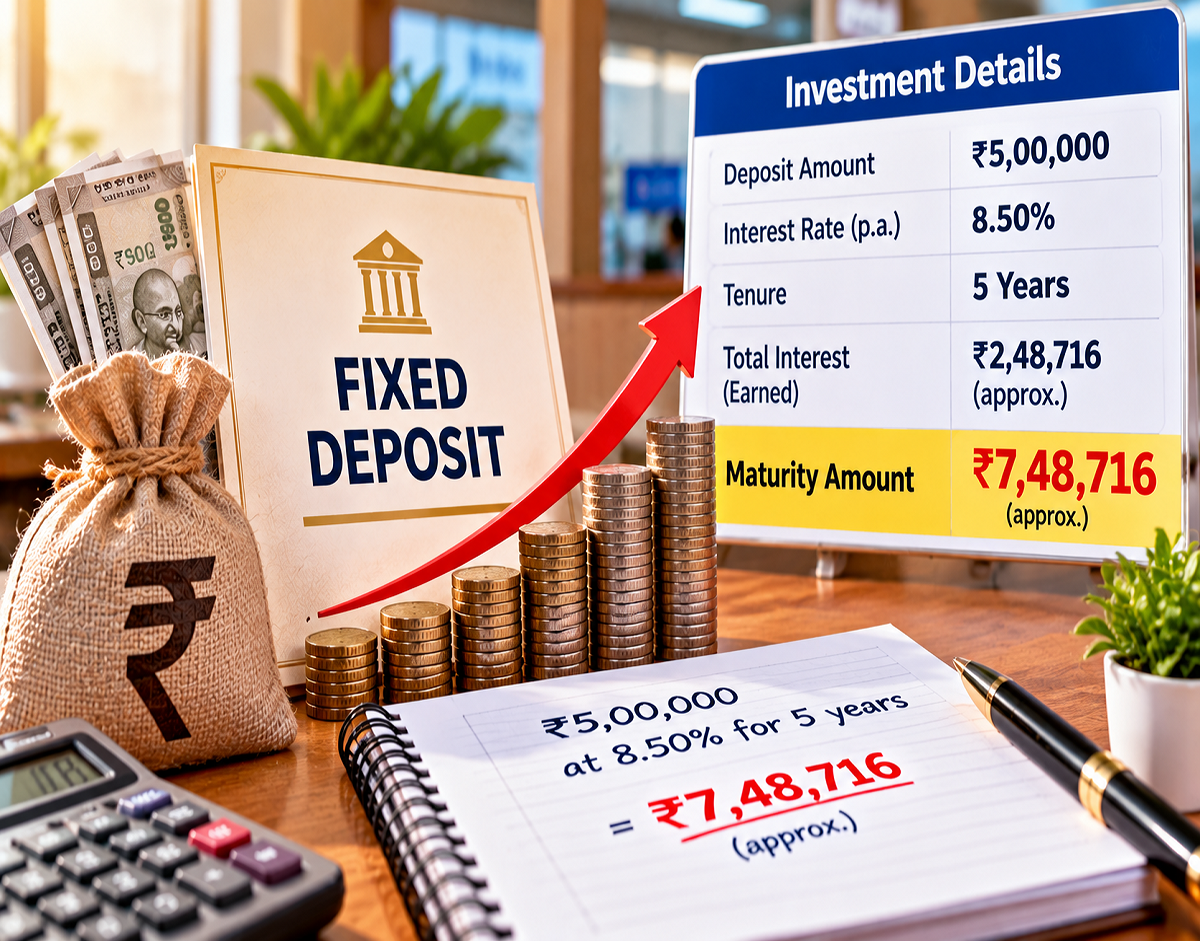
Fixed Deposit Return Calculation 2026: Fixed deposits remain a popular option for savers who prefer predictable returns instead of exposing their entire savings to market fluctuations. With some banks offering interest rates of up to 8.50% on selected FD tenures and customer categories, investors may be wondering how much a ₹5 lakh deposit could grow over five years.
If ₹5 lakh actually earns 8.50% per annum for the entire five-year period, the maturity corpus can cross ₹7.6 lakh under a quarterly-compounding illustration.
However, there is an important condition: a bank advertising an interest rate of "up to 8.50%" does not necessarily mean that the same rate is available on every five-year FD. Higher rates are often linked to specific tenures, senior-citizen categories or special deposit schemes.
Here is an easy calculation to understand the potential return.
₹5 Lakh FD at 8.50%: What Could You Get After 5 Years?
Suppose an investor places ₹5 lakh in a fixed deposit for five years and receives an annual interest rate of 8.50% throughout the tenure.
With quarterly compounding, the approximate calculation would look like this:
| FD Details | Approximate Amount |
|---|---|
| Initial Investment | ₹5,00,000 |
| Interest Rate | 8.50% per annum |
| Tenure | 5 years |
| Assumed Compounding | Quarterly |
| Approximate Interest Earned | ₹2.61 lakh |
| Approximate Maturity Value | ₹7.61 lakh |
Therefore, under these assumptions, a ₹5 lakh investment could generate approximately ₹2.61 lakh in interest, taking the maturity value to around ₹7.61 lakh after five years.
The actual amount may differ depending on the bank's compounding method, payout option and applicable FD terms.
How Does ₹5 Lakh Become More Than ₹7.6 Lakh?
The increase comes from compounding.
In a cumulative FD, the interest earned is added to the deposit at specified intervals. Future interest is then calculated on the increased amount rather than only on the original principal.
As this process continues, the investor effectively earns returns on previously accumulated interest as well.
Over a five-year period, compounding can create a meaningful difference compared with simply multiplying ₹5 lakh by 8.50% for five years.
Don't Assume Every 5-Year FD Offers 8.50%
This is one of the most important points for investors.
A bank may advertise its highest FD interest rate as 8.50%, but that rate could be available only on a particular deposit period—for example, a special tenure of a certain number of days rather than a standard five-year deposit.
Some of the highest rates may also be available only to senior citizens.
Therefore, before calculating your expected five-year return, check the rate specifically offered for a five-year tenure and your customer category.
Using a bank's maximum advertised rate for a tenure where that rate does not actually apply can produce an unrealistic maturity estimate.
Regular Customers and Senior Citizens May Get Different Rates
Many banks offer senior citizens an additional interest rate over the rate available to regular depositors.
As a result, two people depositing the same ₹5 lakh for the same period could receive different maturity amounts if they qualify for different interest rates.
The precise additional rate varies across banks and deposit products.
Investors should therefore check the bank's current FD rate table rather than assuming that an advertised senior-citizen rate is available to all customers.
Cumulative vs Interest-Payout FD
How you choose to receive the interest can also affect the experience of the investment.
A cumulative FD generally allows interest to accumulate and compound until maturity. This can be useful for someone whose objective is to build a larger corpus.
A non-cumulative deposit can provide interest at specified intervals, such as monthly or quarterly, depending on the bank's product.
The latter may appeal to someone seeking regular income, but its payout structure is different from a cumulative FD where the interest remains invested.
Therefore, the ₹7.61 lakh illustration should be understood in the context of a cumulative deposit with the assumed compounding method.
What If You Break the FD Before 5 Years?
A five-year FD may offer predictable returns if held until maturity, but withdrawing the money early can change the calculation.
Banks generally have their own premature-withdrawal rules. Depending on those rules, the applicable interest rate may be recalculated for the actual period the money remained deposited, and a penalty may also apply.
This means an investor expecting approximately ₹7.61 lakh at the end of five years may receive a different return if the FD is closed early.
Before investing, check the bank's premature-closure terms, particularly if there is a possibility that you may need the money for an emergency.
Is FD Interest Tax-Free?
No. Interest earned on a regular bank fixed deposit is generally taxable according to applicable income-tax rules.
Banks may also deduct TDS when interest crosses the applicable threshold, subject to current tax provisions and the depositor's circumstances.
It is important to distinguish between TDS and final tax liability. TDS is tax deducted at source, while the actual tax payable depends on the investor's total taxable income and applicable tax rules.
Eligible taxpayers may have separate provisions available to them, but these should be evaluated according to their individual tax situation.
What About 5-Year Tax-Saving FDs?
A five-year tax-saving FD is different from an ordinary five-year fixed deposit.
Eligible tax-saving bank deposits can qualify for a deduction under Section 80C, subject to applicable income-tax rules and the tax regime chosen by the taxpayer.
Such deposits generally come with a mandatory lock-in period, which means premature withdrawal is typically not available in the same way as with an ordinary FD.
Investors should therefore not select a tax-saving FD solely because it has a five-year tenure. The lock-in, interest rate and tax treatment should all be considered.
Check Deposit Insurance Coverage Too
Bank deposits are covered under the Deposit Insurance and Credit Guarantee Corporation framework, subject to applicable rules.
DICGC insurance currently covers up to ₹5 lakh per depositor per bank, including principal and accrued interest, in the same right and capacity.
This becomes particularly relevant when an investor is placing a large amount with a bank offering unusually high FD rates.
A higher interest rate can be attractive, but depositors should also consider the institution, liquidity conditions and deposit-insurance limits before deciding where to keep their savings.
Is ₹5 Lakh at 8.50% Enough to Reach ₹7.6 Lakh?
If a genuine five-year cumulative FD offers 8.50% per annum and interest is compounded quarterly, then ₹5 lakh can grow to approximately ₹7.61 lakh over five years.
That represents an approximate gain of ₹2.61 lakh before considering the investor's tax liability.
But the headline rate needs to be checked carefully. An advertised maximum rate of 8.50% may be available only on a special tenure or to a particular category of depositor.
Before opening an FD, compare the exact five-year rate, compounding method, premature-withdrawal penalty, tax implications and deposit-insurance coverage.
Disclaimer: This article is for informational purposes only and does not constitute investment or tax advice. The ₹7.61 lakh maturity value is an illustrative calculation assuming ₹5 lakh earns 8.50% annually for five years with quarterly compounding. Actual FD rates, maturity amounts, tax treatment and terms vary by bank and customer category. Verify the latest rate and conditions directly with the bank before investing.