Business
Bank Strike September 28-30: Check Which Banking Services May Stop and What Should Keep Working
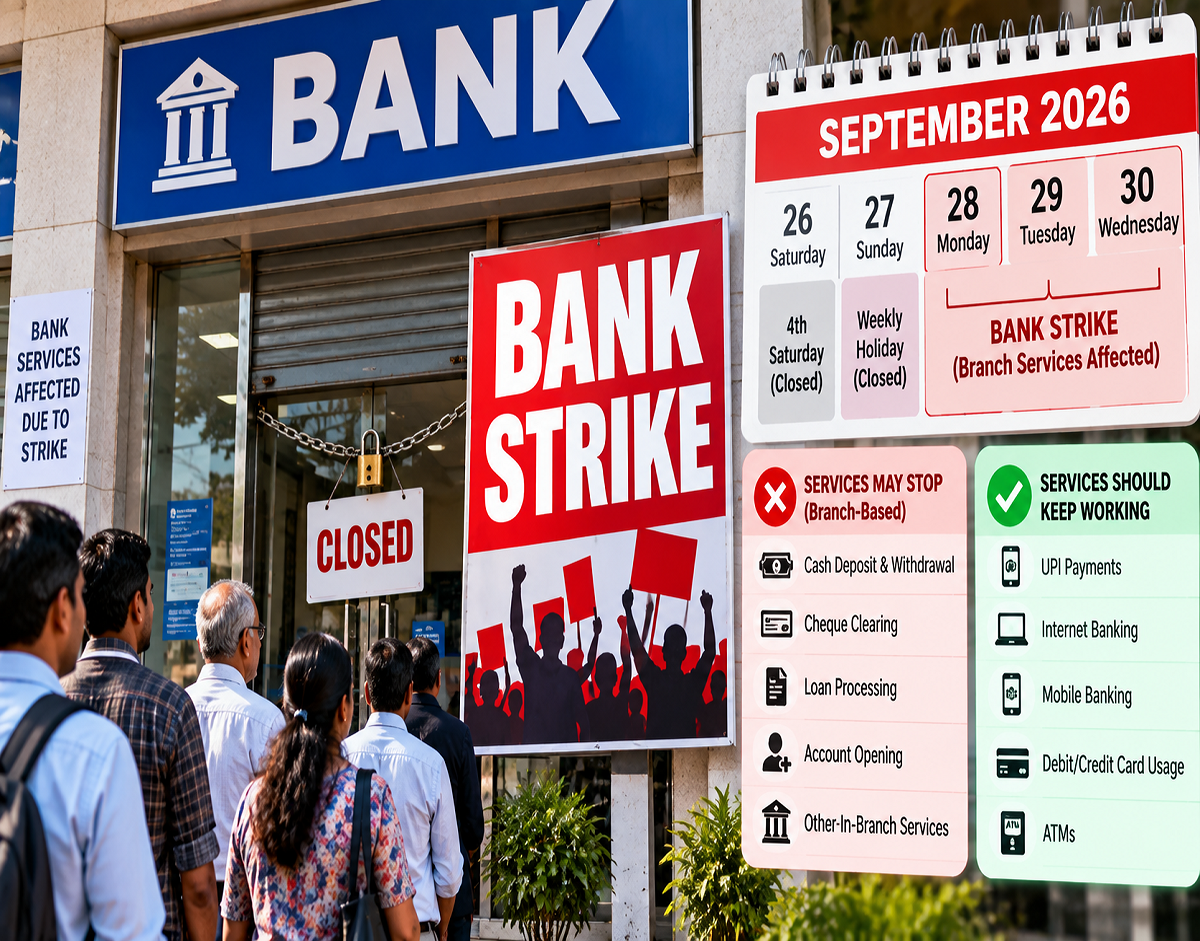
Bank Strike September 2026: Bank customers may face disruption in branch-based services for three days as a strike is scheduled from September 28 to September 30, 2026. Services that require employees to be physically present at a branch—including counter transactions, document verification and some cheque-related work—could be affected.
Digital banking services such as UPI, mobile banking and internet banking are expected to remain available, although customers should keep in mind that technical or operational disruptions can never be completely ruled out.
The strike comes immediately before the half-yearly financial closing at the end of September, making the timing particularly important for customers with branch-dependent work.
Public-sector banks and regional rural banks could see a greater impact depending on employee participation, while the effect on private-sector banks may differ.
Three-Day Bank Strike From September 28
The strike is scheduled for:
| Date | Day | Status |
|---|---|---|
| September 28, 2026 | Monday | Bank strike |
| September 29, 2026 | Tuesday | Bank strike |
| September 30, 2026 | Wednesday | Bank strike |
Customers should understand that a strike is different from an RBI-declared nationwide bank holiday.
The actual impact can vary according to the bank, location, union participation and staffing arrangements. Therefore, it should not automatically be assumed that every branch of every bank will be completely closed for all three days.
However, branch-dependent services can face substantial disruption.
Cash Deposits and Withdrawals at Counters May Be Hit
Customers who usually visit a bank counter to deposit or withdraw cash may face difficulty during the strike.
If branch staffing is affected, regular counter operations can be delayed or unavailable.
Customers who need cash may be able to use ATMs, while those with access to cash-deposit machines may be able to deposit money without visiting a staffed counter.
However, availability depends on the facilities provided by the particular bank and location.
Passbook Updates Could Be Delayed
Customers who rely on physical passbooks may also face disruption.
Manual passbook printing or updating services available inside branches could be unavailable if the branch is closed or operating with reduced staff.
Customers with mobile or internet banking can generally check account balances and transaction histories digitally instead of waiting for a physical passbook update.
Cheque Processing May Face Delays
Cheque-related work is another area where delays may occur.
Some cheque-clearing systems are highly automated, but branch-level acceptance, verification and other manual processes can still depend on bank staff.
Customers depositing important cheques around the strike period should therefore be prepared for possible delays.
The exact impact will depend on the bank and the type of transaction involved.
Demand Draft and Other Branch Services Could Be Affected
Customers requiring a new demand draft from a bank branch may also face difficulties during the strike.
Other services involving manual forms, signatures, approvals or staff verification can be delayed.
If a transaction has a strict deadline, customers should check whether the same service is available digitally or through another authorised channel.
KYC and Account Update Requests May Have to Wait
Many KYC services can now be completed digitally in certain circumstances, but some customers may still need to visit their bank branch.
If physical document verification is required, the process could be delayed during the strike.
The same applies to requests involving account corrections, signature updates, document submission and other branch-level verification.
Customers should not assume that a pending KYC request will automatically be processed during the strike simply because online banking remains functional.
Loan Documentation Could Also Be Delayed
People in the middle of a home loan, car loan, personal loan or business-loan process should pay particular attention.
Submitting physical documents, completing verification, signing agreements or receiving branch-level approvals may take longer if the relevant staff are unavailable.
Already automated EMI payments should not be confused with manual loan-processing work.
Existing EMIs and scheduled payments can continue through electronic systems, subject to normal processing and sufficient funds, even when branch operations are disrupted.
Bank Locker Access May Not Be Available
Physical bank lockers are located inside branches and generally require branch access.
If a branch is closed because of the strike, customers may not be able to operate their lockers.
Anyone who needs documents, jewellery or other important items stored in a bank locker should check with the branch about availability rather than assuming locker access will remain open during strike hours.
Will UPI Work During the Bank Strike?
UPI services are expected to continue operating because the strike is primarily expected to affect branch-based operations.
Customers should generally still be able to make person-to-person and merchant payments through UPI.
However, a bank strike does not guarantee that every digital transaction will always work without interruption. Independent technical problems, server issues or maintenance can still affect digital services.
Customers should therefore keep an alternative payment method available for important transactions.
Mobile and Internet Banking Should Remain Available
Mobile and internet banking are also expected to continue during the three-day strike.
Depending on the services supported by their bank, customers may be able to:
- Transfer money electronically
- Check account balances and statements
- Pay utility bills
- Make UPI payments
- Manage beneficiaries
- Pay credit-card bills
- Perform other supported online transactions
Transactions requiring manual approval or branch intervention, however, could still be delayed.
Will ATMs Remain Operational?
ATMs are expected to remain functional during the strike.
Customers should be able to withdraw cash as long as the ATM is operational and has sufficient cash.
The bigger concern could be cash replenishment.
If the strike affects cash-loading operations in a particular area, heavily used ATMs could run short of currency.
This does not mean that all ATMs will run out of cash. Availability will depend on the location, usage and replenishment arrangements.
Cash Deposit Machines Could Be Useful
Customers who need to deposit cash may be able to use a cash deposit machine or cash recycler if their bank provides the facility.
These machines can reduce dependence on branch counters.
Before depositing a large amount, however, customers should check the applicable machine limits and bank rules.
Keep the transaction receipt or digital confirmation until the deposit appears correctly in the account.
Will Salary and Pension Payments Stop?
A branch strike does not automatically mean that salaries, pensions, interest payments or other scheduled electronic credits will stop.
Payments processed through automated banking systems can continue.
However, transactions that require manual intervention may face delays.
Customers expecting an important credit should therefore distinguish between an automated electronic payment and a transaction awaiting branch-level processing.
What About NEFT, RTGS and IMPS?
Electronic payment systems are generally designed to operate independently of routine branch-counter services.
Customers using digital channels may therefore continue to access supported electronic fund-transfer facilities.
However, if a particular transaction requires bank-level manual review, compliance verification or other intervention, its completion could take longer.
For urgent payments, customers should check the status after initiating the transaction rather than repeatedly sending money if confirmation is delayed.
Why Were Some Government Banks Open on Sunday?
Ahead of the scheduled three-day strike, public-sector banks and regional rural banks were kept open on Sunday, September 27, according to the supplied information.
The arrangement was intended to help reduce disruption and allow customers to complete important branch-related work before the strike period.
Bank offices and certain operational facilities, including branch-linked ATM operations and currency chests, were also covered under the special arrangements described in the source.
Five Consecutive Days of Normal Branch Access Could Be Disrupted
The timing of the strike is particularly important because it follows the regular weekend closure.
September 26 was the fourth Saturday, when bank branches are normally closed.
September 27 was Sunday, although special opening arrangements were made for specified public-sector and regional rural banking operations.
The strike is then scheduled for September 28, 29 and 30.
Customers should therefore expect unusual branch schedules around the end of September and check directly with their bank before travelling to a branch.
Strike Comes at the End of the Half-Year
September 30 is also significant because it marks the end of the first half of the financial year for banks.
A strike around this period can create additional operational pressure because several internal financial and administrative processes take place around the half-year closing.
For ordinary customers, the practical concern remains whether a transaction requires branch staff.
If it can be completed entirely through an ATM, UPI, mobile app or internet banking, disruption may be limited. If physical documents, cash counters, verification or branch access are required, delays are more likely.
What May Be Affected and What Should Continue?
| Banking Service | Likely Situation During Strike |
|---|---|
| Branch cash counter | May be affected |
| Physical passbook update | May be affected |
| Cheque-related manual work | May face delays |
| Demand draft at branch | May be affected |
| Physical KYC/document verification | May be delayed |
| Loan document processing | May be delayed |
| Bank locker access | Depends on branch opening |
| UPI | Expected to continue |
| Mobile banking | Expected to continue |
| Internet banking | Expected to continue |
| ATMs | Expected to operate, subject to cash availability |
| Cash deposit machines | Expected where operational |
| Automated salary/pension credits | Generally expected to continue |
Don't Fall for Bank Strike Scams
Periods of banking disruption can also be used by fraudsters to create urgency.
Customers may receive messages claiming that their UPI, ATM card or bank account must be "re-activated" because of the strike.
Do not share an OTP, debit-card PIN, CVV, internet-banking password or UPI PIN with anyone.
Banks do not require customers to disclose such credentials simply because employees are on strike.
Avoid installing unknown apps or clicking unfamiliar links sent through SMS or messaging platforms.
Check With Your Bank Before Visiting a Branch
The September 28-30 strike is expected to primarily affect services that depend on employees being physically available at bank branches.
Cash-counter transactions, passbook services, cheque-related manual processing, demand drafts, physical KYC, loan documentation and locker access could face disruption.
At the same time, UPI, mobile banking, internet banking, ATMs and other automated digital services are expected to remain available, subject to normal technical and operational conditions.
Since strike participation and service availability can differ among banks and locations, customers with important branch-related work should check directly with their bank before travelling.
Disclaimer: This article is for informational purposes only. The actual impact of the September 28-30, 2026 bank strike can vary by bank, branch, location, employee participation and operational arrangements. Customers should confirm branch availability and critical transaction status directly through their bank's official channels.