Technology
Voter ID Instead of Aadhaar for Government Schemes? New Proposal Could Change Beneficiary Verification Rules
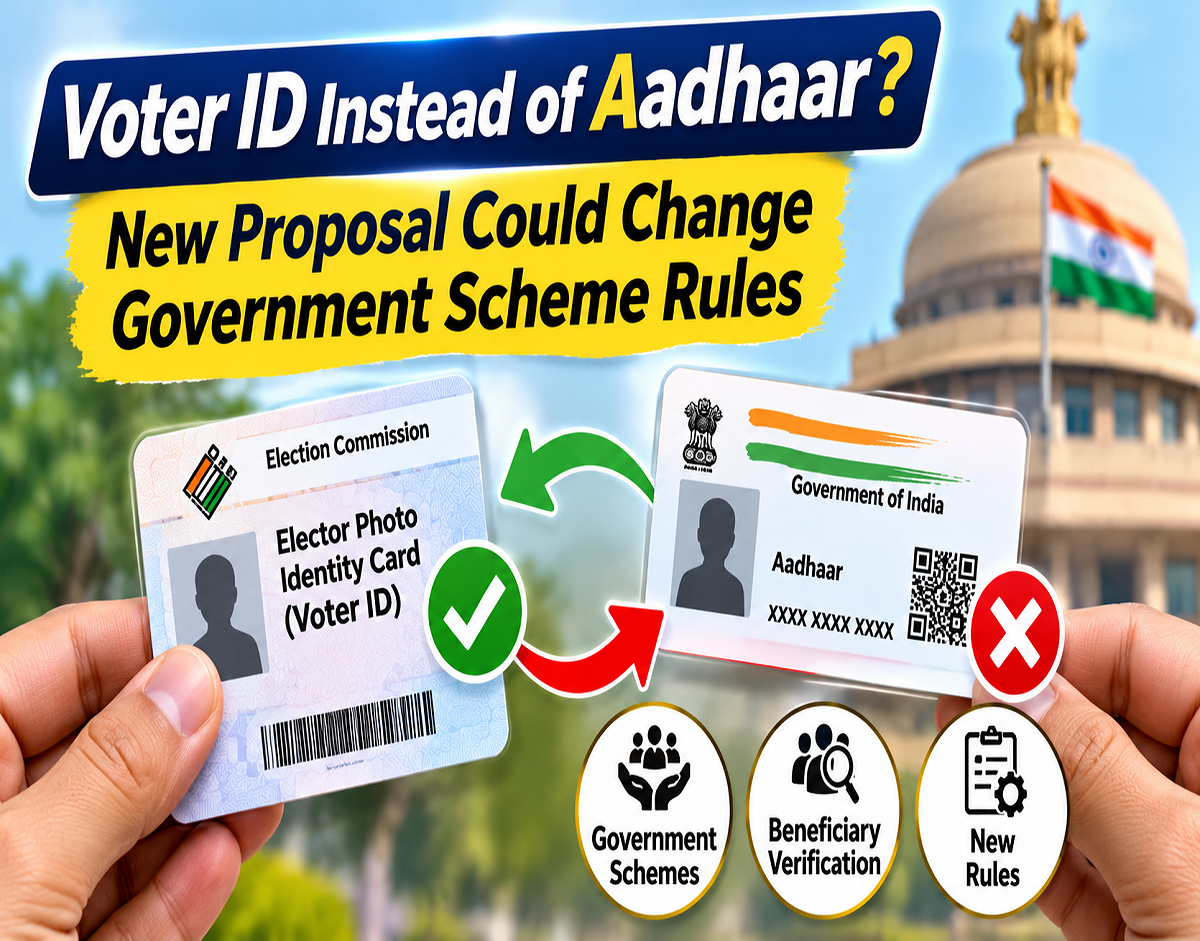
Aadhaar Voter ID Update 2026: Millions of Indians receiving financial assistance through government welfare schemes may eventually get another option for identity verification. A proposal to use Voter ID cards along with biometric information for identifying beneficiaries has attracted attention, raising questions about whether Aadhaar will remain mandatory for accessing certain government benefits.
According to a Prabhat Khabar report published on November 5, 2026, Union Minister Rajiv Ranjan Singh, popularly known as Lalan Singh, has discussed the possibility of using Voter ID details and biometric verification to identify beneficiaries of government schemes.
If such a system is formally introduced, it could provide an additional method for verifying the identity of eligible recipients and ensuring that government assistance reaches the intended individuals.
However, the proposal has not been announced as an implemented nationwide policy, and there is currently no confirmed instruction allowing beneficiaries to replace Aadhaar with Voter ID across all welfare schemes.
What Is the New Voter ID Verification Proposal?
The proposal discussed in the report involves using a beneficiary's Voter ID number together with biometric information, such as fingerprints, for identity verification.
At present, Aadhaar-based authentication is used in various government welfare programmes, depending on their specific rules.
Under the proposed approach, Voter ID could potentially serve as another identification option.
The objective would be to establish the identity of beneficiaries and reduce the possibility of benefits being transferred to an incorrect or ineligible recipient.
However, important operational questions remain unanswered, including how biometric information would be collected, verified and securely processed.
The government has not yet clarified which schemes might adopt the proposed mechanism or when any changes could take effect.
Will Voter ID Replace Aadhaar for Government Benefits?
The short answer is not at present.
The report discusses a possible alternative verification mechanism, not a confirmed decision to discontinue Aadhaar-based identification.
Beneficiaries should therefore continue following the existing requirements of their respective government schemes.
Aadhaar, Voter ID and other identity documents have different purposes and legal frameworks.
Any decision to introduce Voter ID as an alternative would require clear eligibility conditions, verification procedures and official implementation guidelines.
Until those instructions are issued, possessing a Voter ID card alone should not be assumed to satisfy the requirements of every government welfare programme.
Which Government Schemes Could Be Affected?
Several major government programmes provide financial assistance or other benefits to eligible citizens.
The report identifies schemes such as PM-KISAN, Pradhan Mantri Awas Yojana and social security pensions as examples of programmes where beneficiary identification is important.
| Government Scheme | Main Benefit | Status of Proposed Voter ID Option |
|---|---|---|
| PM-KISAN Samman Nidhi | Financial assistance to eligible farmer families | No confirmed replacement of existing Aadhaar requirements |
| Pradhan Mantri Awas Yojana | Housing assistance for eligible households | No confirmed change announced |
| Old-Age Pension Schemes | Financial support to eligible senior citizens | Subject to existing scheme rules |
| Widow Pension Schemes | Financial assistance to eligible widows | No universal Voter ID substitution announced |
| Disability Pension Schemes | Financial support to eligible persons with disabilities | Existing identification requirements continue |
These schemes are mentioned as potential areas where alternative identity verification could be relevant. The report does not establish that the proposed system has been approved for any of them.
What Could Change for PM-KISAN Beneficiaries?
PM-KISAN is an important financial assistance programme for eligible farmer families.
Under the scheme, eligible beneficiaries receive ₹6,000 annually in three instalments of ₹2,000 each, subject to the applicable eligibility conditions.
Aadhaar-based identification and e-KYC are important components of the existing beneficiary verification process.
If an officially approved alternative identity system is introduced in the future, it could potentially affect how some beneficiaries complete verification.
However, farmers should not assume that they can currently complete PM-KISAN e-KYC using only a Voter ID card.
They should continue following the instructions available through the official PM-KISAN portal.
Could Pensioners Also Benefit From the Proposal?
Old-age, widow and disability pension schemes provide financial assistance to eligible beneficiaries.
These programmes may be administered by central or state authorities, and their identification requirements can differ.
An additional identity verification option could be useful for some beneficiaries who face difficulties with existing authentication methods.
However, the report does not confirm that Voter ID-based biometric verification will be introduced for pension payments.
Pensioners should continue complying with the requirements prescribed by their pension-disbursing authority.
Aadhaar vs Voter ID: What Is the Difference?
Although both documents can help establish identity, they are issued for different purposes.
| Feature | Aadhaar Card | Voter ID Card |
|---|---|---|
| Issuing authority | UIDAI | Election Commission of India |
| Primary purpose | Identity identification and authentication | Electoral identification |
| Identification number | 12-digit Aadhaar number | EPIC number |
| Biometric framework | Aadhaar authentication framework | No equivalent universal authentication facility established by the supplied report |
| Government scheme usage | Used according to scheme-specific rules | Accepted where permitted; broader substitution remains a proposal |
A Voter ID card is primarily associated with electoral registration, while Aadhaar is widely used for identity-related services.
The existence of a Voter ID number does not automatically mean that the card can perform the same authentication functions as Aadhaar.
Will Government Scheme Payments Continue Through Bank Accounts?
The proposed change concerns how beneficiaries might be identified.
It does not, by itself, establish any change to the way government benefits are paid.
Many welfare programmes use Direct Benefit Transfer (DBT) arrangements to send financial assistance to eligible beneficiaries.
Under applicable scheme rules, payments may involve bank account information, Aadhaar-linked arrangements or other prescribed mechanisms.
If an alternative identification method is introduced, the government would need to clarify how it interacts with existing payment and verification systems.
Beneficiaries should not change their bank details or payment arrangements based solely on reports about the proposal.
What Should Beneficiaries Do Right Now?
There is no need for beneficiaries to rush to replace Aadhaar with Voter ID.
People receiving government assistance should continue following the existing requirements of their respective schemes.
They should ensure that their personal information and bank details are accurate, complete any required e-KYC procedures and monitor official announcements.
It is also important to avoid sharing Aadhaar numbers, Voter ID details, fingerprints or OTPs with unknown individuals claiming to offer registration under a new government scheme.
No new Voter ID-based welfare registration process has been established by the supplied report.
When Will the New System Be Implemented?
The government has not announced a confirmed implementation date in the report.
There is also no published list of schemes that will adopt Voter ID-based biometric verification.
Several details would need clarification before such a system could operate, including identity verification standards, eligibility rules, data protection measures and the responsibilities of implementing agencies.
Beneficiaries should wait for official notifications rather than relying on unverified social media messages.
Conclusion
The possibility of using Voter ID cards alongside biometric information for government scheme verification has opened a discussion about alternative identification methods for welfare beneficiaries.
According to the November 5 report, Union Minister Rajiv Ranjan Singh referred to the possibility of such an arrangement.
If formally introduced, the mechanism could provide an additional verification option for eligible citizens.
However, Aadhaar has not been officially replaced by Voter ID for PM-KISAN, housing assistance, pension schemes or other government benefits on the basis of this proposal.
Beneficiaries should continue using the identification and verification methods currently prescribed for their schemes until the government issues formal instructions.
Disclaimer: The proposed Voter ID-based verification arrangement has not been independently confirmed through an official implementation notification. This article does not suggest that existing Aadhaar or e-KYC requirements have been withdrawn.