Technology
Unpaid E-Challan Rules: Vehicle Seizure, PUC and RC Restrictions—What Supreme Court Order Says
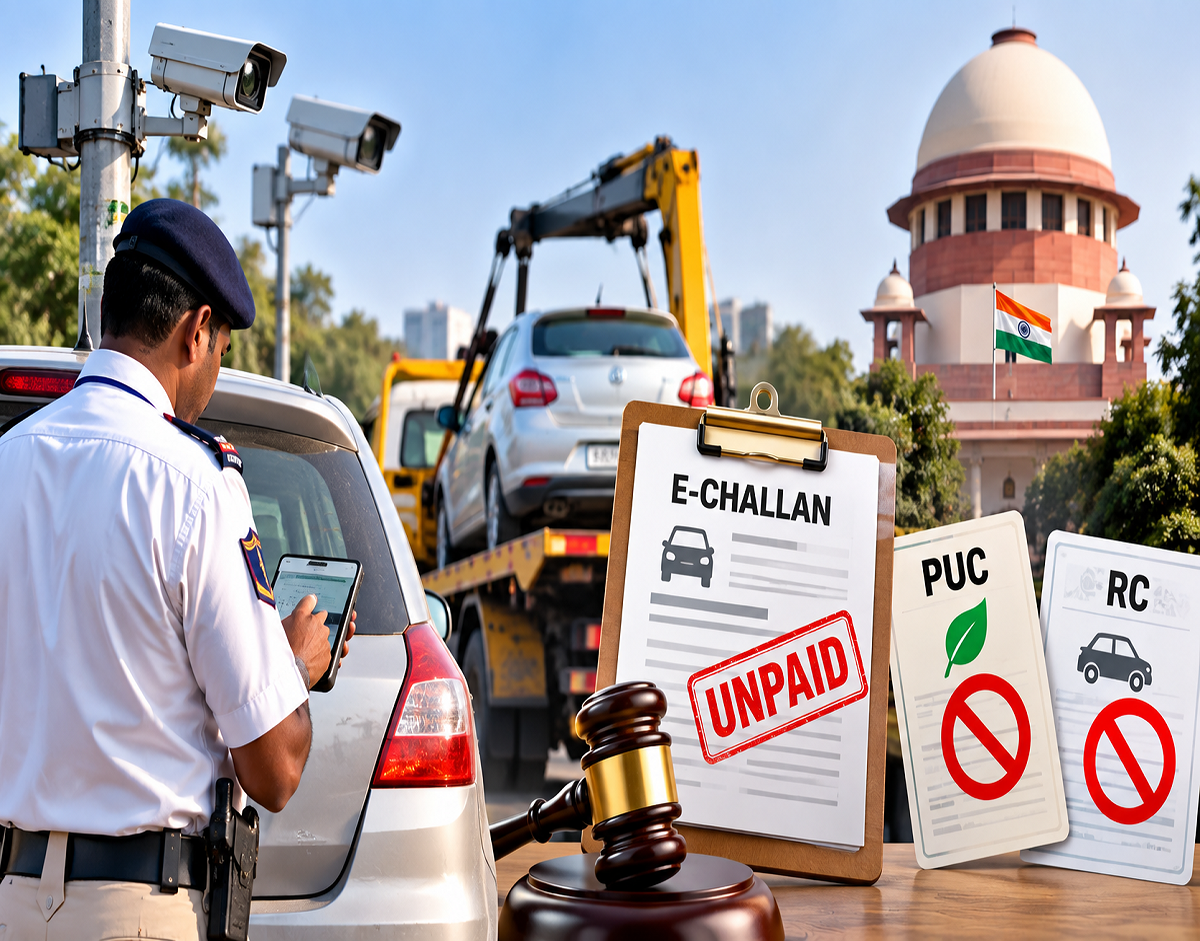
Vehicle owners who leave traffic e-challans unpaid could face consequences beyond the original fine. A recent Supreme Court order has outlined measures aimed at improving the recovery of pending traffic penalties, including restrictions on certain vehicle-related services and possible action during enforcement checks.
The directions were issued in an order dated September 28, 2026, which was uploaded on October 1, in the long-running S. Rajaseekaran v. Union of India road-safety matter.
One question attracting particular attention is whether unpaid traffic fines will now be added to consumers' electricity bills. Although such an option was reportedly discussed during proceedings, the written Supreme Court order cited in the report does not direct authorities to recover pending e-challans through electricity bills.
Instead, the order focuses on measures connected directly with vehicles, their documentation and enforcement.
More Than ₹23,000 Crore in E-Challans Remains Unpaid
The scale of outstanding traffic penalties was a major issue before the court.
According to figures placed before the Supreme Court, e-challans involving approximately ₹49,194.05 crore were due for recovery. Of this amount, around ₹26,175.05 crore had been collected.
That leaves approximately ₹23,019 crore outstanding.
The court raised concerns over the effectiveness of issuing large numbers of traffic challans if penalties are not ultimately recovered or enforced.
The latest directions are therefore aimed at strengthening compliance rather than allowing unpaid challans to remain merely as digital records.
These Vehicle Services Could Be Restricted
Vehicle owners with outstanding challans could face restrictions when attempting to use certain vehicle-related services.
According to the directions described in the report, authorities may prevent specified services from being processed until the pending challan amount is cleared.
These include renewal of the vehicle's registration certificate, issuance of a duplicate RC, change of the registered owner's address and issuance of a fitness certificate.
In practical terms, an unpaid traffic penalty could therefore affect routine vehicle documentation.
Vehicles With Pending Challans May Be Blacklisted
Another significant measure concerns the Parivahan portal.
Vehicles carrying unpaid challans may be blacklisted on the system. Such a status could create difficulties when an owner wants to sell the vehicle or transfer its ownership.
The measure is intended to connect unpaid traffic penalties with vehicle-related administrative services, making it harder for long-pending challans to remain unresolved.
Vehicle owners should therefore consider clearing legitimate pending challans before initiating an RC transfer or other major vehicle-related transaction.
Pending E-Challan Could Affect PUC Issuance
The order also addresses the Pollution Under Control (PUC) certificate, according to the report.
A PUC certificate may not be issued for a vehicle while applicable challans remain unpaid.
This could have wider consequences because a valid PUC certificate is a key compliance document for vehicles covered by pollution-control requirements.
Vehicle owners should check their challan status before approaching an authorised centre for vehicle-related compliance services.
Vehicle Could Face Action During Random Checking
The directions also envisage stronger on-road enforcement.
Authorities have been directed to conduct random vehicle checks, and vehicles found with outstanding e-challans could face enforcement action, including possible impounding or seizure as applicable under the directions and legal framework.
This means that an old e-challan should not be viewed simply as an online notice that can be ignored indefinitely.
Drivers should periodically check whether any challan has been issued against their vehicle and use the available legal process if they believe a challan has been issued incorrectly.
Five or More Violations Could Have Further Consequences
The court also referred to Rule 21(25) of the Central Motor Vehicles Rules, 1989, according to the report.
For the one-year period beginning January 1, 2026, five or more specified violations may be treated as conduct constituting nuisance or danger to the public under the applicable rule.
Such cases can have implications for the driver's licence. Depending on the applicable legal process and circumstances, authorities may consider measures affecting licence renewal or suspension.
This makes repeated violations potentially more serious than a series of individual monetary penalties.
AI-Based Traffic Enforcement to Be Expanded
The Supreme Court has also called for stronger electronic enforcement by states and Union Territories.
According to the report, authorities have been asked to implement the Ministry of Road Transport and Highways' October 28, 2025 standard operating procedure (SOP) on electronic traffic enforcement.
Electronic enforcement systems are expected to use AI-enabled capabilities and identify multiple categories of traffic violations.
The report says these systems should be capable of detecting 12 types of violations, including offences such as driving in an incorrect lane and stopping or parking vehicles in prohibited locations.
Such technology could allow traffic authorities to identify violations without depending entirely on manual roadside enforcement.
Online Dashboard to Track Electronic Enforcement
The Ministry of Road Transport and Highways has also been directed to develop an online dashboard covering electronic traffic enforcement across states and Union Territories.
The dashboard is expected to provide information about enforcement cameras and other equipment, including how many devices have been installed and how many are operational.
It is also expected to show the types of traffic violations being detected.
The information should be updated at least monthly, according to the directions described in the report. Annual statistics may also be incorporated into the Road Accidents in India report.
Will Unpaid E-Challans Be Collected Through Electricity Bills?
This is one of the most important points for vehicle owners.
The possibility of recovering unpaid e-challans through electricity bills was reportedly raised during the proceedings. However, the written Supreme Court order cited in the report does not contain a direction requiring traffic fines to be added to electricity bills.
Therefore, it would be misleading to say that unpaid e-challans are now being recovered through electricity bills as a result of this order.
The written directions instead focus on vehicle-related enforcement measures such as restricting certain online services, linking compliance with fitness and PUC-related processes, blacklisting vehicles and strengthening roadside enforcement.
What Vehicle Owners Should Do
Vehicle owners should check periodically whether any valid e-challan is pending against their vehicle and clear legitimate dues through authorised government channels.
If a challan appears incorrect, owners should use the prescribed grievance or legal mechanism rather than ignoring it.
The broader message from the Supreme Court's directions is that outstanding e-challans may increasingly affect other vehicle-related services. At the same time, there is currently no written direction in the cited order requiring unpaid traffic challans to be recovered through household electricity bills.