Food
Traditional Indian Foods With Centuries of History: Why Khichdi, Dosa, Millets and More Still Survive
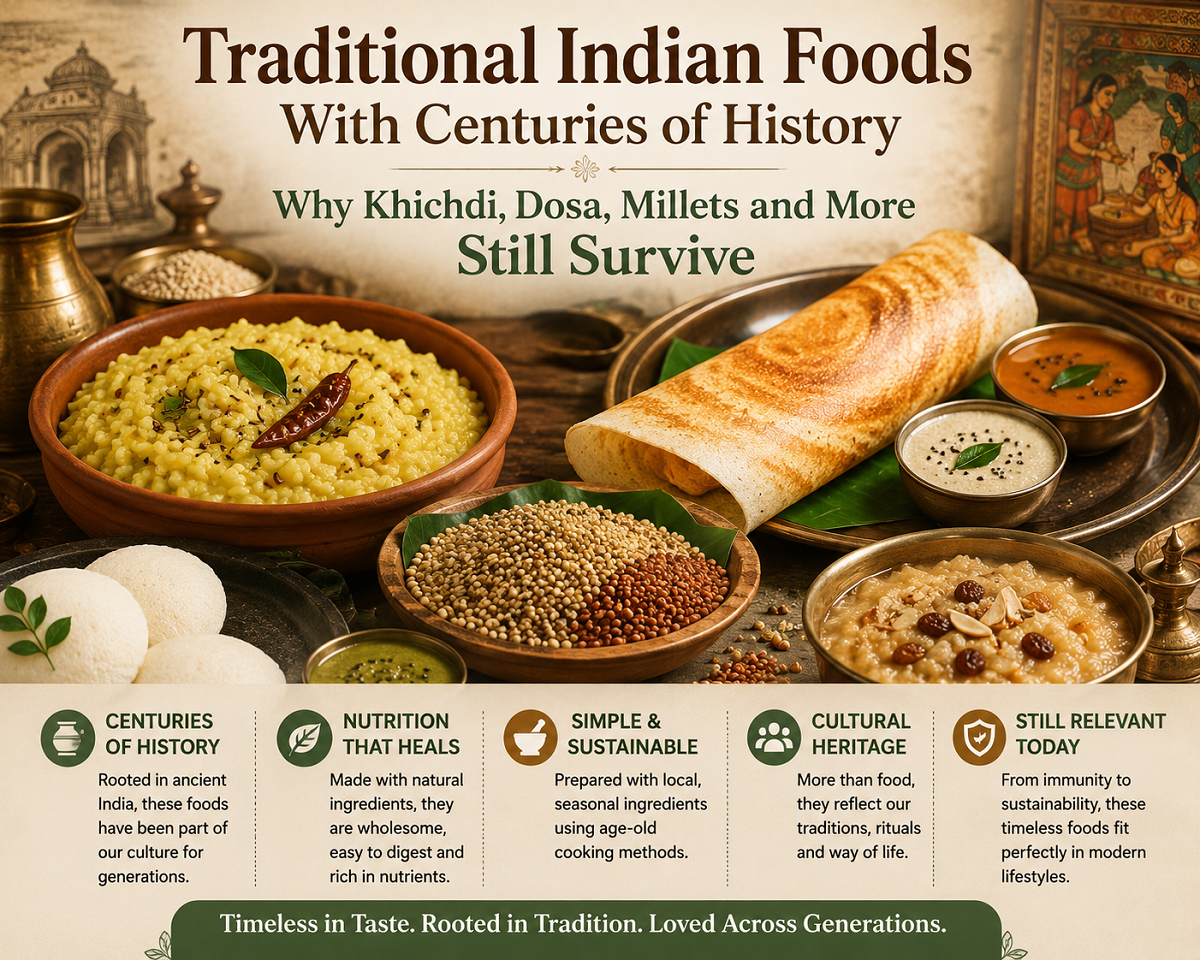
India's culinary heritage is much more than a collection of recipes. Every region has dishes, ingredients and cooking techniques that have travelled through generations, often without ever being formally documented. Some foods prepared in Indian kitchens today have roots stretching back hundreds of years, yet they continue to feel completely at home on a modern dining table.
What makes these traditional Indian recipes remarkable is their ability to evolve. Families changed spices, substituted locally available grains and adapted cooking methods, but the basic ideas survived. From comforting khichdi and fermented dosa batter to millet rotis and traditional sweets, India's old recipes demonstrate how practical food traditions can remain relevant for centuries.
Here are some of the best examples.
1. Khichdi: A Simple Combination That Refuses to Disappear
Few Indian foods demonstrate culinary simplicity better than khichdi.
At its most basic, khichdi combines grain and pulses, commonly rice and dal, into a single comforting preparation. However, there is no single recipe that represents every household or region.
One family may prepare a thin, lightly seasoned version, while another adds vegetables, ghee and an elaborate tempering of spices. Regional variations may also replace rice with other grains.
This flexibility is one reason khichdi has survived for generations.
Instead of depending on expensive or difficult-to-find ingredients, the dish can be adjusted according to what is available in the kitchen. Its soft texture and straightforward preparation have also made it a familiar choice for children, older people and anyone wanting a simple meal.
Khichdi's longevity shows that a recipe doesn't have to be complicated to become an enduring part of food culture.
2. Dosa: Fermentation Turned Into an Everyday Food
Today, dosa is available everywhere from roadside eateries to luxury hotels and restaurants outside India. But its story stretches much further back than its contemporary popularity.
Historical references to dosa-like preparations go back centuries, particularly in discussions of South Indian culinary traditions.
Modern dosa is generally associated with a fermented batter made from rice and lentils, although recipes and proportions vary considerably.
Fermentation is the key.
Instead of relying on modern processing equipment, traditional cooks discovered that soaking, grinding and allowing ingredients to ferment could transform their flavour and texture.
The result is a batter capable of producing everything from thin and crisp dosas to softer variations.
The continuing popularity of dosa demonstrates how an old cooking technique can remain perfectly suited to modern life.
3. Idli: Traditional Fermentation With a Different Result
Idli provides another example of how fermentation became deeply embedded in Indian food traditions.
Rice-and-lentil batter is fermented and then steamed to produce the familiar soft cakes. Recipes differ between regions and households, and the historical evolution of modern idli has been the subject of considerable culinary discussion.
What matters is the method's remarkable staying power.
Fermentation develops the batter, while steaming produces a completely different texture from frying or roasting.
Today, idli can be served with sambar, chutneys and numerous regional accompaniments. Instant mixes and ready-made batters may have changed how quickly people prepare the dish, but the basic concept remains deeply connected to older food traditions.
4. Bajra: An Old Grain Finding a New Audience
Pearl millet, commonly known as bajra, has been part of food traditions in several regions of India for generations.
In states including Rajasthan, Gujarat and Haryana, bajra has traditionally been transformed into rotis and other preparations suited to local climates and agricultural conditions.
For many families, millet wasn't a fashionable health product—it was everyday food.
In recent years, however, interest in millets has increased considerably. Urban consumers are rediscovering grains that rural communities have cooked for generations.
Bajra roti paired with vegetables, dal, curd, ghee or other regional accompaniments shows how traditional grains can remain relevant even as diets change.
5. Ragi: A Traditional Millet With Modern Popularity
Ragi, or finger millet, is another grain whose current popularity has deep traditional roots.
It has long featured in food cultures across parts of southern India and elsewhere, appearing in preparations such as ragi mudde, porridge, rotis and other grain-based dishes.
Modern consumers may encounter ragi in biscuits, breakfast cereals and packaged snacks, but these products represent new uses of a very old ingredient.
This illustrates an important feature of Indian food culture: traditional ingredients don't necessarily disappear when lifestyles change. Sometimes they simply take on new forms.
6. Jowar Rotis Continue an Old Grain Tradition
Jowar, or sorghum, has similarly been used in Indian kitchens for generations.
Jowar-based flatbreads remain associated with food traditions in Maharashtra, Karnataka and other regions where the grain has historically been cultivated and consumed.
Preparing a good jowar roti can require technique because the dough behaves differently from wheat flour. That knowledge is often learned by watching another person rather than following exact written instructions.
It is a good example of culinary knowledge being preserved through practice.
Traditional Sweets Also Carry Generations of History
India's culinary continuity isn't limited to everyday staples.
Numerous sweets have survived through generations because they are connected with festivals, weddings, religious occasions and family celebrations.
The ingredients and preparation may change from one region to another, but techniques involving milk, grains, jaggery, sugar, nuts, ghee and slow cooking have been passed down through families for generations.
Recipes survive particularly well when they become part of rituals and celebrations. People continue preparing them not simply because they enjoy the taste, but because the food becomes associated with memories and identity.
Why So Many Traditional Recipes Were Never Written Down
One fascinating aspect of Indian culinary history is that much of it cannot be found in conventional cookbooks.
For generations, recipes were frequently taught through observation.
A daughter might learn a dish from her mother or grandmother by watching how much water she added, how the dough felt in her hands or how she judged whether a spice mixture had roasted sufficiently.
There might be no measuring cup, written cooking time or precisely documented temperature.
Instructions such as "cook until the aroma changes" or "add enough water to make the right consistency" only make complete sense after someone has prepared the dish repeatedly.
This makes family kitchens important repositories of culinary knowledge.
Why Have These Foods Survived for So Long?
The answer is largely practicality.
Traditional recipes generally evolved around ingredients available locally, seasonal conditions, household budgets and established cooking methods.
They could also be modified.
If one grain wasn't available, another might be substituted. If a household couldn't afford a particular ingredient, the basic preparation could still survive without it.
That adaptability allowed recipes to move from one generation to another without remaining frozen in time.
Modern appliances have changed the process even further. Stone grinding may have been replaced by electric mixers, wood-fired cooking by gas or induction stoves, and lengthy preparation by pressure cookers.
Yet many of the fundamental recipes remain recognisable.
The Bottom Line
India's centuries-old food traditions show that culinary heritage doesn't have to remain locked in history.
Khichdi, dosa, idli and traditional millet preparations involving bajra, ragi and jowar continue to be eaten because they have repeatedly adapted to changing lifestyles while retaining their essential character.
Their survival offers an important lesson: the most enduring recipes are not necessarily the most elaborate ones. They are often the dishes that use accessible ingredients, adapt easily and continue to serve a practical purpose.
A recipe passed from one kitchen to another for hundreds of years is more than food. Every time someone cooks it again, a small piece of culinary history continues into another generation.