
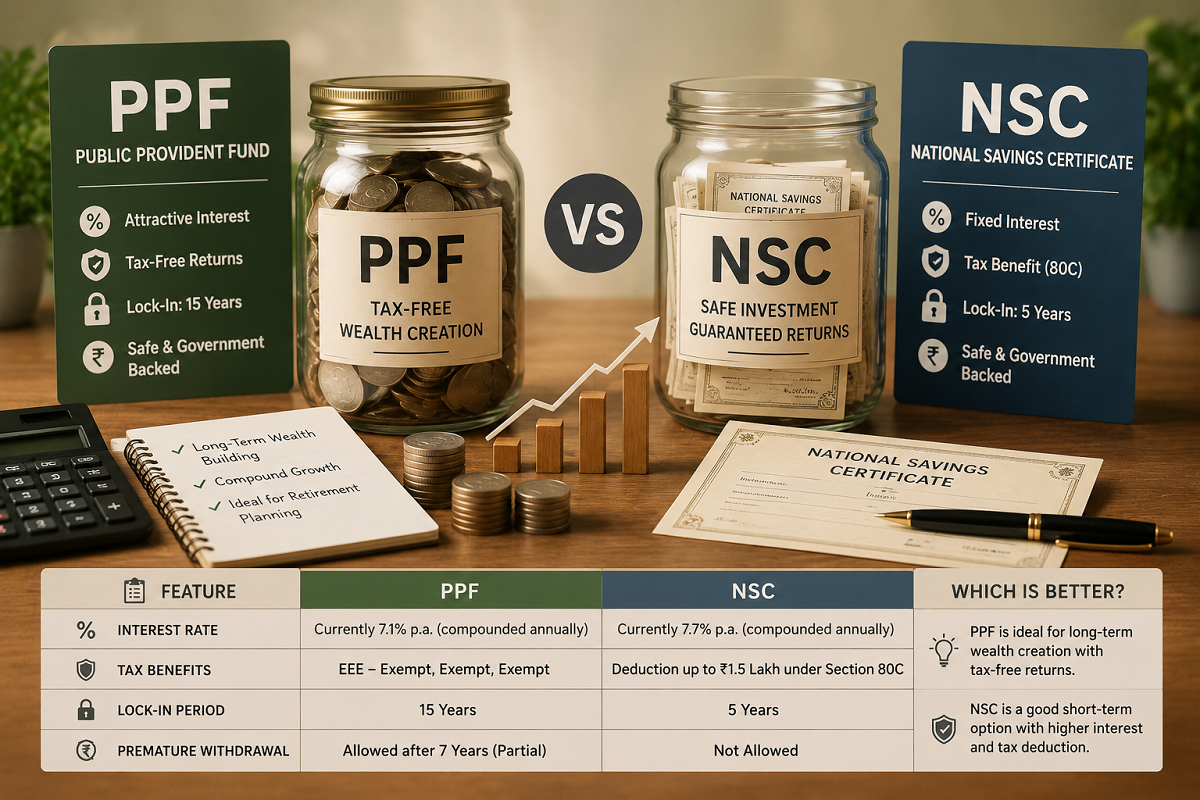
Investors looking for government-backed savings options often compare the Public Provident Fund (PPF) with the National Savings Certificate (NSC). Both are popular small-savings schemes, but they serve very different financial goals.
For the July-September 2026 quarter, the PPF interest rate is 7.1% per annum, while NSC offers 7.7%. At first glance, NSC appears more attractive because of its higher interest rate. However, taxation, investment limits, maturity period and liquidity can significantly change the final outcome.
A simple ₹10 lakh comparison may suggest that NSC generates more money over five years, but there is an important catch: you cannot invest ₹10 lakh into a PPF account in one financial year. PPF has an annual contribution ceiling of ₹1.5 lakh.
Therefore, a ₹10 lakh PPF calculation over five years should be treated only as a mathematical illustration of how money might grow at a 7.1% annual rate, not as an actual permitted PPF investment strategy.
PPF and NSC Interest Rates
For the current quarter, the two schemes offer the following rates:
PPF: 7.1% per annum
NSC: 7.7% per annum
NSC has the higher headline interest rate. It also locks the applicable rate for the entire five-year tenure once the investment is made.
PPF works differently. Its interest rate is reviewed periodically by the government, meaning the rate applicable in future quarters can change.
What Would ₹10 Lakh Become at 7.1%?
To understand the difference mathematically, assume ₹10 lakh grows at an annual compounded rate of 7.1% for five years.
The amount would rise to approximately ₹14.09 lakh.
That represents growth of roughly ₹4.09 lakh over the original amount.
However, this cannot be replicated by depositing ₹10 lakh into PPF at once because the scheme permits a maximum investment of ₹1.5 lakh in a financial year.
PPF also has an original maturity period of 15 years, not five years.
This makes the five-year calculation useful only for comparing the impact of the interest rate.
What Would ₹10 Lakh Become in NSC?
NSC allows investors to put in a much larger amount because there is no prescribed overall maximum investment ceiling for purchase.
At an assumed annual compounded rate of 7.7%, a ₹10 lakh NSC investment could grow to approximately ₹14.49 lakh after five years.
The total interest earned would therefore be around ₹4.49 lakh.
On a pre-tax basis, NSC would be ahead of the 7.1% hypothetical calculation by approximately ₹39,900.
PPF vs NSC: Five-Year Illustration
| Feature | PPF | NSC |
|---|---|---|
| Interest rate | 7.1% | 7.7% |
| Hypothetical ₹10 lakh value after 5 years | Around ₹14.09 lakh | Around ₹14.49 lakh |
| Approx. growth | ₹4.09 lakh | ₹4.49 lakh |
| Actual maturity | 15 years | 5 years |
| Annual investment limit | ₹1.5 lakh | No overall maximum investment limit |
| Interest taxation | Generally tax-free | Taxable |
| Rate treatment | Reviewed periodically | Locked at purchase |
The comparison makes it clear that NSC scores better on the headline five-year return, but PPF has important tax advantages.
PPF Has a Major Tax Advantage
PPF is widely known for its tax-efficient structure.
Subject to prevailing income-tax rules, the interest earned and maturity proceeds from PPF are generally exempt from tax.
Eligible contributions can also qualify for deduction under Section 80C when the investor uses a tax regime that permits such deductions.
This means the return credited to the PPF account is not reduced by tax in the same way as interest from many other fixed-income products.
For investors in higher tax brackets, this can make the effective post-tax return relatively attractive even though the stated PPF rate is lower than NSC.
How Is NSC Interest Taxed?
NSC interest is taxable in the hands of the investor.
The interest accrued during the earlier years is generally treated as reinvested, and subject to applicable tax provisions it may qualify for Section 80C treatment within the overall limit.
However, the final year's interest is not reinvested because the certificate matures, so that amount is taxable according to the applicable rules.
The effective return from NSC therefore depends partly on the investor's tax slab and eligibility for deductions.
An investor in a lower tax bracket may retain a larger portion of the interest than someone taxed at a higher rate.
NSC Is Better Suited to a Five-Year Goal
NSC has a clear five-year maturity period.
This makes it more suitable for someone who knows that the money will be needed after approximately five years.
The rate applicable when the certificate is purchased remains fixed for the tenure, which provides certainty about the maturity calculation.
Premature withdrawal is generally restricted except in specific circumstances allowed under the scheme rules.
Therefore, investors should not put money into NSC that they may need unexpectedly in the near term.
PPF Is Designed for Long-Term Wealth Creation
PPF is fundamentally a long-term savings product.
Its original tenure is 15 years, after which the account can be extended under applicable rules.
The scheme also provides limited liquidity during the tenure. Partial withdrawals are permitted after the prescribed period, and a loan facility may be available in earlier years subject to scheme conditions.
Because of its long investment horizon, PPF is commonly used for objectives such as retirement planning, children's education or creating a long-term tax-efficient corpus.
It should not be viewed as a direct five-year alternative to NSC.
Which Scheme Offers More Flexibility for a Large Investment?
For someone who wants to invest ₹10 lakh immediately, NSC is the more practical of the two because PPF does not permit such a large annual contribution.
PPF allows only up to ₹1.5 lakh to be deposited in a financial year.
This means investing ₹10 lakh through PPF would have to be spread across several years, subject to annual contribution limits.
As a result, the actual investment pattern, timing of deposits and interest earned would be very different from the simple ₹10 lakh lump-sum illustration.
Which One Could Be Better for You?
The answer depends on the financial goal rather than only the interest rate.
NSC may suit investors who want a fixed five-year tenure, a known rate of return and the ability to invest a relatively large lump sum.
PPF may be more suitable for people building a long-term retirement or savings corpus and who value tax-efficient interest and maturity proceeds.
Tax position also matters. A higher stated interest rate does not automatically translate into a higher post-tax return.
Final Takeaway
At current illustrative rates, ₹10 lakh growing at 7.7% for five years would reach around ₹14.49 lakh, while the same amount mathematically compounded at 7.1% would reach approximately ₹14.09 lakh.
That puts NSC ahead by roughly ₹39,900 before tax.
But the comparison should not be misunderstood. A ₹10 lakh lump-sum PPF investment is not permitted, and PPF does not mature in five years. Its annual deposit limit is ₹1.5 lakh and its standard tenure is 15 years.
NSC is therefore better suited to a genuine five-year lump-sum comparison, while PPF is primarily a long-term, tax-efficient savings tool.
Disclaimer: The calculations are illustrative and based on the stated interest rates. Small-savings rates, taxation rules and scheme conditions may change. Investors should verify the latest government rules and consult a qualified financial or tax adviser before investing.