Business
FD vs SCSS for Senior Citizens: Compare Returns, Safety, Tax Benefits and Income on ₹10 Lakh
For senior citizens looking for a steady income after retirement, two of the most common choices are bank fixed deposits and the Senior Citizens’ Savings Scheme, or SCSS. Both can provide predictable returns, but they differ on interest rates, safety, investment limits, payout structure and tax treatment.
The right choice depends on what matters most to the investor. Someone who prioritises government-backed safety and regular quarterly income may prefer SCSS, while another investor may choose a bank FD for flexibility, higher deposit limits or a better rate offered by a particular institution.
A simple comparison using ₹10 lakh and ₹30 lakh can make the differences easier to understand.
SCSS vs Senior Citizen FD: Key Differences
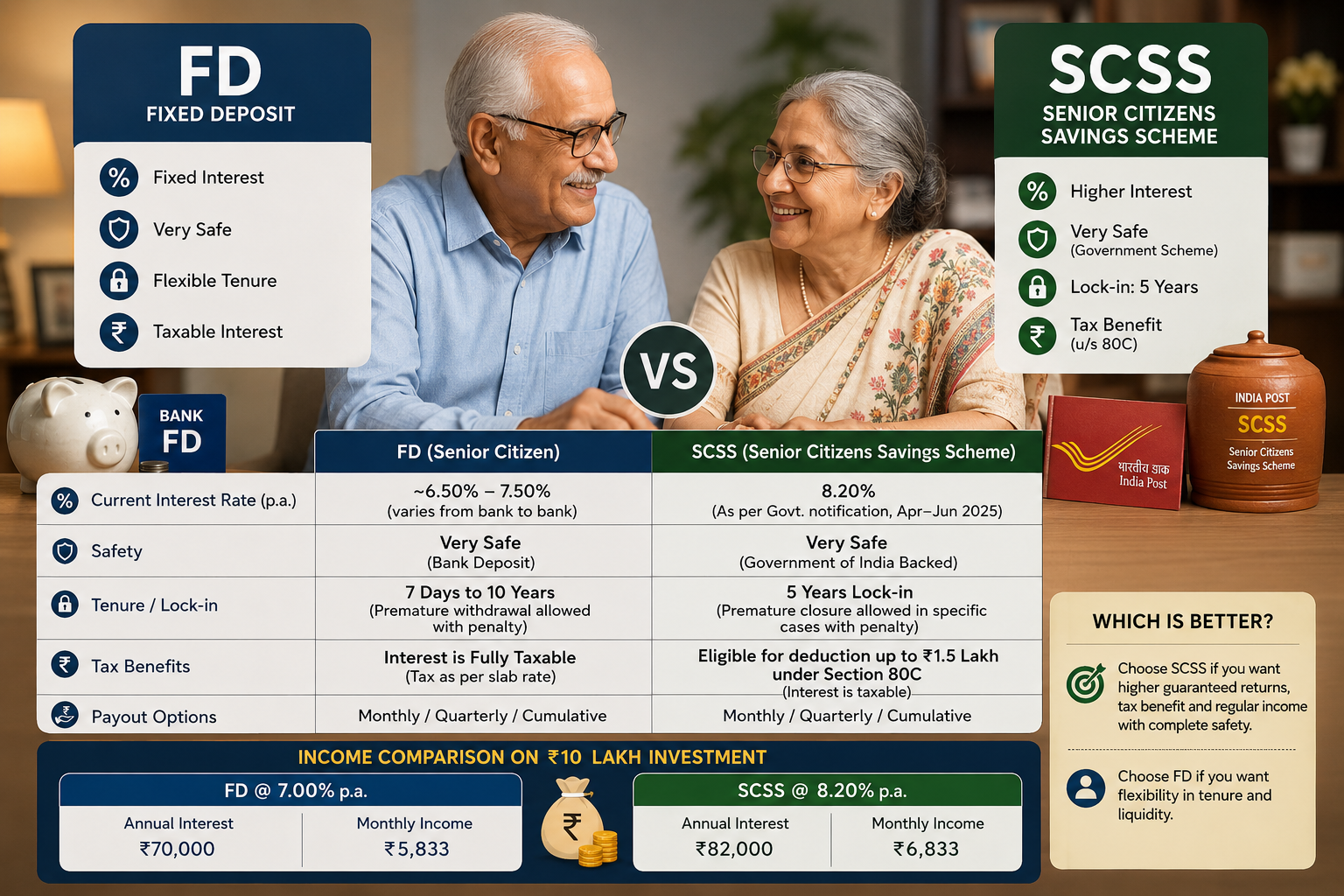
SCSS currently offers an interest rate of 8.2% per annum. Senior citizen FD rates vary from bank to bank. Large banks may offer roughly 7% to 8% or slightly more on selected tenures, while some small finance banks may offer higher rates.
Here is a broad comparison:
| Feature | Senior Citizen FD | SCSS |
|---|---|---|
| Interest Rate | Varies by bank and tenure | 8.2% |
| Safety | Deposit insurance up to applicable DICGC limit | Government-backed scheme |
| Tenure | Multiple options depending on bank | 5 years, extendable as per rules |
| Maximum Investment | No universal overall cap | ₹30 lakh per individual |
| Interest Payout | Monthly, quarterly or at maturity, depending on FD | Quarterly |
| Tax Benefit | Available on eligible 5-year tax-saving FDs under Section 80C | Eligible under Section 80C, subject to tax rules |
The biggest difference is that SCSS has a government-backed structure, while the safety of an FD depends on the bank and applicable deposit insurance protection.
How Much Income Can ₹10 Lakh Generate?
Suppose a senior citizen invests ₹10 lakh and compares SCSS with FDs offering different interest rates.
The annual income may look like this:
| Option | Interest Rate | Annual Interest | Approx. Quarterly Income |
|---|---|---|---|
| SCSS | 8.2% | ₹82,000 | ₹20,500 |
| FD | 7.5% | ₹75,000 | ₹18,750 |
| FD | 8.0% | ₹80,000 | ₹20,000 |
| FD | 8.3% | ₹83,000 | ₹20,750 |
This comparison shows that SCSS can provide more income than many conventional bank FDs.
However, if a bank offers an 8.3% senior citizen FD, the annual interest on ₹10 lakh would be ₹83,000, which is ₹1,000 more than SCSS.
That difference alone should not decide the investment because safety, tenure and liquidity also matter.
What Happens If You Invest ₹30 Lakh in SCSS?
SCSS permits an investment of up to ₹30 lakh per individual, subject to applicable scheme rules.
At an annual interest rate of 8.2%, a ₹30 lakh investment would generate:
Annual interest: ₹2,46,000
Since SCSS pays interest quarterly, the investor would receive approximately:
Quarterly payout: ₹61,500
This regular payment structure is one reason the scheme is popular among retirees who want predictable cash flow for household expenses.
Why SCSS Scores High on Safety
For many retirees, protecting the retirement corpus is more important than earning the highest possible return.
SCSS is a government-backed small-savings scheme, which makes it attractive to investors who want a high degree of capital security.
Bank FDs are also widely considered relatively low-risk, but there is an important distinction.
Deposits with eligible banks are covered under the Deposit Insurance and Credit Guarantee Corporation framework only up to the prescribed insurance limit per depositor per bank, including principal and interest.
Therefore, someone placing a very large amount in a single bank should understand the deposit insurance rules instead of assuming that every rupee is covered.
Investors using FDs may consider spreading large deposits across financially sound banks, depending on their needs and risk tolerance.
Can Bank FDs Offer Better Returns Than SCSS?
Yes, in some cases.
Certain banks, particularly small finance banks, may offer senior citizens FD rates equal to or higher than the SCSS rate.
For example, an FD paying 8.3% generates slightly higher pre-tax income than SCSS at 8.2%.
However, the higher return may come with a different risk profile.
An investor should compare the bank’s financial strength, deposit insurance coverage, tenure, premature withdrawal rules and interest payout options before chasing a higher headline rate.
The highest interest rate is not automatically the best retirement option.
Tax Treatment of SCSS and FD Interest
Interest earned from both SCSS and bank FDs is generally taxable.
The income is added to the investor’s taxable income and taxed according to the applicable income-tax provisions.
Senior citizens should therefore compare post-tax rather than only pre-tax returns.
Both SCSS investments and eligible five-year tax-saving bank FDs may qualify for deduction under Section 80C under the old tax regime, subject to the overall deduction limit and other applicable conditions.
Taxpayers using a regime where such deductions are not available should not assume that the investment will automatically reduce their tax liability.
TDS rules may also apply depending on the amount of interest earned and the prevailing income-tax provisions.
Which Option Provides Better Liquidity?
Bank FDs generally offer more flexibility because investors can choose from a variety of tenures.
Premature withdrawal is also usually possible, although the bank may impose a penalty or reduce the applicable interest rate.
SCSS has a defined five-year tenure, with extension available under the scheme rules.
Premature closure is permitted only under prescribed conditions and may involve deductions or penalties depending on when the account is closed.
Therefore, investors who may need the money unexpectedly should study liquidity rules carefully before committing the entire retirement corpus.
SCSS Is Designed Specifically for Retirement Income
One major advantage of SCSS is that it is specifically structured for eligible senior citizens.
The quarterly interest payment provides a predictable income stream, which can help retirees manage recurring expenses such as utilities, groceries, insurance and healthcare.
Someone investing ₹30 lakh would receive ₹61,500 every quarter at the current 8.2% rate.
However, investors should remember that SCSS interest is not compounded within the account in the same manner as a cumulative FD. It is paid out periodically.
Therefore, SCSS is especially useful for income generation rather than simply maximising compounded maturity value.
When Could an FD Be More Suitable?
A bank FD may be useful when an investor wants a tenure different from five years, requires monthly rather than quarterly income, wants to invest beyond the SCSS limit or finds an attractive rate at a trusted bank.
FDs can also be structured across different maturity dates.
For example, a retiree may divide money across one-year, two-year and three-year deposits instead of locking the entire amount for the same period.
This can provide greater flexibility and help manage changing interest rates.
Which Is Better for a Senior Citizen?
There is no single answer for everyone.
SCSS may be more suitable for someone whose main priorities are government-backed safety, regular quarterly income and a five-year investment horizon.
A bank FD may suit someone who wants flexible tenures, different payout frequencies or needs to invest more than the SCSS limit.
Some retirees may also use both.
For example, part of the retirement corpus can be placed in SCSS for regular income, while the remaining amount is spread across FDs for liquidity and diversification.
Final Comparison
On a ₹10 lakh investment, SCSS at 8.2% generates approximately ₹82,000 a year. A 7.5% FD would provide about ₹75,000, while an 8% FD would generate ₹80,000. An 8.3% FD could produce ₹83,000.
So, some FDs may beat SCSS marginally on interest income.
But for retirees, return is only one part of the decision. SCSS offers a government-backed structure and predictable quarterly payments, while FDs provide greater flexibility and potentially higher rates in selected cases.
The best approach is to compare safety, post-tax returns, liquidity, payout frequency and investment limits before deciding where to place retirement savings.
Disclaimer: This article is for general information only. Interest rates, taxation rules, SCSS conditions and bank FD offers may change. Investors should verify current rules and consult a qualified financial or tax adviser before making an investment decision.