
Business
Onion Prices Jump 94% in a Year: Retail Rate Hits ₹53.84/kg Despite Government Buffer Stock Sale
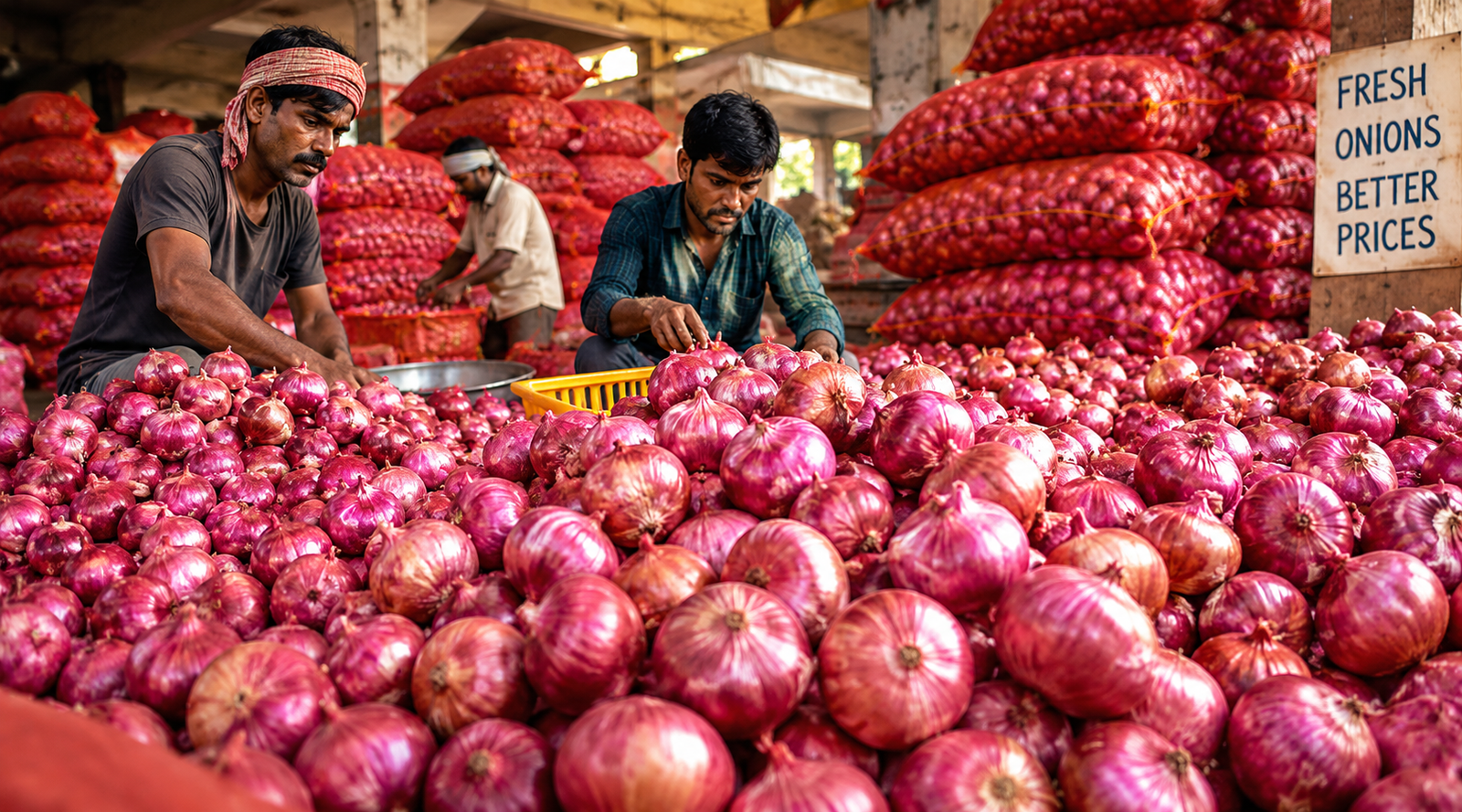
Onion prices are once again putting pressure on household budgets, with retail rates rising sharply across several markets. Despite government efforts to supply onions from buffer stocks at subsidised prices, consumers in some places are reportedly paying as much as ₹60-70 per kg.
According to the supplied report, the average retail price of onions across the country stood at ₹53.84 per kg on September 16, 2026. This was around 94% higher than the price recorded a year earlier.
The government is selling onions from its buffer stock at ₹35 per kg in an attempt to provide relief and improve availability. However, the substantial difference between the subsidised government rate and prices prevailing in several retail markets shows that consumers are still facing elevated costs.
Onion Price Reaches ₹53.84 Per Kg on Average
Onions are an essential part of household food consumption in India, which means even a relatively short period of price increases can have a noticeable impact on monthly grocery expenses.
The supplied report states that India's average retail onion price reached ₹53.84 per kg on September 16.
Compared with the corresponding period a year earlier, this represents an increase of approximately 94%.
However, ₹53.84 is a national average. Actual retail prices can vary significantly between cities and markets depending on local supply, transportation expenses and availability.
In several markets, consumers are reportedly paying between ₹60 and ₹70 per kg.
Government Selling Buffer Stock Onion at ₹35 Per Kg
To contain rising prices, the government has been releasing onions from its buffer stock.
According to the supplied information, these onions are being offered to consumers at ₹35 per kg through designated channels.
The objective of releasing buffer stocks is to increase supply in the market and provide consumers with an alternative when open-market prices rise sharply.
At ₹35 per kg, the government-supported price is substantially below the ₹53.84 national average retail rate mentioned for September 16.
The difference becomes even wider when compared with markets where onions are selling for ₹60-70 per kg.
Why Are Market Prices Still High?
The report highlights a gap between government-supported onion sales and the prices consumers are encountering in the wider retail market.
Buffer-stock releases can provide relief, but their impact depends on how much stock reaches different markets and consumers. Open-market prices can continue to remain elevated when demand is high relative to immediately available supply.
The report also points to the seasonal transition between the rabi and kharif onion crops as an important part of the current supply situation.
Such periods can create temporary supply tightness because stocks from an earlier crop must meet market demand until supplies from the next crop become available in sufficient quantities.
Rabi-Kharif Supply Gap in Focus
Onion availability in India is closely linked to different crop cycles.
The rabi crop plays an important role in maintaining supplies for an extended period because onions harvested during this season can be stored and released gradually.
However, as stored supplies reduce and the market waits for fresh kharif arrivals, the balance between demand and availability can tighten.
The supplied report links the current price pressure with this gap between crop cycles.
Any improvement in market supply can therefore become important in determining how quickly retail prices ease.
Why Buffer Stock Releases Matter
A buffer stock allows the government to hold agricultural produce and release it when market supplies become tight or prices rise significantly.
In the case of onions, releasing government-held stocks can serve two purposes: increasing availability and providing consumers with access to onions at a lower administered price.
The current ₹35-per-kg sale is intended to offer such relief.
However, the existence of government onions at ₹35 does not mean every consumer across the country will automatically be able to purchase onions at that price.
Availability can depend on the distribution network and the locations where subsidised sales are being conducted.
That helps explain why retail-market rates can remain significantly higher than the government's buffer-stock selling price.
Consumers Paying ₹60-70 in Some Markets
For households, the most important number is ultimately the price they pay at their neighbourhood market.
While the national average cited in the report was ₹53.84 per kg on September 16, onion prices in several markets were reportedly between ₹60 and ₹70 per kg.
At ₹70 per kg, buying five kilograms of onions would cost ₹350. At the government's ₹35-per-kg buffer-stock price, the same quantity would cost ₹175.
This illustrates how strongly the place of purchase can affect household expenditure during a period of elevated prices.
Will Onion Prices Come Down Soon?
The supplied information does not provide a confirmed date by which onion prices will fall.
Future prices will depend on factors such as fresh crop arrivals, availability of stored onions, the volume and reach of government buffer-stock releases and local market conditions.
Therefore, it would be premature to assume that the current price spike will disappear immediately.
Consumers may see different rates across cities and even between markets within the same city.
What Consumers Should Know
The key concern is the sharp year-on-year increase in onion prices. According to the supplied report, the national average retail rate stood at ₹53.84 per kg on September 16, 2026, around 94% higher than a year earlier.
At the same time, onions were reportedly being sold for ₹60-70 per kg in several markets, even as the government supplied buffer-stock onions at ₹35 per kg through designated channels.
The large difference highlights the challenge of translating subsidised buffer-stock releases into lower prices throughout the broader retail market.
For consumers, the immediate impact will depend heavily on local availability. Prices could change as fresh supplies enter markets and additional buffer stocks are released, so buyers should compare prevailing rates in their local market rather than relying only on the national average.