Health
LIC Investment Plan 2026: Can ₹1 Lakh Provide Life Cover and Guaranteed Returns? Check Benefits and Conditions
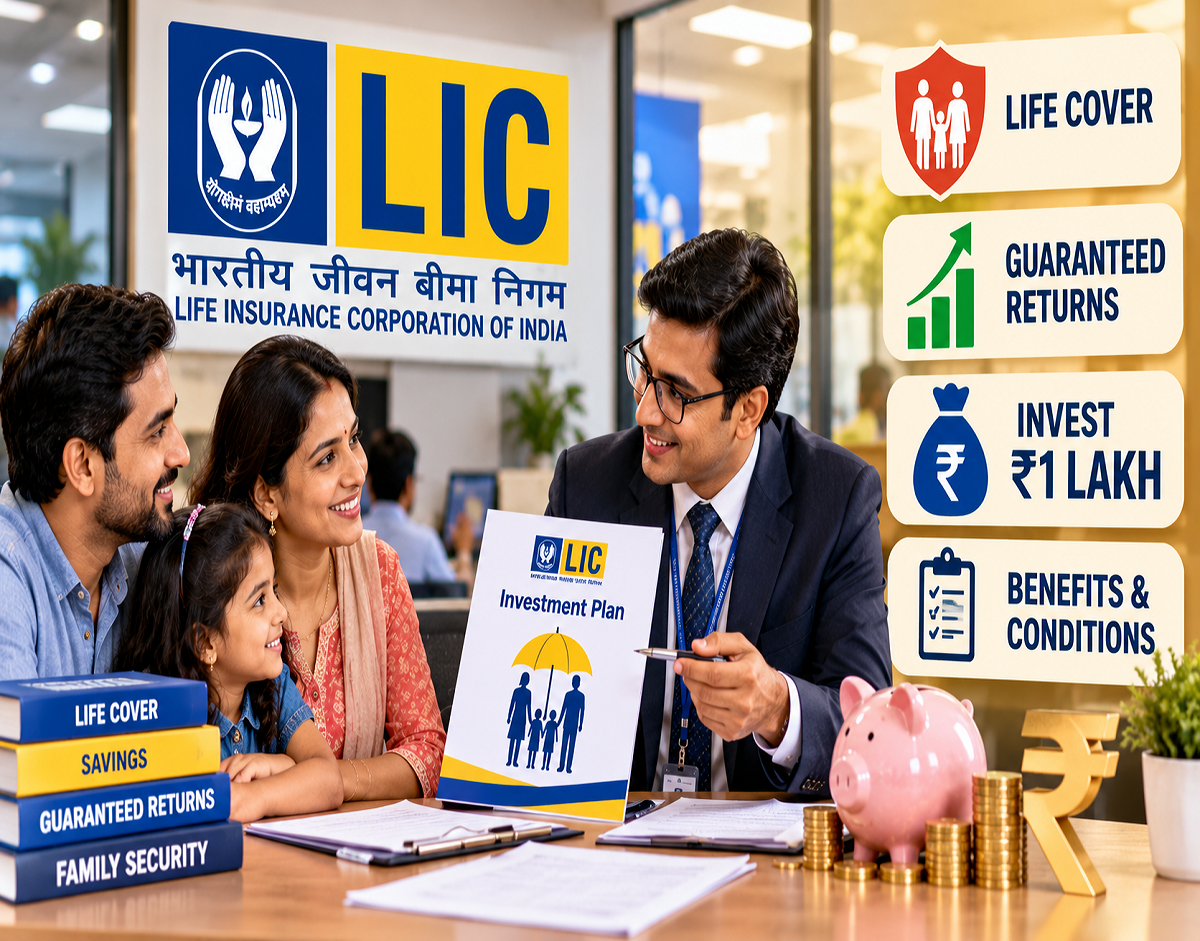
LIC Savings Plan 2026: Life Insurance Corporation of India (LIC) offers insurance products designed to provide financial protection alongside savings benefits. A recent report has highlighted an LIC investment option that allegedly allows customers to start with ₹1 lakh while receiving life insurance coverage, maturity benefits and potential bonuses. However, the report does not identify the policy by its official name or plan number. Investors should understand the difference between guaranteed benefits and non-guaranteed bonuses before committing their savings.
LIC Investment Scheme 2026: What Is the ₹1 Lakh Plan?
Many individuals prefer financial products that combine life insurance protection with long-term savings.
Traditional life insurance policies can help families prepare for future financial requirements while providing benefits to nominees if the insured person dies during the policy term.
The October 14, 2026 report describes an LIC savings-oriented insurance plan with a claimed minimum investment of ₹1 lakh.
According to the report, the policy offers life cover throughout the applicable insurance period and a maturity benefit for eligible policyholders who complete the term.
It also refers to possible bonus additions, tax benefits and policy loan facilities.
However, the report does not provide the official LIC product name, plan number, policy brochure or confirmed premium structure.
Therefore, the claimed ₹1 lakh minimum investment and other features cannot be attributed to a specific LIC policy without further verification.
Customers should avoid assuming that every LIC savings plan offers the same benefits.
How Does Life Insurance Coverage Work?
One of the primary purposes of a life insurance policy is to provide financial protection to the insured person's family.
When an eligible policyholder dies during the policy term, the insurer pays the applicable death benefit to the nominee or other legally entitled recipient, subject to policy conditions.
The death benefit may be based on the sum assured and other components specified in the contract.
However, the amount payable is not necessarily identical to the basic sum assured in every LIC policy.
Some products provide additional benefits, while others follow different formulas depending on the premium paid, policy term and selected coverage.
The policyholder's family should review the death benefit provisions carefully before purchasing the plan.
Claims are also subject to the insurer's verification procedures and the terms of the insurance contract.
What Happens When the LIC Policy Reaches Maturity?
Savings-oriented life insurance policies may provide a maturity benefit when the insured person survives the policy term and satisfies the relevant conditions.
Depending on the product, the maturity amount may include a guaranteed sum assured and applicable bonus additions.
The report mentions two possible bonus components:
Simple Reversionary Bonus: In participating insurance policies, LIC may declare bonuses according to the product's terms and the insurer's applicable bonus declarations.
Final Additional Bonus: Certain eligible policies may receive a final additional bonus when the relevant conditions are met.
However, not every LIC policy offers both types of bonuses.
More importantly, future bonus declarations are generally not guaranteed unless the policy specifically states otherwise.
Investors should distinguish between guaranteed contractual benefits and illustrations based on assumed or historical bonuses.
Are LIC Returns Really Guaranteed?
The word guaranteed is frequently used in advertisements for insurance and savings products.
However, investors should understand precisely which benefits are guaranteed.
A policy may guarantee a specified maturity benefit while offering additional bonuses that depend on future declarations.
Another policy may provide guaranteed additions under its own terms.
These structures are different.
For example, if a policy brochure guarantees a particular maturity amount, that contractual benefit can be evaluated separately from any non-guaranteed additions.
On the other hand, an illustration showing a potentially higher maturity value does not mean that the entire projected amount is guaranteed.
Since the October 2026 report does not identify the LIC product, its exact guaranteed return cannot be calculated reliably.
Customers should request the official benefit illustration and policy brochure before investing.
LIC ₹1 Lakh Investment: How Much Money Will You Receive?
The report suggests that an investment beginning at ₹1 lakh may help customers build savings over time.
However, the final maturity amount depends on several factors.
These include the selected LIC product, entry age, premium amount, premium payment term, policy duration and applicable bonus structure.
A single premium of ₹1 lakh and annual premiums of ₹1 lakh can produce very different financial outcomes.
For example, consider the following hypothetical premium arrangements.
| Premium Payment Option | Illustrative Total Premium Paid |
|---|---|
| ₹1 Lakh as a Single Premium | ₹1 Lakh |
| ₹1 Lakh Annually for 5 Years | ₹5 Lakh |
| ₹1 Lakh Annually for 10 Years | ₹10 Lakh |
| ₹1 Lakh Annually for 15 Years | ₹15 Lakh |
These figures show only the total premium contributions.
They do not represent an actual LIC policy, maturity projection or guaranteed return.
Taxes, additional premiums and other charges, where applicable, are not included.
Investors should obtain a personalized benefit illustration to understand the actual premium commitment and potential payout.
Can LIC Policyholders Get Tax Benefits Under Section 80C?
Life insurance premiums may qualify for deductions under Section 80C of the Income Tax Act, subject to applicable conditions.
However, this benefit is generally relevant to taxpayers using the old tax regime.
The deduction is also subject to statutory limits and conditions relating to the policy.
Therefore, it would be incorrect to assume that every person purchasing an LIC policy automatically receives a tax deduction.
Tax treatment depends on the policy, premium structure, taxpayer's circumstances and applicable law.
Customers should also remember that Section 80C deductions are subject to the overall eligible deduction limit.
Is the LIC Maturity Amount Completely Tax-Free?
The October 2026 report suggests that maturity proceeds are tax-free.
However, this statement requires important qualifications.
Tax exemption for life insurance proceeds depends on the conditions prescribed under Section 10(10D) and other applicable provisions.
Certain policies may not qualify for exemption because of premium-related conditions or other statutory restrictions.
Different rules may apply depending on the policy's issue date, type and premium amount.
Death benefits generally receive different tax treatment from certain taxable maturity proceeds, subject to the applicable law.
Therefore, investors should not assume that every LIC maturity payout is automatically exempt from income tax.
It is advisable to verify the policy's tax treatment before making an investment decision.
Can You Take a Loan Against an LIC Policy?
Some traditional life insurance policies provide a loan facility after the policy acquires the required surrender value.
This can help eligible policyholders access funds without immediately surrendering their insurance contract.
However, the availability of a policy loan depends on the specific LIC product.
The report refers to loans becoming available after two or three years.
That period should not be treated as a universal rule for all LIC policies.
Certain products may have different eligibility conditions, while others may not offer policy loans.
Loan amounts, interest rates and repayment terms also vary.
Policyholders should understand that outstanding loans and accrued interest can reduce the benefits payable under the contract.
Who Can Apply for LIC Savings and Insurance Plans?
Eligibility varies according to the insurance product.
LIC policies generally specify minimum and maximum entry ages, coverage limits, premium requirements and policy terms.
Some plans are designed for young adults, while others target families, working professionals or individuals planning for retirement.
The report suggests that Indian citizens can choose a policy according to their age and financial goals.
However, eligibility cannot be confirmed without identifying the actual product.
Customers should also check whether medical underwriting, income documentation or other verification requirements apply.
How to Buy an LIC Policy Online or Through an Agent
People interested in LIC savings and insurance products should begin by comparing officially available plans.
The general process involves reviewing the product's eligibility conditions, premium structure and benefits.
Customers can visit LIC's official website at licindia.in to explore available products.
They may also seek assistance from an authorized LIC agent or branch office.
Before purchasing, applicants should request the product brochure and benefit illustration.
The application process may require identity verification, personal information and other documents depending on the selected plan.
Not every LIC policy is necessarily available for direct online purchase.
What Should Investors Check Before Paying ₹1 Lakh?
Before purchasing a savings-oriented insurance policy, customers should evaluate the following details:
- Official LIC plan name and plan number
- Minimum premium and payment frequency
- Guaranteed maturity and death benefits
- Non-guaranteed bonus components
- Policy term and premium payment duration
- Surrender value and early exit conditions
- Policy loan eligibility and interest charges
- Applicable tax treatment
- Exclusions and claim conditions
These details are particularly important for long-term policies because early surrender may result in receiving less than the total premiums paid.
Investors should also compare the insurance coverage with their family's actual financial protection needs.
A savings policy may not provide the same level of life cover as a separate term insurance policy purchased for protection.
LIC Savings Plan vs Fixed Deposit: What Is the Difference?
Some investors compare traditional insurance savings plans with bank fixed deposits.
However, the two products serve different purposes.
| Feature | LIC Savings-Oriented Policy | Bank Fixed Deposit |
|---|---|---|
| Main Purpose | Life Cover and Savings, Depending on Plan | Deposit-Based Savings |
| Life Insurance Cover | Available According to Policy Terms | Not Normally Included |
| Returns | Guaranteed and/or Non-Guaranteed Components | Contracted Deposit Interest Rate |
| Early Exit | Surrender Conditions May Apply | Premature Withdrawal Rules May Apply |
| Tax Treatment | Depends on Insurance and Tax Provisions | Interest Generally Taxable Under Applicable Rules |
| Liquidity | Depends on Product Features | Depends on Deposit Terms |
The appropriate choice depends on whether the investor prioritizes insurance protection, liquidity, savings or a combination of these objectives.
LIC Investment Plan 2026: What Is Confirmed?
LIC offers a range of insurance products with different premium structures, coverage features and maturity benefits.
However, the October 14 report does not identify a specific policy that can be independently matched to all the claimed features.
In particular, the following details remain unverified in the supplied material: the ₹1 lakh minimum investment, the absence of an upper investment limit, the exact guaranteed return and the stated policy loan conditions.
There is also no basis for calculating a definite maturity amount without the policy's official benefit illustration.
The most important point is that life insurance protection, guaranteed benefits and bonus-based returns are not interchangeable. Investors should verify each component separately.
Before investing ₹1 lakh or any other amount, customers should confirm the product's official terms and evaluate whether it meets their long-term financial goals.
Disclaimer: This article provides general information about LIC savings-oriented insurance products. The supplied report does not specify an official plan name or number, so its individual claims have not been verified against a product brochure. Returns, bonuses, insurance benefits and tax treatment depend on the selected policy and applicable conditions.