Business
iPhone 18 Pro Costs ₹1.64 Lakh: What If You Invest the Money in FD or Equity for 5, 10 or 15 Years?
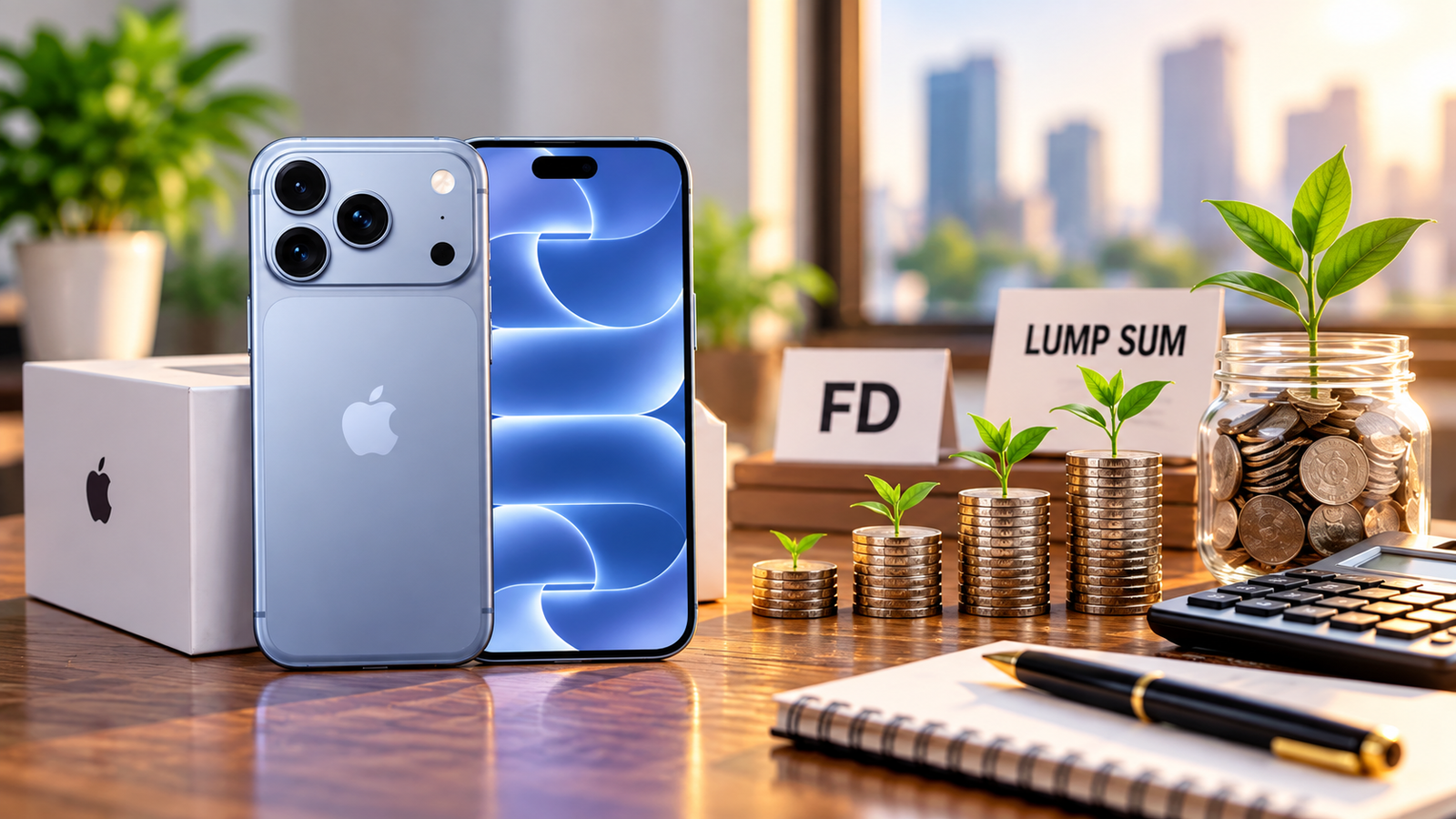
Buying a premium smartphone can require a sizeable amount of money. The iPhone 18 Pro, for example, has a starting price of ₹1,64,900 in India, according to the supplied article. But what if, instead of spending that amount immediately on a smartphone, you invested it and allowed compounding to work for several years?
The difference can become substantial over time.
Consider two hypothetical choices: putting ₹1,64,900 into a fixed deposit earning 6.5% annually or making a one-time market-linked equity investment assumed to earn an average return of 12% per year.
Under the calculations provided in the source, the FD could grow to around ₹4.24 lakh in 15 years. At an assumed 12% return, the lump-sum investment could reach approximately ₹9.03 lakh over the same period.
The comparison demonstrates not that buying an expensive phone is necessarily a bad decision, but how significant the opportunity cost of a large purchase can become when viewed over a long investment horizon.
₹1,64,900 Invested Instead of Spent: The Calculation
The calculation begins with a one-time amount of ₹1,64,900.
Two hypothetical return rates are used:
For the FD calculation, the assumed annual interest rate is 6.5%. For the market-linked lump-sum investment, an annual return of 12% is assumed.
The investment periods considered are 5, 10 and 15 years.
Here is how the money could grow under those assumptions:
| Investment Period | FD at 6.5% | Lump Sum at 12% |
|---|---|---|
| 5 Years | ₹2.26 lakh | ₹2.91 lakh |
| 10 Years | ₹3.10 lakh | ₹5.12 lakh |
| 15 Years | ₹4.24 lakh | ₹9.03 lakh |
These are illustrative calculations. Actual FD interest rates can vary by bank and tenure, while returns from equity investments are market-linked and cannot be guaranteed.
What Happens After 5 Years?
The impact of compounding is already visible within five years.
If ₹1,64,900 is placed in an FD earning 6.5% annually, the amount could increase to approximately ₹2.26 lakh after five years.
That represents growth of roughly ₹61,000 over the initial investment, according to the source calculation.
Now consider the same ₹1,64,900 invested in a market-linked option that hypothetically delivers an average annual return of 12%.
After five years, the corpus could reach approximately ₹2.91 lakh.
That is an increase of roughly ₹1.26 lakh over the original amount.
However, the 12% figure is an assumption, not an assured return.
What If You Leave the Money Invested for 10 Years?
The gap becomes much wider when the investment horizon is extended.
At an assumed 6.5% annual return, ₹1,64,900 in an FD could grow to approximately ₹3.10 lakh after 10 years.
Under the 12% annual-return assumption, the same initial lump sum could potentially grow to around ₹5.12 lakh.
That puts the projected market-linked corpus roughly ₹2 lakh ahead of the FD amount in this illustration.
This difference is largely driven by compounding at different assumed rates.
A higher rate applied over a longer period does not merely generate more returns on the original principal. The returns generated in earlier years can themselves start generating additional returns.
15 Years Can Change the Picture Dramatically
Extending the investment period to 15 years makes the effect even clearer.
At 6.5% annually, the ₹1,64,900 FD could grow to approximately ₹4.24 lakh.
At the hypothetical 12% annual market-linked return, the same initial amount could potentially become around ₹9.03 lakh.
In other words, under the assumptions used in the source, the market-linked investment could grow to more than five times the original ₹1.64 lakh amount over 15 years.
The difference between the two projected maturity amounts is approximately ₹4.79 lakh.
That illustrates why even a few percentage points of additional annual return can create a large difference over a long period.
Why Does Compounding Become So Powerful?
Compounding means earning returns not only on your original investment but also on returns accumulated in previous years.
In the early years, the difference can appear relatively modest.
As the investment period becomes longer, however, the accumulated returns form a larger base on which future returns are calculated.
This is why time can be just as important as the amount invested.
The example also demonstrates why delaying an investment by several years can have a substantial impact on the eventual corpus, particularly for long-term financial goals.
FD and Equity Investment Carry Different Risks
The two options in this comparison should not be treated as identical investments with different interest rates.
An FD generally provides a predetermined interest rate for the chosen deposit period, subject to the terms of the bank and deposit.
A market-linked equity investment is fundamentally different.
A 12% annual return is only an assumption used for illustrating long-term growth. Equity markets can rise or fall, and actual returns may be substantially different.
An investor could earn more than the assumed rate, less than it, or experience losses over particular periods.
Therefore, the projected ₹2.91 lakh, ₹5.12 lakh and ₹9.03 lakh figures should not be interpreted as guaranteed maturity amounts.
Buying an iPhone vs Investing ₹1.64 Lakh
A smartphone and an investment serve completely different purposes.
A phone provides immediate utility. It can be used for communication, work, photography, entertainment and many other activities.
But financially, purchasing a phone means exchanging cash for a consumer product that will generally depreciate over time.
Investing the same amount gives the money an opportunity to generate future returns.
The supplied article therefore uses the ₹1.64 lakh smartphone price mainly to illustrate the long-term opportunity cost of spending a sizeable amount today.
It does not mean that purchasing an expensive smartphone is automatically financially irresponsible.
When Buying the Premium Phone May Be Reasonable
The decision should depend on your overall financial position rather than the phone's price alone.
If your emergency fund is already adequate, important financial goals are on track and buying the phone does not require taking expensive debt or exhausting your savings, spending money on something you value may fit comfortably within your budget.
The situation is different if ₹1.64 lakh represents a large portion of your total savings.
In that case, comparing the purchase with alternative uses of the money can be worthwhile.
For example, the same amount could be allocated towards retirement, a home purchase, children's education, an emergency reserve or another long-term financial goal.
The Bigger Lesson Is About Opportunity Cost
The most useful takeaway from this calculation is not whether an iPhone should or should not be purchased.
It is about opportunity cost.
Every large purchase involves choosing one use of money over another.
Spending ₹1,64,900 today means giving up whatever that ₹1,64,900 could potentially become in the future.
Using the assumptions in the supplied calculation, the same amount could become around ₹2.26 lakh to ₹2.91 lakh in five years, ₹3.10 lakh to ₹5.12 lakh in 10 years, or ₹4.24 lakh to ₹9.03 lakh in 15 years, depending on the investment route and actual returns.
Final Takeaway
The ₹1,64,900 price of the iPhone 18 Pro provides an interesting example of how today's spending can be compared with tomorrow's potential wealth.
At an assumed 6.5% annual FD rate, ₹1,64,900 could grow to around ₹4.24 lakh in 15 years. At an assumed 12% annual return from a market-linked lump-sum investment, it could potentially reach around ₹9.03 lakh.
But the two projections carry very different levels of uncertainty. FD rates can vary, while equity returns are market-linked and may not deliver the assumed 12%.
So the decision is not simply “iPhone or investment.” The more useful question is whether a major discretionary purchase fits comfortably into your financial plan without compromising emergency savings or long-term goals.
Disclaimer: The calculations above are illustrative and based on the assumptions provided in the source. Market-linked returns are not guaranteed, and FD rates vary across banks and tenures. Consider your financial circumstances and professional advice where appropriate before making investment decisions.