
Business
8th Pay Commission Update: Fitment Factor, Basic Pay and Pension Issues Discussed During Chandigarh Visit
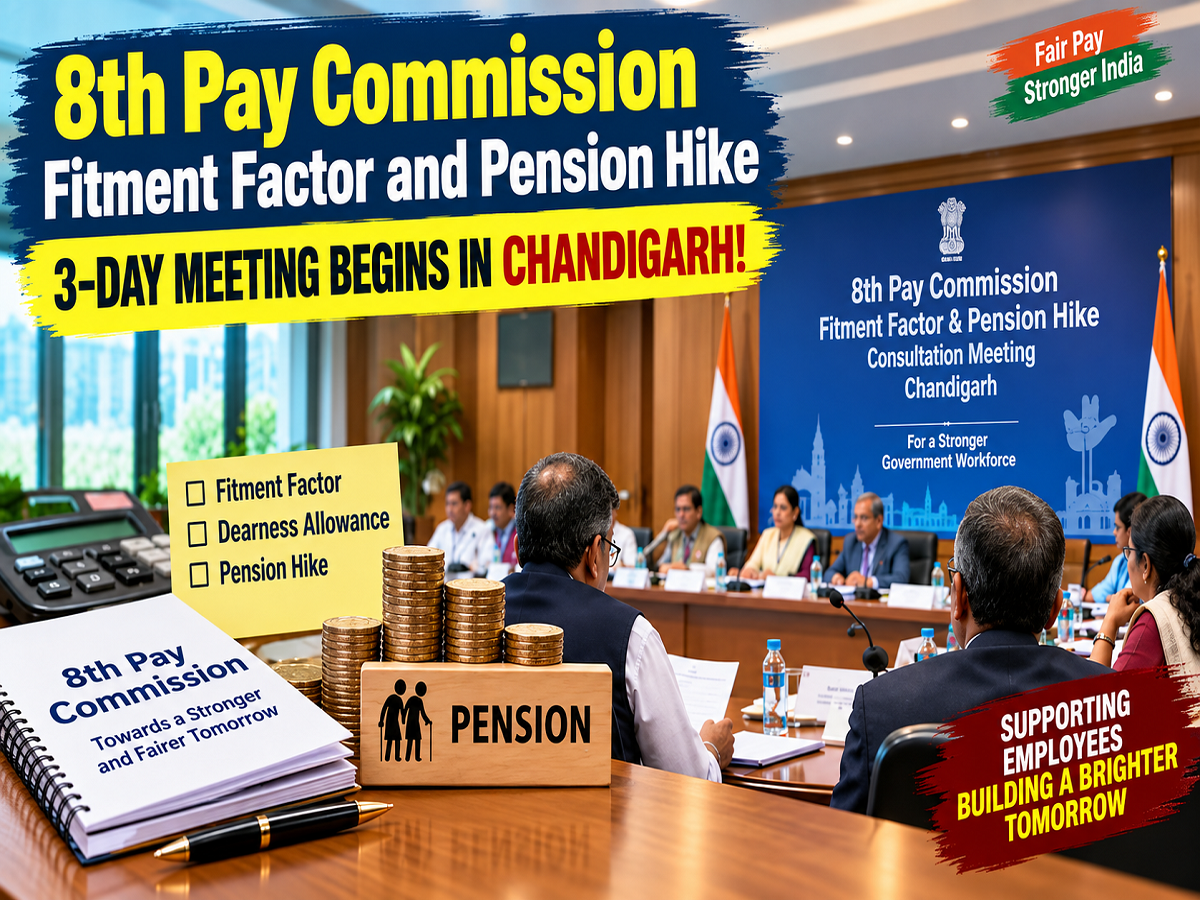
The 8th Central Pay Commission's three-day visit to Chandigarh has put issues such as the fitment factor, basic pay, allowances and pension reforms back in focus for central government employees and pensioners.
According to the supplied report, the Commission's team is visiting Chandigarh from September 16 to September 18, 2026. During the visit, discussions are being held with representatives of employee unions and pensioners' associations from Punjab, Haryana, Himachal Pradesh and the Union Territory of Chandigarh, along with representatives connected with railway and defence personnel.
The Commission is headed by former Supreme Court Justice Ranjana Prakash Desai.
While expectations surrounding salary and pension revisions are high, employees should note that the Commission has not announced a final fitment factor, revised basic pay structure or pension increase at this stage.
What Is Being Discussed During the Chandigarh Visit?
The supplied report specifically notes that the Pay Commission has not released a formal agenda for the meetings.
However, based on memoranda submitted by employee unions, several major issues are reportedly forming part of the consultations.
One of the most prominent subjects is the fitment factor, which is used while restructuring basic pay under a new pay commission.
Employee representatives are seeking changes that could result in a higher basic salary. However, no final fitment factor has yet been stated in the supplied report.
Therefore, any numerical fitment factors or salary calculations circulating separately should not be treated as an approved recommendation on the basis of this Chandigarh consultation alone.
Basic Pay Structure Is Another Key Issue
Basic salary is another major area being raised during the consultations.
Employee representatives are seeking a pay structure that takes into account inflation and the rising cost of living.
Any revision in basic pay can be significant because several components of a government employee's compensation may be linked directly or indirectly to basic salary.
However, the Commission is currently in the consultation process. The discussions do not mean that a particular basic-pay increase has already been approved.
DA Calculation and Merger Rules Under Discussion
Dearness Allowance is also among the issues mentioned in the memoranda cited in the source.
The discussions reportedly include the method used to calculate DA and the rules governing its treatment or possible incorporation while developing the revised pay structure.
DA is intended to help employees manage the impact of inflation. Its treatment becomes an important consideration whenever a new pay commission develops a revised salary framework.
At present, however, the supplied report does not provide any confirmed new DA formula or merger decision.
HRA and Travel Allowance May Also Be Reviewed
Allowances are another important part of the consultation.
Employee representatives have raised issues relating to benefits such as House Rent Allowance (HRA) and Travel Allowance (TA).
The objective of the consultation is to examine whether the existing allowance structure adequately reflects present-day expenses and service requirements.
Any actual increase in HRA, TA or another allowance would depend on the Commission's eventual recommendations and the government's subsequent decisions.
Pension Reforms in Focus
Pensioners are also an important part of the ongoing consultation exercise.
According to the supplied report, discussions include post-retirement financial security and the possibility of restructuring pension-related provisions.
This makes the Commission important not only for serving central government employees but also for pensioners awaiting clarity on how the next pay revision could affect retirement benefits.
No specific percentage increase in pension has been confirmed in the supplied report.
Employee Welfare and Service Conditions Also Raised
The scope of the discussions goes beyond salary and pension.
Issues connected with employee welfare and service conditions have also reportedly been raised. These include working hours, allowances and compensation-related matters.
Feedback gathered during consultations can help the Commission understand concerns affecting different groups of government employees before it prepares its recommendations.
Who Are the Key Members of the 8th Pay Commission?
According to the information provided in the source, former Supreme Court Justice Ranjana Prakash Desai heads the 8th Central Pay Commission.
Pankaj Jain, a former IAS officer, is named as the Member-Secretary.
Professor Pulak Ghosh is listed as a member. The source identifies him as a professor of finance at IIM Bangalore and a member of the Prime Minister's Economic Advisory Council.
The Commission is holding consultations with stakeholders as part of the process leading to its eventual recommendations.
When Could the 8th Pay Commission Submit Its Report?
The source states that the Commission was constituted in November 2025 and has been given 18 months to submit its final recommendations.
On that timeline, the report is expected to be submitted to the government by May 2027.
Submitting the report, however, is different from implementing every recommendation.
Once the report reaches the government, its recommendations would have to be examined before decisions are taken on the revised pay structure, allowances and pension provisions.
Will Employees Have to Wait Until 2029 or 2030?
The supplied article suggests that, based on trends surrounding previous pay commissions, complete implementation could take around two years and that employees and pensioners might receive the full benefit by 2029 or 2030.
This should be treated as an estimate based on the source's interpretation of previous implementation patterns rather than as an officially announced implementation date.
The supplied material does not establish 2029 or 2030 as a confirmed government deadline.
Actual implementation will depend on when the Commission submits its report, what recommendations it makes, which proposals the government accepts and the timetable subsequently announced.
Why the Chandigarh Meetings Matter
The Chandigarh visit is part of the broader consultation process that the source says has been underway since March.
Feedback from employee unions, pensioner organisations and other representatives can provide the Commission with information about concerns related to pay, allowances, pensions and service conditions.
However, consultations and demands should not be confused with final recommendations.
A demand for a higher fitment factor does not mean that a particular factor has been approved. Similarly, discussions about HRA, DA, basic salary or pensions do not establish how much these components will ultimately increase.
What Central Government Employees Should Watch Next
For employees and pensioners, the most important developments will be the Commission's eventual recommendations and the government's decisions on them.
The Chandigarh meetings indicate that issues such as the fitment factor, basic pay, DA, HRA, TA, pensions and employee welfare are being raised during the consultation phase.
But there is still no final salary-hike percentage, approved fitment factor or confirmed pension increase in the supplied report.
With the Commission expected, according to the source, to submit its report by May 2027, employees should distinguish between union demands, consultation-stage discussions, Pay Commission recommendations and final government-approved decisions when assessing future salary or pension calculations.