Business
VPF vs FD 2026: Earn EPF-Linked Interest on Extra Savings, Check Tax Rules and Withdrawal Benefits
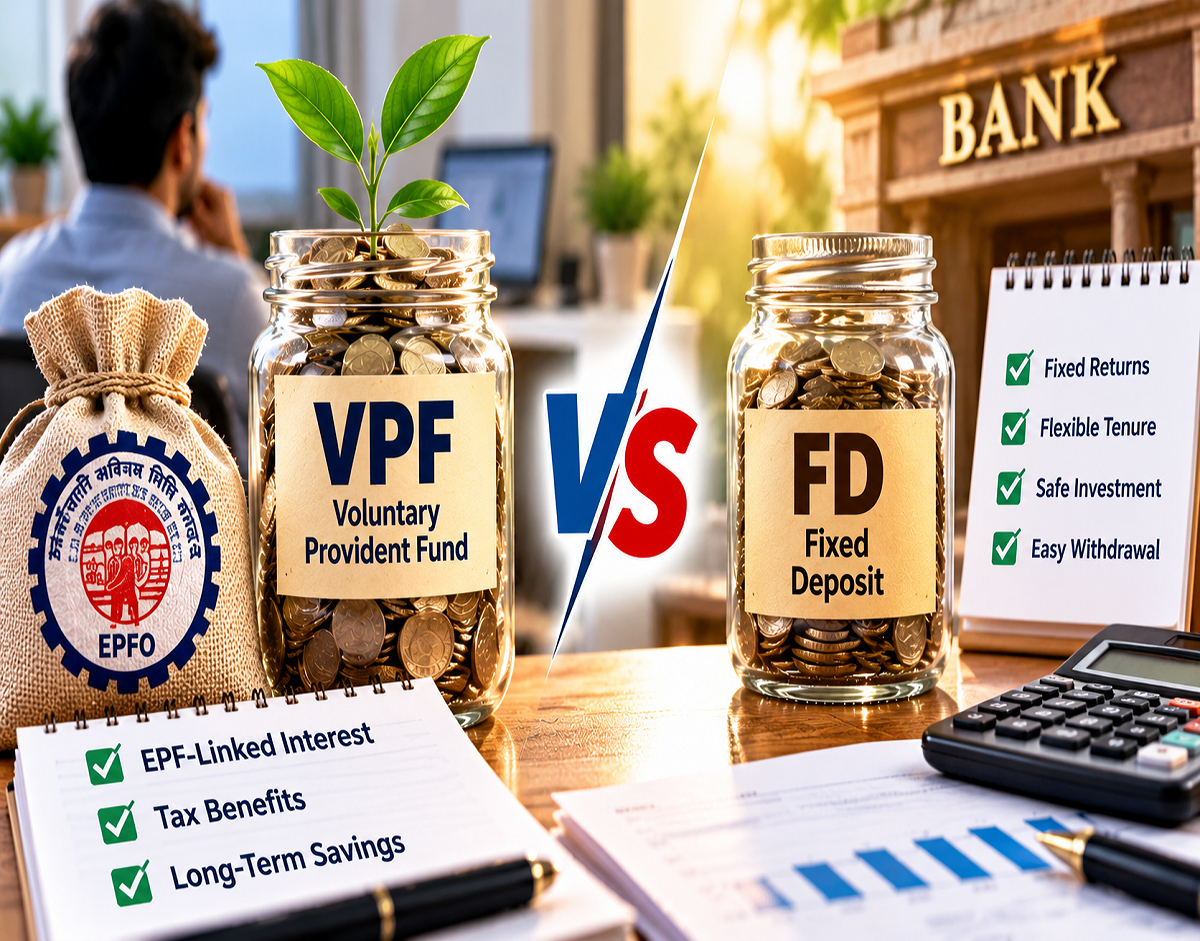
Voluntary Provident Fund (VPF) 2026: Salaried employees planning to build a larger retirement fund may have an additional savings option beyond their mandatory Employees' Provident Fund (EPF) contributions.
The Voluntary Provident Fund, commonly known as VPF, allows eligible employees to contribute more than the standard EPF deduction from their salary.
One of its biggest attractions is that voluntary contributions earn the same declared interest rate as regular EPF contributions.
For the financial year 2025–26, the EPF interest rate was set at 8.25% per annum. This makes VPF worth comparing with bank fixed deposits, particularly for employees focused on long-term retirement savings.
However, VPF and bank FDs are not identical products. They differ in liquidity, taxation, contribution limits and withdrawal rules.
Here is a detailed explanation of how VPF works, how much employees can contribute and whether it could help build a larger retirement corpus.
What Is the Voluntary Provident Fund?
The Voluntary Provident Fund is an extension of the employee's EPF contribution.
Under the standard EPF arrangement, an employee generally contributes 12% of eligible wages to the provident fund.
VPF allows an eligible employee to voluntarily contribute an additional amount through payroll deductions.
For example, if an employee's mandatory EPF contribution is ₹2,400 per month, they may choose to contribute another ₹3,000 or ₹5,000 through VPF, subject to the applicable rules and payroll arrangements.
The additional amount is credited to the employee's provident fund account and earns interest according to the applicable EPF rate.
Importantly, employers are generally not required to match an employee's additional voluntary contribution.
VPF is therefore a way to increase personal retirement savings rather than a separate employer-funded benefit.
VPF Interest Rate 2026: How Much Can Employees Earn?
For FY 2025–26, the EPF interest rate was 8.25% annually, and the same rate applies to eligible VPF contributions.
This rate is attractive compared with many traditional savings products, although not every bank FD necessarily offers a lower rate.
Unlike a bank fixed deposit, the EPF interest rate is declared for each financial year. It is not permanently locked at 8.25%.
The rate for future years may be revised.
VPF vs FD: Interest Rate Comparison
| Feature | VPF | Bank Fixed Deposit |
|---|---|---|
| Interest Rate | Same as EPF; 8.25% for FY 2025–26 | Depends on bank and tenure |
| Rate Structure | Declared for each financial year | Generally fixed for selected tenure |
| Investment Method | Salary deduction | Lump-sum deposit |
| Employer Matching | No matching required on extra VPF | Not applicable |
| Liquidity | EPF withdrawal rules apply | Premature withdrawal usually available, subject to conditions |
| Interest Taxation | Exemption subject to contribution limits | Generally taxable |
| Main Purpose | Retirement savings | Flexible savings goals |
How Much Extra Can You Contribute to VPF?
Eligible employees can voluntarily contribute beyond the usual 12% EPF deduction, up to the applicable limit based on their basic salary and dearness allowance.
The voluntary contribution is made through the employer's payroll system.
For example, consider an employee whose eligible monthly wages are ₹30,000.
| Contribution Type | Monthly Amount |
|---|---|
| Mandatory Employee EPF at 12% | ₹3,600 |
| Additional Voluntary Contribution | ₹5,000 |
| Total Employee EPF and VPF | ₹8,600 |
| Annual Employee Contribution | ₹1,03,200 |
This is an illustrative calculation assuming EPF contributions are made on the full ₹30,000 wage amount.
Actual deductions may differ depending on the employer's payroll arrangements and applicable contribution rules.
VPF Calculator: What Could ₹5,000 Monthly Become in 20 Years?
Suppose an employee contributes an additional ₹5,000 every month through VPF for 20 years.
The total additional contribution would be ₹12 lakh.
Assuming an unchanged annual return of 8.25% and a simplified monthly compounding calculation, the estimated value could reach approximately ₹30.7 lakh.
| Investment Details | Illustrative Calculation |
|---|---|
| Monthly VPF Contribution | ₹5,000 |
| Investment Period | 20 years |
| Total Contribution | ₹12,00,000 |
| Assumed Annual Interest Rate | 8.25% |
| Estimated Final Corpus | Approximately ₹30.7 lakh |
| Estimated Growth Above Contributions | Approximately ₹18.7 lakh |
This is a mathematical projection, not a guaranteed EPFO maturity amount.
EPFO uses its prescribed interest calculation and crediting method, and future interest rates can change. Tax treatment may also affect the investor's net benefit.
VPF Tax Rules 2026: Is All Interest Tax-Free?
VPF has important tax advantages, but the interest is not automatically tax-free without limits.
Under the applicable rules, where the employer also contributes to the provident fund, interest attributable to the employee's own contributions exceeding ₹2.5 lakh in a financial year is taxable.
The threshold applies to mandatory employee EPF contributions and voluntary VPF contributions combined.
The employer's contribution is not counted toward this ₹2.5 lakh employee-contribution threshold.
Where no employer contribution is made, a separate ₹5 lakh threshold may apply under the relevant tax provisions.
Understanding the ₹2.5 Lakh Tax Threshold
| Annual Employee EPF | Annual VPF | Combined Contribution | Amount Above ₹2.5 Lakh |
|---|---|---|---|
| ₹1,20,000 | ₹60,000 | ₹1,80,000 | Nil |
| ₹1,80,000 | ₹60,000 | ₹2,40,000 | Nil |
| ₹2,00,000 | ₹1,00,000 | ₹3,00,000 | ₹50,000 |
In the third example, the entire ₹50,000 excess contribution does not become taxable income merely because the threshold is crossed.
Instead, the interest attributable to contributions exceeding the threshold is subject to taxation under the applicable calculation rules.
Employees should consider their combined annual contributions before deciding how much extra to invest through VPF.
Does VPF Qualify for Section 80C Tax Benefits?
Eligible employee contributions to EPF and VPF may qualify for deductions under Section 80C within the overall ₹1.5 lakh limit under the old income tax regime.
However, this deduction is generally not available to individuals choosing the new tax regime.
The Section 80C deduction limit and the ₹2.5 lakh interest-taxation threshold are separate provisions.
Employees should not confuse the two.
Tax benefits also depend on the relevant financial year, applicable legislation and individual circumstances.
VPF Withdrawal Rules: Can You Take Out Money Anytime?
VPF follows the provident fund withdrawal framework rather than the rules applicable to bank fixed deposits.
This means employees generally cannot treat VPF as an unrestricted savings account.
Withdrawals and advances are subject to the applicable EPF eligibility conditions.
The EPFO has introduced changes aimed at simplifying partial withdrawals for specified purposes, including medical needs, education, marriage, housing and other eligible circumstances.
The revised framework includes provisions concerning eligible withdrawal amounts and the balance retained for retirement.
Employees should verify the currently implemented rules before applying for a withdrawal.
How to Start VPF Contributions
Employees who already participate in EPF can generally request additional voluntary contributions through their employer.
The process usually begins with the HR or payroll department.
Employees can specify the additional contribution amount or percentage according to the company's payroll procedures.
Once implemented, the additional deduction appears in salary records and is deposited through the provident fund contribution process.
Employees should periodically check their EPFO passbook to confirm that the additional amounts have been credited correctly.
Is VPF Better Than an FD for Retirement?
VPF and fixed deposits serve different financial needs.
VPF may appeal to employees who want to strengthen long-term retirement savings and are comfortable with provident fund withdrawal restrictions.
A bank FD may be more suitable for a goal requiring access to funds after a specified period.
FDs also allow investors to choose from different banks, deposit durations and payout structures.
However, bank FD interest is generally taxable, and premature withdrawals may involve penalties.
VPF can offer favourable tax treatment within applicable limits, but it provides less flexibility for short-term financial needs.
The decision should account for liquidity, tax position, existing retirement savings and future cash requirements.
VPF Investment 2026: Key Takeaway
Voluntary Provident Fund contributions allow eligible salaried employees to save more than their mandatory EPF deductions.
The additional contributions earn the applicable EPF interest rate, which was 8.25% for FY 2025–26.
The arrangement can help employees build a larger retirement corpus through regular salary deductions.
However, investors should remember that the interest rate can change, withdrawals are restricted and interest on contributions above the applicable tax threshold may be taxable.
VPF can be a useful retirement savings option, but it should not be selected solely because its current interest rate is higher than that of some bank fixed deposits.
Employees should assess their financial goals, emergency savings, tax position and liquidity requirements before increasing their provident fund contributions.
Disclaimer: This article is for general financial information. Interest projections are illustrative and not guaranteed. Tax and withdrawal rules are subject to applicable legislation and EPFO directions.