Technology
UPI Payment Rules 2026: Sending Money to Friends and Family Is Free, NPCI Clarifies MDR Charges
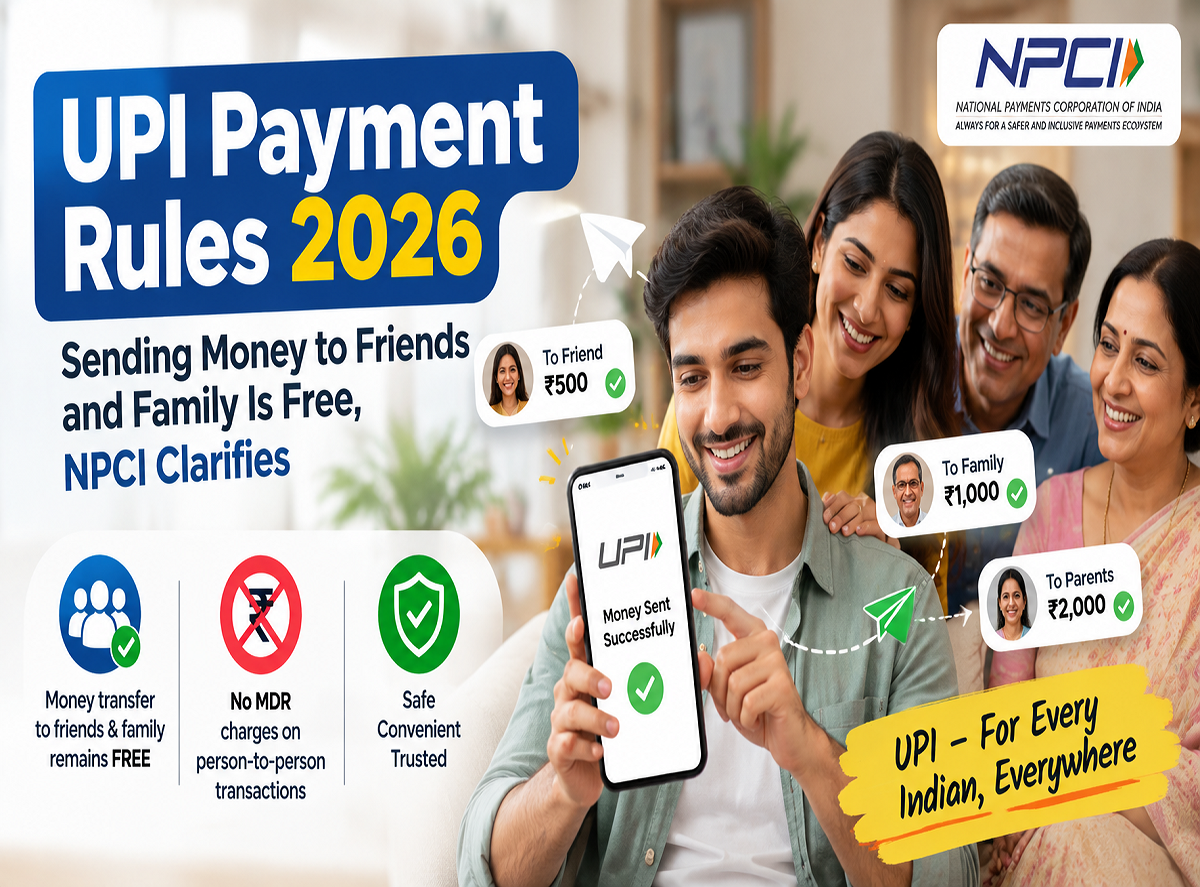
UPI Transaction Charges 2026: Do you regularly transfer money to friends, relatives or family members through Google Pay, PhonePe, Paytm or other UPI applications? There is an important clarification for millions of digital payment users across India. The National Payments Corporation of India (NPCI) has confirmed that person-to-person (P2P) transactions made through UPI remain free from Merchant Discount Rate (MDR) charges.
In its latest public awareness message, NPCI explained that individuals can continue sending money to their siblings, friends and family members without worrying about MDR on these personal transfers.
The clarification is particularly relevant amid ongoing discussions about transaction charges, digital payment fees and possible changes to India's UPI payment ecosystem.
NPCI Confirms No MDR on Personal UPI Transfers
NPCI, which operates the Unified Payments Interface (UPI), has shared an important update through its official UPI social media account.
According to the organisation, person-to-person payments remain free from MDR charges.
This means that when an individual transfers money directly to another person's bank account through UPI, no MDR applies to that transaction.
For example, if someone sends ₹1,000 to a friend or transfers ₹10,000 to a family member using a standard bank-account-linked UPI payment, the transaction does not attract MDR.
The clarification reinforces the distinction between personal money transfers and certain merchant-related payment arrangements.
However, consumers should understand that MDR is a specific payment acceptance charge. NPCI's statement does not necessarily address every possible fee associated with separate banking or payment services.
What Is MDR in UPI Payments?
MDR stands for Merchant Discount Rate.
It generally refers to a charge associated with payment acceptance services, typically paid by a merchant or another party under the applicable payment arrangement.
MDR is commonly discussed in relation to digital transactions involving merchants and payment service providers.
However, a normal UPI transfer between two individuals is classified as a person-to-person transaction rather than a merchant payment.
NPCI has clarified that such P2P transfers do not attract MDR.
This distinction is important because many users mistakenly assume that discussions about merchant payment charges automatically mean that personal UPI transfers will become chargeable.
What Is a P2P UPI Transaction?
P2P stands for Person to Person.
It refers to a payment in which one individual transfers money directly to another individual using UPI.
Common examples include:
- Sending money to parents or other family members
- Transferring funds to a brother or sister
- Repaying money borrowed from a friend
- Sharing household expenses
- Splitting a restaurant bill with friends
- Sending money to a relative for personal expenses
These transactions are generally completed through a linked bank account using a UPI application.
NPCI's latest clarification confirms that MDR does not apply to this category of payments.
Will You Pay Any MDR on ₹1,000, ₹5,000 or ₹10,000 Transfers?
For standard P2P UPI transactions, the MDR remains zero.
| P2P UPI transfer amount | MDR applicable |
|---|---|
| ₹500 | ₹0 |
| ₹1,000 | ₹0 |
| ₹2,000 | ₹0 |
| ₹5,000 | ₹0 |
| ₹10,000 | ₹0 |
| ₹25,000 | ₹0 |
| ₹50,000 | ₹0 |
The figures above illustrate the MDR treatment of ordinary person-to-person UPI transfers.
Actual transaction limits depend on the applicable UPI rules, bank policies and account-specific restrictions.
The absence of MDR does not mean that every transaction amount will necessarily be permitted by a particular bank or application.
What Is the Difference Between P2P and P2M Payments?
UPI transactions are commonly divided into two categories: P2P and P2M.
P2P (Person to Person) transactions involve transferring money from one individual to another.
P2M (Person to Merchant) transactions involve payments made to businesses, retailers or service providers.
For example, sending ₹2,000 to a friend is a P2P transaction.
Paying ₹2,000 to a registered shopkeeper for goods is generally classified as a P2M transaction.
The distinction matters because merchant payment arrangements may be subject to different regulatory provisions and commercial terms.
However, NPCI's latest statement specifically addresses MDR on P2P transactions. It should not be interpreted as announcing a new fee for ordinary merchant UPI payments.
Are Merchant UPI Payments Also Free?
Under India's existing framework, prescribed zero-MDR provisions apply to eligible UPI merchant transactions made through supported payment arrangements.
Separate commercial arrangements may exist for certain payment methods, including eligible wallet-based or other prepaid payment instrument transactions.
Consumers should therefore avoid confusing standard bank-account-linked UPI payments with every other type of digital payment.
Any applicable charges depend on the payment instrument, transaction category and relevant rules.
NPCI's current clarification does not announce a new MDR charge for personal UPI transfers or establish a new consumer fee for merchant payments.
How Can You Send Money Safely Through UPI?
Although personal UPI transfers remain free from MDR, users should continue following essential security precautions.
Before making a payment, verify the recipient's name and UPI ID.
Never share your UPI PIN, OTP or banking password with another person.
Avoid transferring money in response to suspicious calls or messages.
Users should also remember that entering a UPI PIN is generally required to authorise a payment, not to receive money.
If someone claims that a PIN is needed to accept a refund, reward or incoming transfer, the request should be treated cautiously.
Always use trusted UPI applications and check transaction details before approving a payment.
Where Can Users Get Help With UPI Transactions?
People experiencing payment failures, incorrect transfers or other UPI-related problems can first contact their bank or the payment application used for the transaction.
NPCI also provides an official support platform for UPI-related assistance.
Users can visit NPCI UPI Help Portal to access relevant information and support options.
In cases involving suspected financial cyber fraud, victims should immediately contact their bank and report the incident through the national cybercrime helpline at 1930.
Complaints can also be submitted through the government's official cybercrime reporting portal.
NPCI's Latest Clarification Brings Relief to UPI Users
UPI has become an important part of everyday financial transactions in India, allowing individuals to transfer money quickly through their smartphones.
From sharing expenses to supporting family members, person-to-person payments are among the most common uses of the system.
NPCI's latest message confirms that MDR is not applicable to these personal transactions.
Users can therefore continue making standard P2P UPI transfers without an MDR deduction.
The key takeaway: Sending money to friends, siblings or family members through ordinary P2P UPI transactions remains free from MDR, irrespective of the transfer amount, subject to applicable transaction limits.
Source Credit: National Payments Corporation of India (NPCI) — Official UPI X account (@UPI_NPCI), public clarification dated October 29, 2026. View original NPCI announcement. Additional reference: NPCI official website.