Technology
CNAP New Rule From November 1: Unknown Callers' Names to Appear on Your Phone, Know How It Works
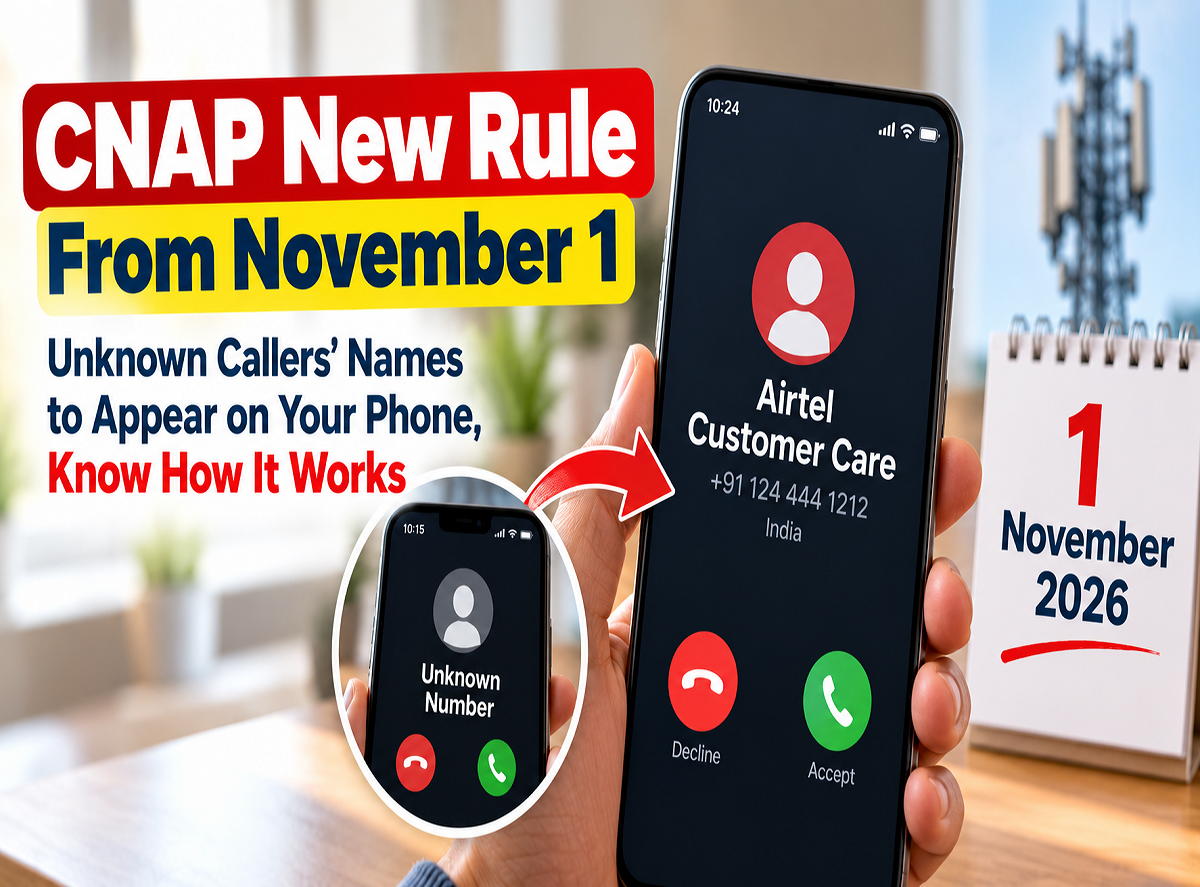
CNAP Caller ID Rule 2026: Receiving calls from unknown numbers could soon become less confusing for millions of mobile users in India. The Department of Telecommunications (DoT) has directed telecom operators to introduce a new caller identification facility called Calling Name Presentation (CNAP) from November 1, 2026.
Under the new system, users will be able to see the registered name of an incoming caller along with the mobile number, even when that number is not saved in their contact list.
The initiative aims to improve caller identification and help people recognise potentially suspicious calls.
According to an Aaj Tak report published on October 30, the facility will initially apply to 4G and newer mobile networks, including 5G.
What Is CNAP and How Does It Work?
CNAP stands for Calling Name Presentation.
It is a network-based caller identification service designed to display the identity associated with an incoming telephone number.
Currently, when someone receives a call from an unsaved number, the phone generally displays the number without identifying the person behind it, unless another caller identification service is available.
With CNAP, telecom operators will use subscriber information maintained in their records to provide the caller's registered name.
For example, if someone receives a call from an unfamiliar domestic number, the phone may display the registered subscriber's name alongside the number.
This could help users decide whether to answer, reject or investigate the call.
What Will Change From November 1, 2026?
The Department of Telecommunications issued instructions on October 13, directing telecom service providers to introduce CNAP across their service areas from November 1.
The service is intended to operate automatically for supported users.
Here are the main details:
| Feature | CNAP Rule 2026 |
|---|---|
| Full form | Calling Name Presentation |
| Scheduled implementation | November 1, 2026 |
| Responsible authority | Department of Telecommunications |
| Initial network coverage | 4G and higher-generation networks |
| Caller information | Phone number and caller name |
| Separate activation request | Not required |
| International calls | Identified as international calls under specified conditions |
| Main objective | Improve caller identification and user safety |
The introduction of CNAP on 2G, 3G and traditional landline networks will be considered separately.
Will the Caller Name Appear if the Number Is Not Saved?
Yes. This is one of the central features of the new service.
If an incoming domestic number is not saved in the recipient's contacts, CNAP is designed to display the name recorded in the originating telecom operator's subscriber database.
If the number is already saved in the recipient's phonebook, the saved contact name takes priority.
For example, if a user has saved a family member's number as "Papa," that contact name will continue to appear.
For an unfamiliar number, the system will instead attempt to show the registered caller identity.
However, this does not guarantee that every incoming call will display a meaningful or accurate personal name in all circumstances.
Will CNAP Work on Jio, Airtel, Vi and BSNL?
The DoT instructions apply to licensed telecom access service providers, rather than being limited to one company.
Major operators such as Jio, Airtel, Vodafone Idea and BSNL are therefore covered by the applicable directions.
The initial implementation concerns 4G and newer mobile networks.
Actual availability may depend on network readiness, technical compatibility and rollout arrangements.
Users should follow their telecom operator's official announcements for service-specific information.
Do You Need to Download an App to Use CNAP?
No separate caller identification application is required for the network-based CNAP facility.
The government has directed telecom operators to provide the service automatically to eligible users without requiring an individual activation request.
This distinguishes CNAP from optional third-party caller identification applications.
However, CNAP does not necessarily offer every feature available in such applications, including community spam reports or advanced call filtering.
Its primary purpose is to present the registered caller identity through the telecom network.
How Is CNAP Different From Truecaller?
CNAP and third-party caller identification applications use different approaches to identifying incoming calls.
| Feature | CNAP | Third-party caller ID apps |
|---|---|---|
| Information source | Telecom subscriber records | App-specific databases and other permitted sources |
| Separate application | Not required | Usually required |
| Activation | Network-based | Depends on the application |
| Caller name display | Registered identity or saved contact name | Name available through the app |
| Spam detection | Not its primary stated function | May offer additional spam detection tools |
CNAP is intended to improve the visibility of registered caller information.
It should not be considered a complete replacement for other security measures.
Will CNAP Help Prevent Cyber Fraud?
The new system could help users identify unfamiliar callers more easily.
Phone-based fraud frequently involves individuals pretending to represent banks, government departments, courier companies or law-enforcement agencies.
Displaying caller information may provide an additional clue when assessing an unexpected call.
However, a displayed name is not proof that a caller is trustworthy.
A SIM card may be registered in someone else's name, and fraudsters may attempt to misuse legitimate identities or exploit other weaknesses.
Users should continue independently verifying calls that request money, confidential information or urgent action.
Never disclose an OTP, UPI PIN or banking password simply because a caller's name appears on the screen.
What Happens When an International Number Calls?
The DoT instructions also address international calls.
For an unsaved international number, the CNAP display is intended to show the words "International Call" alongside the calling number.
This may help users distinguish incoming international calls from domestic calls.
However, the label does not automatically mean that a call is fraudulent.
Users should assess unfamiliar calls based on the circumstances and avoid responding to suspicious requests.
Will Businesses Be Able to Display Their Company Names?
The CNAP framework includes provisions for eligible business and bulk connections.
Such users may be permitted to display a verified preferred business name rather than the ordinary subscriber name.
The preferred name must meet the applicable verification conditions, such as being a registered trademark or a trade name registered under GST.
Telecom operators must verify the relevant documentation before approving the business identity.
This could help customers recognise calls from legitimate organisations, although verification of the displayed name should not replace other fraud-prevention precautions.
What About Privacy and Incorrect Caller Names?
The DoT instructions include provisions intended to address privacy and data security.
Users covered by the permitted Calling Line Identification Restriction (CLIR) facility are exempt from having their calling name presented.
Telecom operators are also required to establish grievance mechanisms for complaints related to caller-name information.
If an incorrect name appears, users should contact their telecom service provider and follow its correction or grievance process.
Important Safety Tips for Mobile Users
Even after CNAP becomes available, users should remain alert when receiving unexpected calls.
Be cautious if someone claims that your bank account will be blocked immediately unless you share an OTP.
Avoid installing unfamiliar applications at a caller's request.
Do not transfer money to an unknown person claiming to be a police officer or government official.
For suspected financial cyber fraud, contact your bank immediately and report the incident through the national cybercrime helpline 1930.
Complaints can also be submitted through the National Cyber Crime Reporting Portal.
CNAP Rule 2026: What Mobile Users Should Remember
India's new Calling Name Presentation system is scheduled to be introduced from November 1, 2026, on 4G and newer telecom networks.
The facility is intended to show registered caller information automatically, making it easier to identify unfamiliar incoming numbers.
While the system could improve transparency, it cannot eliminate phone scams or guarantee the identity of every caller.
The key takeaway: From November 1, telecom operators are directed to introduce CNAP so supported users can see registered caller names alongside incoming numbers. No separate activation is required, but users should continue verifying suspicious calls independently.