Business
NPS Retirement Plan: Invest ₹10,000 Monthly From Age 25 to Build a ₹3.4 Crore Fund by Retirement

NPS Investment Calculator 2026: Planning for retirement at an early age can make a significant difference to your financial future. Even a relatively modest monthly investment can potentially grow into a substantial retirement corpus when maintained consistently over several decades. The National Pension System (NPS) is one investment option that allows individuals to build long-term savings through market-linked investments.
According to a retirement planning illustration discussed by Rahul Bhagat, CEO of DSP Pension Fund, investing ₹10,000 every month for 35 years could create a retirement fund of approximately ₹3.4 crore, assuming an annual return of 10%.
The same monthly contribution over 25 years could generate approximately ₹1.2 crore. This comparison highlights the importance of beginning retirement investments early and allowing compounding to work over a longer period.
However, these are illustrative projections rather than guaranteed NPS returns. Actual outcomes depend on market performance, investment allocation, charges and other factors.
Start Investing at 25 and Build a Bigger Retirement Fund
Many working professionals postpone retirement planning because they believe they need a high salary or a large initial investment.
However, starting early can be more important than investing a large amount later.
For example, consider an individual who begins investing ₹10,000 every month at the age of 25 and continues until age 60.
The total investment period would be 35 years.
During this period, the investor would contribute ₹42 lakh from personal savings.
Assuming an illustrative annual return of 10%, the investment could grow to approximately ₹3.4 crore by retirement.
A person starting at age 35 and investing the same amount until age 60 would have only 25 years to accumulate retirement savings.
The shorter investment period would result in a substantially smaller corpus, despite maintaining the same monthly contribution.
NPS Calculator: ₹10,000 Monthly Investment for 25 vs 35 Years
The following comparison uses the rounded projections highlighted in the source report.
| Investment Details | Start at 35 | Start at 25 |
|---|---|---|
| Monthly investment | ₹10,000 | ₹10,000 |
| Investment period | 25 years | 35 years |
| Total contribution | ₹30 lakh | ₹42 lakh |
| Assumed annual return | 10% | 10% |
| Estimated retirement fund | ₹1.2 crore | ₹3.4 crore |
Illustrative figures from the source report. Actual calculator results vary with compounding assumptions, investment timing and charges.
The difference is significant.
By investing an additional ₹12 lakh over 10 more years, the investor could potentially accumulate more than ₹2 crore in additional retirement wealth under the assumptions used in the illustration.
This is primarily due to the power of compounding over a longer investment period.
How Compounding Helps Your Retirement Savings Grow
Compounding is one of the most important concepts in long-term investing.
It occurs when investment returns remain invested and can generate additional returns over time.
For example, suppose your retirement investments earn returns during the first year. If those returns remain invested, the following year's growth can apply to both the original investment and the accumulated gains.
As this process continues, the potential impact becomes increasingly noticeable.
Illustrative growth of a ₹10,000 monthly investment
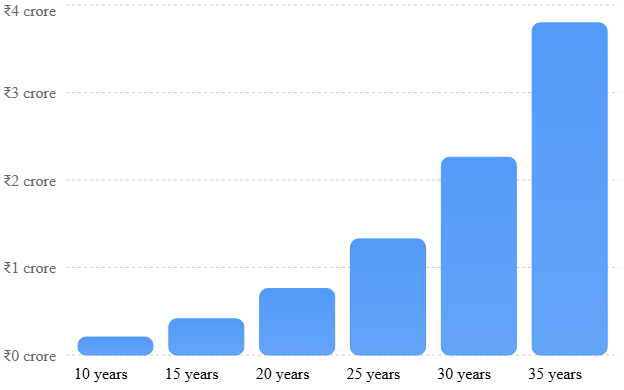
Approximate values using 10% nominal annual return compounded monthly, end-of-month contributions; before fees and taxes.
Values use a standard monthly compounding calculation and therefore differ from the rounded ₹1.2 crore and ₹3.4 crore figures cited in the report.
The longer the investment horizon, the greater the potential benefit from compounding, although returns remain uncertain.
Increasing Your SIP by 5% Every Year Can Make a Difference
Rahul Bhagat also highlighted the importance of increasing investments as income rises.
For example, someone beginning with ₹10,000 per month could increase the monthly contribution by 5% every year.
Under this approach, the monthly investment would gradually rise instead of remaining fixed throughout the investment period.
This strategy is often called a step-up SIP.
It can help investors increase retirement savings without making a sudden large commitment.
Employees receiving annual salary increments may find it easier to allocate a portion of their additional income towards retirement.
However, contribution increases should be planned according to household expenses, emergency savings and other financial obligations.
Why Younger Investors May Consider Higher Equity Exposure
NPS allows subscribers to invest across different asset classes, subject to applicable scheme rules and allocation limits.
These can include equities, corporate debt, government securities and other permitted investments.
Younger investors generally have a longer period before retirement, which may allow them to tolerate greater short-term market fluctuations.
Equity investments offer growth potential but also carry market risk.
Investors approaching retirement may prefer reviewing their asset allocation to manage the possibility of significant losses shortly before withdrawals begin.
Bhagat noted that long investment horizons can provide more time for portfolios to recover from market declines.
Nevertheless, recovery is not guaranteed, and even long-term equity investments can produce disappointing results.
Investment Charges Can Reduce Your Final Retirement Fund
Another important factor in retirement planning is the cost of investing.
Fund management fees and other applicable charges can affect the final amount accumulated over several decades.
Bhagat illustrated this using a ₹10,000 monthly investment continued for 30 years.
Assuming a gross annual return of 10%, the source report suggested that a relatively low annual charge of 0.1% could result in a retirement fund of approximately ₹2 crore.
With a higher annual charge of 1%, the estimated corpus was around ₹1.7 crore.
The reported difference was approximately ₹33 lakh.
These are rounded illustrations, but the underlying lesson is important: even small annual cost differences can become meaningful over a long investment period.
Investors should therefore examine the applicable pension fund management fees and other charges rather than focusing only on projected returns.
What Is the National Pension System?
The National Pension System is a regulated, market-linked retirement savings arrangement designed to help individuals accumulate money for their retirement years.
It operates under the regulatory framework of the Pension Fund Regulatory and Development Authority (PFRDA).
NPS subscribers can contribute periodically and select investment options according to the rules applicable to their account.
Depending on the subscriber category and withdrawal rules, part of the accumulated retirement corpus may be available as a lump sum, while an applicable portion may need to be used to purchase an annuity.
An annuity provides periodic pension payments according to the selected product's terms.
Therefore, an accumulated NPS corpus of ₹3.4 crore should not be confused with an amount that is necessarily available entirely as a cash withdrawal.
Does NPS Guarantee a 10% Annual Return?
No. NPS does not guarantee a fixed annual investment return of 10%.
Returns depend on the performance of the underlying investments and the asset allocation selected by the subscriber.
During strong market periods, returns may be higher than the assumed rate. During weaker periods, they may be lower or even negative.
The 10% figure used in the retirement illustration is an assumption for explaining long-term wealth accumulation.
Investors should also account for inflation because the purchasing power of money generally declines over time.
A retirement fund that appears large today may provide considerably less purchasing power several decades later.
What Should You Remember Before Starting NPS?
Starting retirement planning early offers the advantage of a longer investment horizon, but choosing the right contribution amount and investment allocation is equally important.
An individual beginning at age 25 may have several decades to accumulate savings, while someone starting later may need to contribute more each month to pursue a similar retirement target.
Regular contributions, periodic increases in investment amounts, suitable asset allocation and attention to investment costs can all influence the eventual outcome.
The comparison shared by Rahul Bhagat demonstrates how a ₹10,000 monthly contribution could potentially create substantial retirement wealth over 35 years.
The key takeaway is that time can be a valuable advantage in retirement planning. However, the final retirement corpus will depend on actual investment performance rather than a fixed or guaranteed return.
Official NPS Information: NPS Trust | Pension Fund Regulatory and Development Authority
Disclaimer: All retirement corpus figures are illustrative estimates and not assured returns. NPS investments are subject to market risks, applicable charges, withdrawal regulations and taxation. Investors should review official scheme documents and seek qualified financial advice before making investment decisions.