Business
SIP or Lump Sum Investment: Where Should You Put ₹10 Lakh for Better Returns Over Five Years?

SIP vs Lump Sum Investment 2026: Planning to invest ₹10 lakh in mutual funds but unsure whether to invest the entire amount immediately or spread it across monthly Systematic Investment Plan (SIP) contributions? Both approaches offer different advantages. A five-year illustration using an assumed 12% annual return shows how investment timing can influence the final corpus, potential profits and exposure to market fluctuations.
SIP vs Lump Sum: Which Investment Strategy Can Build More Wealth?
Investing in mutual funds is a popular way to pursue long-term financial goals. However, choosing how to invest can be just as important as selecting an appropriate fund.
Investors with a substantial amount of savings often face a common question: Should they invest everything at once or gradually enter the market through SIPs?
A lump sum investment puts the entire amount into the selected fund immediately, allowing the money to participate in market movements from the beginning.
A SIP, on the other hand, divides investments into smaller contributions made at regular intervals, usually every month.
To understand how the two approaches compare, consider an investor planning to invest ₹10 lakh over a five-year period, assuming a 12% annual return.
The results can vary considerably because the money enters the market at different times.
₹10 Lakh Lump Sum Investment: How Much Could You Earn in Five Years?
Suppose an investor deposits the entire ₹10 lakh into a mutual fund at the beginning of the investment period.
If the investment grows at an assumed annual compound rate of 12%, its future value can be estimated using the compound interest formula.
LUMP SUM INVESTMENT — FIVE-YEAR ILLUSTRATION
Initial investment
₹10,00,000
Assumed annual return
12%
Estimated final corpus
₹17.62 lakh
Estimated gain
₹7.62 lakh
The calculation is based on:
\[ FV=P(1+r)^n \]
Here, P represents the initial investment, r is the annual growth rate and n is the number of years.
Under these assumptions, the investment could grow to approximately ₹17.62 lakh after five years.
The main advantage is that the full ₹10 lakh remains invested throughout the period, allowing potential returns to compound over the entire five years.
However, investing the entire amount immediately also exposes the full investment to market movements from day one.
₹10 Lakh Through SIP: What Could Your Investment Become?
Now consider an investor who prefers to invest the same ₹10 lakh gradually rather than committing the entire amount immediately.
Spreading ₹10 lakh across 60 months requires a monthly contribution of approximately ₹16,666.67.
Using an assumed 12% annual return with a monthly rate of 1%, the estimated value of an end-of-month SIP would be approximately ₹13.62 lakh.
MONTHLY SIP — FIVE-YEAR ILLUSTRATION
Monthly SIP
₹16,666.67
Total investment
₹10,00,000
Estimated final corpus
₹13.62 lakh
Estimated gain
₹3.62 lakh
The SIP corpus is smaller in this illustration because each monthly contribution remains invested for a different length of time.
For instance, the first SIP instalment has nearly five years to grow, while the final contribution has little time to generate returns.
This shorter average investment period explains much of the difference between the two approaches.
SIP vs Lump Sum: Five-Year Return Comparison
| Investment details | Lump Sum | Monthly SIP |
|---|---|---|
| Total invested | ₹10 lakh | ₹10 lakh |
| Investment period | 5 years | 5 years |
| Payment frequency | One-time | Monthly |
| Assumed annual return | 12% | 12% |
| Estimated corpus | ₹17.62 lakh | ₹13.62 lakh |
| Estimated profit | ₹7.62 lakh | ₹3.62 lakh |
Estimated value after five years
Illustrative results in ₹ lakh, assuming 12% annual growth for lump sum and 1% monthly growth for SIP.
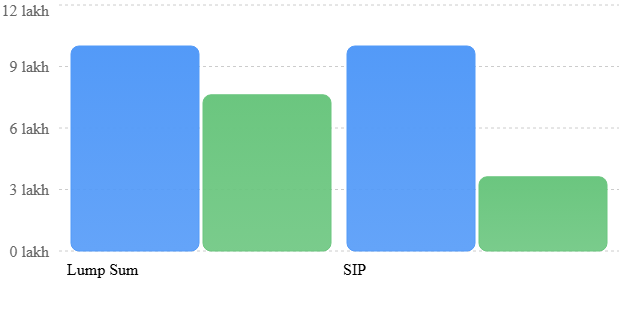
■ Invested
■ Estimated gain
In this simplified example, the lump sum strategy generates approximately ₹4 lakh more than the SIP approach.
However, this comparison has an important limitation: the entire ₹10 lakh is invested immediately in the lump sum scenario, whereas the SIP scenario invests the money gradually over five years.
The calculation does not include any returns that the uninvested SIP money might earn while waiting to be deployed.
Therefore, the result should not be interpreted as proof that lump sum investing will always outperform SIPs.
Why Does Lump Sum Investing Produce Higher Returns in This Example?
The primary reason is the time available for compounding.
When an investor makes a lump sum investment, the entire capital is exposed to market performance from the beginning.
If markets deliver consistent positive returns, the investment has more time to accumulate gains.
With SIPs, the money is invested in instalments. This reduces the amount exposed to the market during the initial months.
As a result, a gradually funded SIP may accumulate a smaller corpus in a steadily rising market.
But real-world markets rarely deliver fixed returns every month or year.
If markets decline sharply after a lump sum investment, the investor could experience substantial losses. Gradual investing can help reduce the risk of committing the entire amount just before a market correction.
When Is SIP a Better Investment Option?
SIPs can be particularly suitable for individuals who earn a regular monthly salary and want to build an investment portfolio over time.
Instead of waiting to accumulate a large amount, investors can begin with smaller contributions and maintain a consistent investing habit.
Another benefit is rupee cost averaging.
When mutual fund prices fall, a fixed SIP amount purchases more units. When prices rise, the same contribution purchases fewer units.
This approach spreads purchases across different market levels and reduces the need to predict the ideal investment date.
However, rupee cost averaging does not guarantee profits or prevent losses during prolonged market declines.
When Should Investors Consider a Lump Sum Investment?
A lump sum investment may be appropriate for individuals who already have substantial surplus funds and are comfortable with market volatility.
Investors receiving a bonus, inheritance, maturity proceeds or other large payments may consider deploying a portion of the money into suitable investments.
The decision should depend on factors such as investment horizon, financial goals, emergency savings and willingness to tolerate temporary losses.
Investing a large amount in an equity mutual fund for only five years can involve significant market risk.
Investors should therefore assess whether the selected asset category matches their financial objectives.
Can You Combine SIP and Lump Sum Investing?
Yes. Investors do not necessarily have to choose only one method.
A combined strategy may involve investing part of the available capital immediately and deploying the remaining amount gradually.
For example, someone holding ₹10 lakh could invest ₹5 lakh initially and distribute the remaining ₹5 lakh through monthly investments.
Another option is a Systematic Transfer Plan (STP), where money is transferred periodically from one mutual fund scheme to another.
Such strategies may help investors manage the timing of market entry, although they do not eliminate investment risk. Transfers can also have tax and exit-load implications.
SIP vs Lump Sum Calculator: Compare Your Own Investment
Use this interactive calculator to explore how different investment amounts, durations and assumed returns affect the estimated outcome.
Total investment
₹10,00,000
Investment period
5 years
Assumed annual return
12%
Lump sum corpus
₹17,62,342
Gain: ₹7,62,342
SIP corpus
₹13,61,161
Gain: ₹3,61,161
Required monthly SIP
₹16,667
Illustrative pre-tax calculations. Lump sum uses annual compounding; SIP assumes end-of-month contributions and a monthly rate equal to the annual assumption divided by 12. Actual mutual fund returns fluctuate and are not guaranteed.
Final Verdict: Is SIP or Lump Sum Better for ₹10 Lakh?
The answer depends on the investor's financial situation rather than the projected returns alone.
In a steadily growing market, investing the entire amount at the beginning can generate a larger corpus because the money has more time to compound.
SIPs, meanwhile, offer disciplined investing, gradual market exposure and convenience for individuals who invest from regular income.
For investors who already have ₹10 lakh available, the choice should also consider what happens to the money that remains uninvested during the SIP period.
The key takeaway: A lump sum investment may produce higher returns under favourable market conditions, while SIPs can help manage investment timing and maintain financial discipline. Neither strategy guarantees superior returns in every market environment.
Disclaimer: This article is intended for educational and informational purposes only. The 12% return assumption is hypothetical and does not represent a guaranteed mutual fund return. Calculations exclude taxes, expense ratios, exit loads and other applicable costs. Mutual fund investments are subject to market risks. Investors should consult a qualified financial adviser before making investment decisions.