Business
8th Pay Commission 2026: Employees Seek 6% Annual Increment, Higher Pension, HRA and 600-Day Leave Encashment
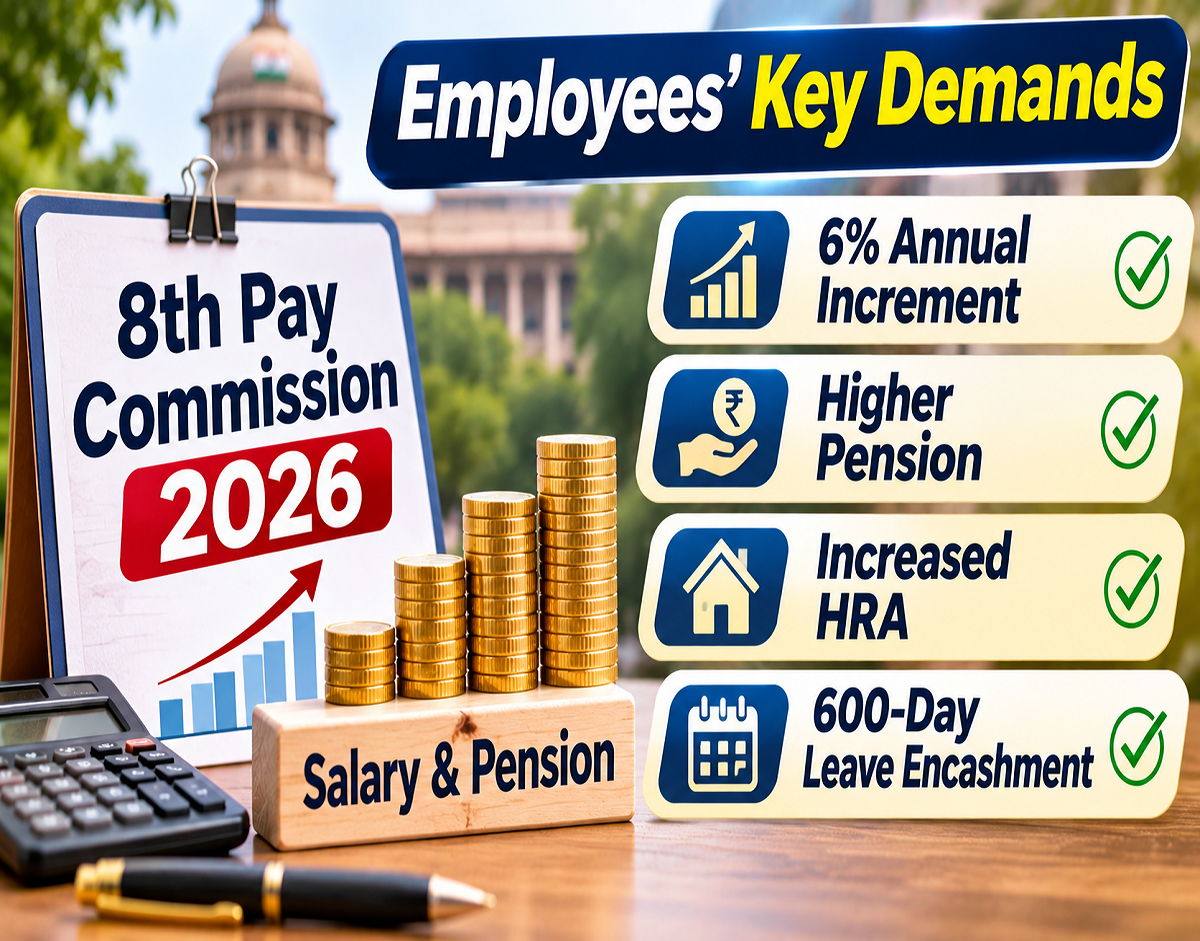
8th Pay Commission Latest Update: Central government employees and pensioners could see significant changes to their salary structure and retirement benefits if fresh proposals submitted by employee representatives are accepted. The National Council of Joint Consultative Machinery (NC-JCM) has reportedly recommended doubling the annual salary increment from 3% to 6%, increasing pension benefits, revising House Rent Allowance (HRA) rates and expanding the retirement leave encashment limit from 300 to 600 days. However, these demands remain proposals, and no final decision has been announced.
8th Pay Commission Receives Fresh Proposals on Salaries and Retirement Benefits
Discussions surrounding the 8th Central Pay Commission have gained momentum as employee organisations and pensioner associations continue presenting their demands.
According to a report published on November 10, 2026, the NC-JCM has submitted several recommendations aimed at improving the financial benefits available to central government employees and retirees.
The proposals cover important components of employee compensation, including annual salary progression, pension calculations, housing allowances, retirement benefits and the structure of the central government pay matrix.
Employee representatives argue that the existing compensation framework needs to reflect rising household expenses, housing costs and changing financial requirements.
The commission is expected to examine submissions from various stakeholders before preparing its recommendations for the central government.
Importantly, the demands submitted by employee organisations should not be confused with approved salary or pension revisions. The government will make the final decision after considering the commission's recommendations.
Annual Salary Increment May Rise From 3% to 6%
One of the major proposals concerns the annual increment granted to central government employees.
Under the existing pay structure, eligible employees generally receive an annual increment equivalent to approximately 3% of their basic salary, implemented through the applicable pay matrix.
The NC-JCM has reportedly requested that the increment rate be increased to 6%.
Employee representatives believe that the present increment structure does not adequately reflect the increasing cost of living.
If the proposal is accepted, eligible employees could experience faster growth in their basic salaries over the course of their careers.
For example, consider an employee with a basic salary of ₹50,000.
ILLUSTRATIVE ANNUAL INCREMENT COMPARISON
Current 3% increment
₹1,500
Illustrative new basic: ₹51,500
Proposed 6% increment
₹3,000
Illustrative new basic: ₹53,000
Actual increments would depend on the approved pay matrix and applicable rules.
The difference would become more significant over multiple years because annual increments affect future basic salary calculations.
However, the proposal does not guarantee that employees will receive a 6% increment under the 8th Pay Commission.
Pension Revision: Demand to Increase Benefits From 50% to 67%
Another important recommendation focuses on retirement income.
According to the report, the NC-JCM has proposed increasing the pension calculation rate from the existing 50% to 67% of the applicable pensionable pay.
Under the existing defined-benefit pension framework, eligible employees generally receive a pension based on prescribed calculations involving pensionable emoluments or average emoluments.
The proposed revision would increase the proportion used to calculate pension benefits for employees covered by the relevant rules.
For illustration, if an eligible employee's pensionable pay is ₹60,000, the difference could look like this:
| Pension calculation | Illustrative monthly amount |
|---|---|
| At 50% | ₹30,000 |
| At proposed 67% | ₹40,200 |
| Potential difference | ₹10,200 |
These calculations are hypothetical and do not include dearness relief, commutation or other adjustments.
The final impact would depend on the pension rules approved by the government and the categories of retirees covered.
The proposal should also not be interpreted as automatically applying to every retirement arrangement, including the National Pension System or Unified Pension Scheme.
Family Pension May Increase From 30% to 50%
The NC-JCM has also reportedly requested an improvement in family pension benefits.
Under the standard family pension framework, the applicable rate is generally 30% of the relevant pensionable emoluments, although enhanced family pension provisions can apply in specified circumstances.
Employee representatives have proposed raising the standard rate to 50%.
The suggested revision is intended to provide greater financial support to eligible family members after the death of a pensioner or government employee.
For example, where the relevant pensionable pay is ₹60,000, a 30% calculation would produce ₹18,000 per month, while a 50% calculation would produce ₹30,000.
The proposal remains subject to examination and government approval.
HRA Rates Could Be Revised to 40%, 35% and 30%
House Rent Allowance is another major component of central government employees' monthly compensation.
HRA is calculated according to the employee's basic pay and the classification of the city where they are posted.
The existing rates referred to in the report are 30%, 20% and 10% for X, Y and Z category cities, respectively.
The NC-JCM has reportedly proposed increasing these rates to 40%, 35% and 30%.
| City category | Existing HRA rate | Proposed HRA rate |
|---|---|---|
| X category | 30% | 40% |
| Y category | 20% | 35% |
| Z category | 10% | 30% |
For an employee earning ₹50,000 in basic pay, the proposed changes would produce the following illustrative monthly HRA amounts:
| City category | Existing HRA | Proposed HRA |
|---|---|---|
| X | ₹15,000 | ₹20,000 |
| Y | ₹10,000 | ₹17,500 |
| Z | ₹5,000 | ₹15,000 |
The calculations demonstrate how the proposed changes could influence gross monthly compensation.
However, actual HRA eligibility and payment would remain subject to government rules, including conditions relating to official accommodation.
Retirement Leave Encashment Limit May Double to 600 Days
The employee representatives have also sought a major change in the maximum amount of earned leave that can be encashed upon retirement.
Under the existing framework, eligible central government employees can generally receive leave encashment benefits for a maximum of 300 days, subject to applicable rules.
The NC-JCM has reportedly requested an increase to 600 days.
If approved, this could allow eligible employees with sufficient accumulated leave to receive a higher retirement payment.
Leave encashment is generally calculated using prescribed salary components, including basic pay and applicable dearness allowance.
However, doubling the maximum limit would not automatically double every employee's retirement benefit.
The actual amount would depend on the number of eligible leave days accumulated, salary at retirement and the rules governing the payment.
Pay Matrix Changes: Proposal to Merge Levels 2 and 3
Another notable demand involves restructuring certain levels of the central government pay matrix.
The report states that the NC-JCM has suggested combining Pay Levels 2 and 3 into a revised structure with a proposed minimum basic salary of ₹83,200.
Under the existing 7th Central Pay Commission framework, the starting basic pay for Level 2 is ₹19,900, while Level 3 begins at ₹21,700.
The proposed restructuring would therefore represent a substantial departure from the current arrangement.
However, the ₹83,200 figure is a reported demand rather than an approved minimum salary.
The commission would need to examine the financial implications, pay relativities and wider effects on the government salary structure before making any recommendation.
Key Demands Submitted to the 8th Pay Commission
| Salary or benefit component | Existing framework | Reported NC-JCM demand |
|---|---|---|
| Annual increment | 3% | 6% |
| Standard pension rate | 50% | 67% |
| Standard family pension | 30% | 50% |
| HRA for X cities | 30% | 40% |
| HRA for Y cities | 20% | 35% |
| HRA for Z cities | 10% | 30% |
| Retirement leave encashment ceiling | 300 days | 600 days |
| Pay Levels 2 and 3 | Separate pay levels | Proposed merger with ₹83,200 minimum basic pay |
All the revised figures in this table are reported employee-side proposals, not final government-approved benefits.
When Will the 8th Pay Commission Submit Its Report?
The 8th Central Pay Commission is expected to evaluate salary structures, allowances, pension-related issues and other service conditions before presenting its findings to the government.
According to the November 10 report, the commission could submit its recommendations around May 2027.
However, this is a projected timeline rather than confirmation of a final submission date.
After receiving the report, the central government would examine its recommendations, assess their financial implications and decide which proposals to accept, modify or reject.
Implementation could require additional administrative decisions and formal notifications.
Therefore, even if the commission submits its report in 2027, the exact timing of revised salary and pension payments will depend on subsequent government action.
Will Central Government Employees Receive Higher Salaries and Arrears?
Many employees are also interested in knowing whether revised pay scales could result in arrears.
The answer depends on the effective date eventually approved by the government.
If revised salaries are implemented retrospectively, eligible employees may become entitled to arrears for the period between the effective date and the actual payment date.
However, no specific arrears amount or payment schedule can be established until the final pay structure and implementation rules are announced.
Employees should also avoid calculating future salaries solely on the basis of reported union demands.
The eventual salary revision will depend on the approved pay matrix, fitment arrangements, allowances and other applicable provisions.
What Should Employees and Pensioners Expect Next?
The commission is expected to continue examining stakeholder submissions and other relevant information before finalising its recommendations.
For employees, the most closely watched issues include the annual increment rate, revised basic pay, HRA and retirement benefits.
Pensioners are particularly interested in proposals concerning pension calculations and family pension provisions.
Official developments can be followed through the Department of Expenditure and the Press Information Bureau.
The key takeaway: Employee representatives have reportedly asked the 8th Pay Commission to double annual increments to 6%, raise standard pension calculations to 67%, increase HRA rates and expand the leave encashment ceiling to 600 days. These demands could significantly change compensation and retirement benefits if accepted, but none of the proposed revisions should be considered approved at this stage.
Disclaimer: This article is based on the supplied news report dated November 10, 2026. The reported NC-JCM proposals have not been independently verified against the complete original submission. All proposed figures are subject to the commission's review and subsequent government approval. Illustrative salary and pension calculations are not official entitlement estimates.