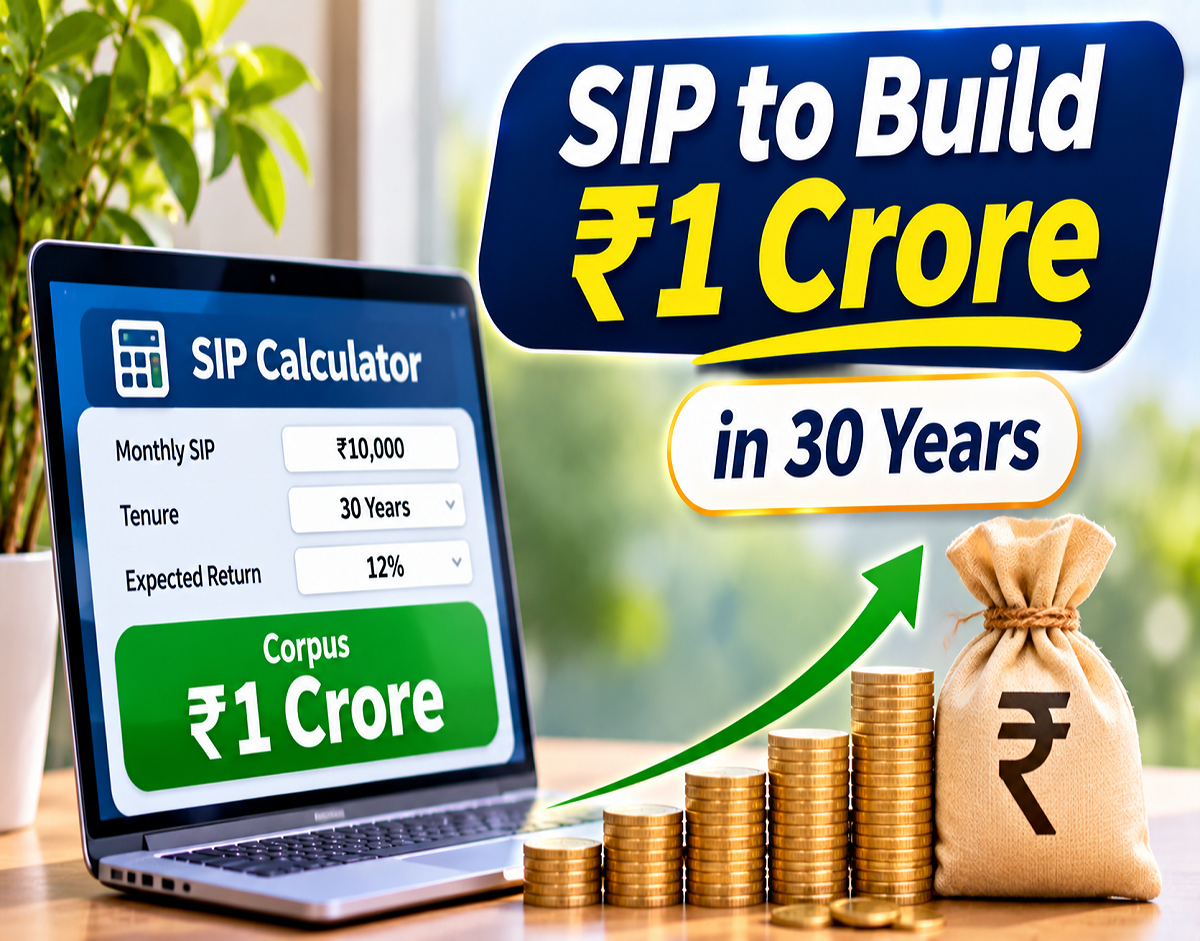
SIP Investment Calculator 2026: Building a retirement fund of ₹1 crore may appear challenging, especially for people who cannot invest large amounts at once. However, starting a Systematic Investment Plan (SIP) early and maintaining regular contributions over several decades can help investors work towards substantial long-term financial goals.
A 30-year investment period provides considerable time for compounding to influence portfolio growth. Depending on the assumed annual return, the monthly investment required to target ₹1 crore could range from approximately ₹1,445 to ₹4,425.
But there is an important consideration: mutual fund returns are market-linked and never guaranteed. The calculations below illustrate possible outcomes rather than assured investment results.
How Much Monthly SIP Is Needed to Build ₹1 Crore in 30 Years?
The amount required depends on the annualised return achieved over the investment period.
For illustration, consider three return assumptions: 10%, 12% and 15% annually.
Using monthly compounding and contributions made at the end of each month, the approximate SIP requirements are:
| Assumed Annual Return | Monthly SIP | Total Investment Over 30 Years | Estimated Investment Gains | Target Corpus |
|---|---|---|---|---|
| 10% | ₹4,424 | ₹15.93 lakh | ₹84.07 lakh | ₹1 crore |
| 12% | ₹2,861 | ₹10.30 lakh | ₹89.70 lakh | ₹1 crore |
| 15% | ₹1,444 | ₹5.20 lakh | ₹94.80 lakh | ₹1 crore |
Note: Figures are rounded and based on a constant nominal annual rate divided into monthly rates. The monthly SIP amounts are approximate; small differences may arise due to rounding. Actual returns fluctuate, and taxes, fund expenses and inflation are not separately deducted.
The table illustrates how sensitive a long-term investment target is to the assumed rate of return.
A higher assumed return reduces the required monthly contribution, but it does not make the investment outcome more certain.
SIP Calculation at 10% Annual Return
Consider an investor who begins a monthly SIP of approximately ₹4,424 and continues investing for 30 years.
Under an illustrative 10% annual return assumption, the investment could grow to approximately ₹1 crore.
During the 360-month investment period, the investor would contribute around ₹15.93 lakh.
The remaining ₹84.07 lakh would represent estimated investment growth.
This calculation demonstrates the potential impact of long-term compounding, although actual market performance may produce a substantially different outcome.
A 10% annualised return should not be interpreted as a guaranteed minimum return from equity mutual funds.
SIP Calculation at 12% Annual Return
Now consider the same 30-year investment horizon with an assumed annual return of 12%.
In this scenario, a monthly SIP of approximately ₹2,861 could mathematically produce a corpus close to ₹1 crore.
The investor's total contributions would amount to around ₹10.30 lakh.
The estimated growth component would be approximately ₹89.70 lakh.
The difference between the 10% and 12% scenarios highlights how even a relatively small change in the assumed annualised return can significantly influence long-term projections.
However, investors should avoid selecting funds solely on the expectation of achieving 12% every year.
Mutual fund performance can vary considerably across different market cycles.
Can a Monthly SIP of ₹1,444 Really Become ₹1 Crore?
Under a hypothetical 15% annual return assumption, investing approximately ₹1,444 every month for 30 years could result in a corpus close to ₹1 crore.
The total amount contributed over the period would be approximately ₹5.20 lakh.
The estimated investment gains would account for the remaining ₹94.80 lakh.
Although the mathematics supports this illustration, achieving a sustained 15% annualised return over three decades is highly uncertain.
Such an assumption should not be treated as a dependable retirement-planning benchmark.
Investors relying on an optimistic return projection may face a substantial shortfall if actual returns are lower.
For important financial goals, using conservative assumptions and reviewing the plan periodically can be more prudent.
How Does Compounding Work in SIP Investments?
Compounding occurs when investment growth generates additional growth over time.
In a SIP, each monthly contribution remains invested for a different duration.
The earliest instalments have the longest opportunity to grow, while contributions made closer to the end of the investment period have less time to accumulate returns.
The future value of a regular monthly investment can be estimated using the following formula:
Future Value = P × [((1 + r)^n − 1) / r]
Where:
- P represents the monthly investment.
- r represents the assumed monthly rate of return.
- n represents the total number of monthly contributions.
For a 30-year SIP, the total number of instalments is 360.
This formula is useful for financial planning, but it simplifies real market behaviour by assuming a constant return.
What Happens If You Increase Your SIP Every Year?
Investors whose income rises over time may consider increasing their monthly SIP contributions annually.
This approach is commonly known as a step-up SIP.
For example, someone could begin investing ₹2,000 per month and increase that amount by 5% or 10% every year.
Under a 10% annual step-up, the monthly contribution would rise to ₹2,200 in the second year and ₹2,420 in the third year.
As contributions increase, the total amount invested also rises.
A step-up SIP may help investors work towards larger financial goals without committing to a high monthly contribution at the beginning.
However, the increased investment requirement must remain affordable.
Why Starting Early Makes a Difference
Time is one of the most important factors in long-term investment planning.
An individual who begins investing at age 25 has a 30-year investment horizon before turning 55.
Someone who starts at age 35 would need to continue until age 65 to obtain the same investment duration.
Starting earlier can reduce the monthly amount required to reach a given target, assuming identical returns.
Delaying investments may require higher contributions or a longer investment period.
Nevertheless, starting early does not eliminate investment risk.
Will ₹1 Crore Have the Same Value After 30 Years?
Inflation is an important factor that is frequently overlooked in long-term SIP projections.
Although ₹1 crore is a substantial amount today, its purchasing power may be considerably lower after three decades.
For example, assuming average inflation of 6% annually, ₹1 crore received after 30 years would have purchasing power equivalent to approximately ₹17.41 lakh in today's money.
This means investors planning for retirement or future household expenses should consider inflation-adjusted targets rather than focusing only on a fixed nominal amount.
A retirement corpus that appears sufficient today may not cover the same lifestyle expenses several decades later.
Important Factors to Consider Before Starting a SIP
Investors should evaluate their financial circumstances before selecting a mutual fund or committing to a long-term contribution schedule.
Emergency savings, outstanding debt, insurance requirements and near-term financial obligations can influence the amount available for investment.
It is also important to choose investments according to risk tolerance and financial objectives.
Equity mutual funds may offer long-term growth potential, but they can experience significant declines.
Debt-oriented schemes generally have different risk characteristics, including interest-rate and credit risks.
Fund expenses, taxes and the timing of withdrawals can also affect the final amount received.
A SIP is simply a method of investing regularly. It does not independently guarantee returns or protect against losses.
Is a 30-Year SIP Suitable for Retirement Planning?
A long-term SIP can form part of a retirement savings strategy, particularly for individuals with a stable income and sufficient time before retirement.
However, retirement planning requires more than calculating a target corpus.
Investors should estimate future living expenses, expected inflation, healthcare costs, other income sources and the number of years their savings may need to support them.
As retirement approaches, reviewing asset allocation and liquidity needs becomes increasingly important.
The right strategy depends on individual circumstances rather than a single return assumption.
Conclusion
Creating a ₹1 crore investment corpus over 30 years is mathematically possible through disciplined monthly investing, but the required SIP amount depends heavily on actual returns.
At an illustrative 10% annual return, approximately ₹4,424 per month would be required. At 12%, the estimated contribution falls to ₹2,861, while a 15% assumption produces a monthly requirement of around ₹1,444.
These figures demonstrate the power of long investment horizons and compounding, not guaranteed mutual fund outcomes.
Investors should use realistic assumptions, account for inflation and review their financial plans regularly to improve their chances of meeting long-term goals.
Disclaimer: This article is intended for educational and informational purposes only. SIP and mutual fund investments are subject to market risks. Past performance does not guarantee future returns. Consult a qualified financial adviser before making investment decisions.