Business
SIP Calculator 2026: Can ₹15,000 Monthly Investment Build ₹1 Crore by Age 45? Check the Step-Up Strategy

SIP Investment Plan 2026: Can you become a crorepati by investing just ₹15,000 every month? For someone starting at age 28 and hoping to accumulate ₹1 crore by age 45, the goal may be achievable, but the outcome depends on investment returns, contribution increases and financial discipline.
A Systematic Investment Plan (SIP) allows investors to put a fixed amount into mutual funds at regular intervals. Over time, consistent contributions and the potential for compounded growth can help build a substantial investment portfolio.
However, maintaining the same monthly investment for 17 years may not be enough to comfortably achieve a ₹1 crore target, particularly if market returns are lower than expected.
Sanjeev Bajaj, Joint Chairman and Managing Director of Bajaj Capital Limited, has highlighted an alternative approach: increasing SIP contributions gradually as income grows.
Known as a step-up SIP, this strategy can make a significant difference to long-term wealth accumulation.
Here is how the calculations work and what investors should consider when planning a ₹1 crore investment goal.
How Much Time Do You Need to Build ₹1 Crore?
Suppose an investor is currently 28 years old and wants to accumulate ₹1 crore before turning 45.
The investment period would be 17 years, or 204 months.
If the investor contributes ₹15,000 every month without increasing the amount, the total investment over 17 years would be:
₹15,000 × 12 × 17 = ₹30,60,000
The final investment value would depend on how the mutual funds perform during that period.
A higher annualised return could help the investor reach the target faster, while weaker returns could leave a substantial shortfall.
Because mutual fund returns are market-linked, no particular growth rate can be guaranteed.
Flat SIP vs Step-Up SIP: What Is the Difference?
A flat SIP involves investing the same amount every month throughout the investment period.
For example, an investor might continue contributing ₹15,000 monthly for the entire 17 years.
A step-up SIP works differently.
Under this approach, the investor increases the monthly contribution at regular intervals, usually once every year.
With a 10% annual step-up, a ₹15,000 monthly SIP would rise to ₹16,500 in the second year and ₹18,150 in the third year.
This approach is particularly useful for salaried professionals whose income may increase through annual increments, promotions or career progression.
Rather than depending entirely on investment performance, the investor gradually contributes more money toward the financial goal.
SIP Calculator: ₹15,000 Monthly Investment Over 17 Years
The following table compares a fixed ₹15,000 monthly SIP with a plan that increases contributions by 10% every year.
| Assumed Annual Return | Fixed ₹15,000 SIP | SIP With 10% Annual Step-Up |
|---|---|---|
| 8% | ₹62.95 lakh | ₹1.26 crore |
| 10% | ₹76.27 lakh | ₹1.47 crore |
| 12% | ₹92.73 lakh | ₹1.72 crore |
Illustrative calculations assume monthly investments over 17 years, with annual returns converted into effective monthly growth rates. Actual mutual fund returns will vary.
Potential SIP corpus after 17 years
Comparison of fixed and 10% annual step-up SIPs, in ₹ lakh.
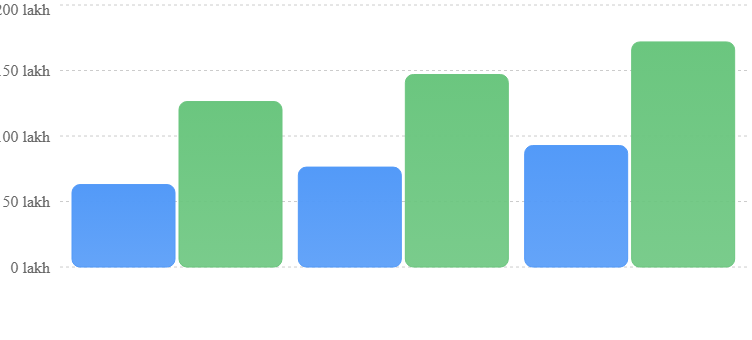
■ Fixed SIP
■ Step-up SIP
The figures show that a fixed SIP may fall short of the ₹1 crore target even with an assumed 12% annual return.
However, increasing contributions by 10% annually could potentially push the corpus beyond ₹1 crore at each of the three illustrated return assumptions.
It is important to remember that the step-up plan also requires substantially higher contributions.
While the fixed SIP involves a total investment of ₹30.60 lakh, the 10% annual step-up plan would require approximately ₹72.98 lakh in contributions over 17 years.
Therefore, the larger corpus results from both increased investment and potential market growth.
How Does a 10% Annual SIP Step-Up Work?
An annual step-up allows investors to increase their savings gradually instead of making a large financial commitment immediately.
For someone starting with ₹15,000 per month, the contribution schedule would look like this:
| Investment Year | Monthly SIP |
|---|---|
| Year 1 | ₹15,000 |
| Year 2 | ₹16,500 |
| Year 3 | ₹18,150 |
| Year 4 | ₹19,965 |
| Year 5 | ₹21,962 |
| Year 10 | ₹35,369 |
| Year 15 | ₹56,962 |
| Year 17 | ₹68,925 |
These figures illustrate an important consideration: a 10% annual step-up becomes a much larger financial commitment over time.
By the seventeenth year, the monthly contribution would be nearly ₹69,000.
Investors should therefore select a step-up percentage that matches their realistic future earning capacity.
Why Increasing Your SIP May Be Better Than Chasing Higher Returns
One of the most useful principles of long-term investing is distinguishing between factors you can control and those you cannot.
Stock market returns are uncertain. Even experienced investors cannot consistently predict how much equity markets will deliver over a particular period.
However, investors have more control over their savings rate, investment discipline and portfolio allocation.
Increasing SIP contributions when income rises can help improve the chances of meeting a long-term financial target without relying exclusively on exceptionally high returns.
A step-up SIP can also encourage investors to allocate part of their salary increases toward wealth creation rather than allowing every increment to become additional spending.
Many mutual fund platforms offer automatic SIP top-up facilities. Where this option is unavailable, investors may be able to increase their contributions manually.
Inflation Alert: Will ₹1 Crore Be Enough After 17 Years?
Inflation is another important factor in retirement and wealth planning.
Although ₹1 crore is a significant financial milestone today, its purchasing power may decline over time.
Assuming average annual inflation of 6%, the present purchasing power of ₹1 crore received after 17 years would be approximately ₹37.14 lakh.
Illustrative purchasing power after 17 years
Future corpus
₹1 crore
Value in today's money
₹37.14 lakh
Based on assumed annual inflation of 6%.
This means investors should periodically review whether their original financial target remains sufficient.
A goal established at age 28 may need adjustment as household expenses, family responsibilities and living costs change.
What Should Your Mutual Fund Portfolio Look Like?
According to the investment approach discussed in the report, asset allocation should reflect the investor's time horizon and risk tolerance.
Early Years: Focus on Long-Term Growth
With approximately 17 years available, an investor who can tolerate market fluctuations may consider maintaining meaningful exposure to diversified equity mutual funds.
Equity investments offer long-term growth potential but can also experience substantial short-term declines.
The appropriate allocation depends on financial circumstances and risk capacity.
Final Years: Gradually Reduce Risk
As the investor approaches age 45, protecting the accumulated corpus becomes increasingly important.
During the final two or three years before the target date, the investor may consider gradually shifting an appropriate portion of the portfolio toward lower-volatility investments.
This approach can reduce the risk of a sharp equity market decline immediately before the money is needed.
However, debt investments also carry risks, including interest-rate and credit risk, depending on the product.
Keep Emergency Savings Separate
Long-term investment plans should not replace emergency savings.
Maintaining a separate emergency fund and suitable health insurance can reduce the likelihood of withdrawing mutual fund investments during an unexpected financial crisis.
This is especially important when equity markets are experiencing a downturn.
Can You Really Become a Crorepati by Age 45?
The calculations suggest that an investor starting at age 28 with a ₹15,000 monthly SIP could potentially accumulate more than ₹1 crore by age 45 using a 10% annual step-up strategy.
However, the result depends on several conditions: maintaining contributions for 17 years, having sufficient income to support the increasing SIP amounts, and earning investment returns reasonably close to the assumptions.
There is no guarantee that mutual funds will deliver annualised returns of 8%, 10% or 12%.
Taxes, investment expenses and market volatility can also affect the final amount available to the investor.
Final Word
A ₹15,000 monthly SIP can be a useful starting point for someone planning to build substantial long-term wealth.
Over 17 years, a fixed SIP could potentially grow to approximately ₹92.73 lakh at an assumed 12% annual return.
Increasing the monthly contribution by 10% every year could raise the illustrative corpus to around ₹1.72 crore under the same return assumption.
The key lesson is that increasing investments as income grows can be just as important as seeking higher returns.
Investors should establish a realistic goal, account for inflation, maintain a suitable asset allocation and review their financial plan regularly.
Disclaimer: All SIP calculations are illustrative and do not represent guaranteed returns. Mutual fund investments are subject to market risks. Investors should assess their financial circumstances and consult a qualified financial adviser before making investment decisions.