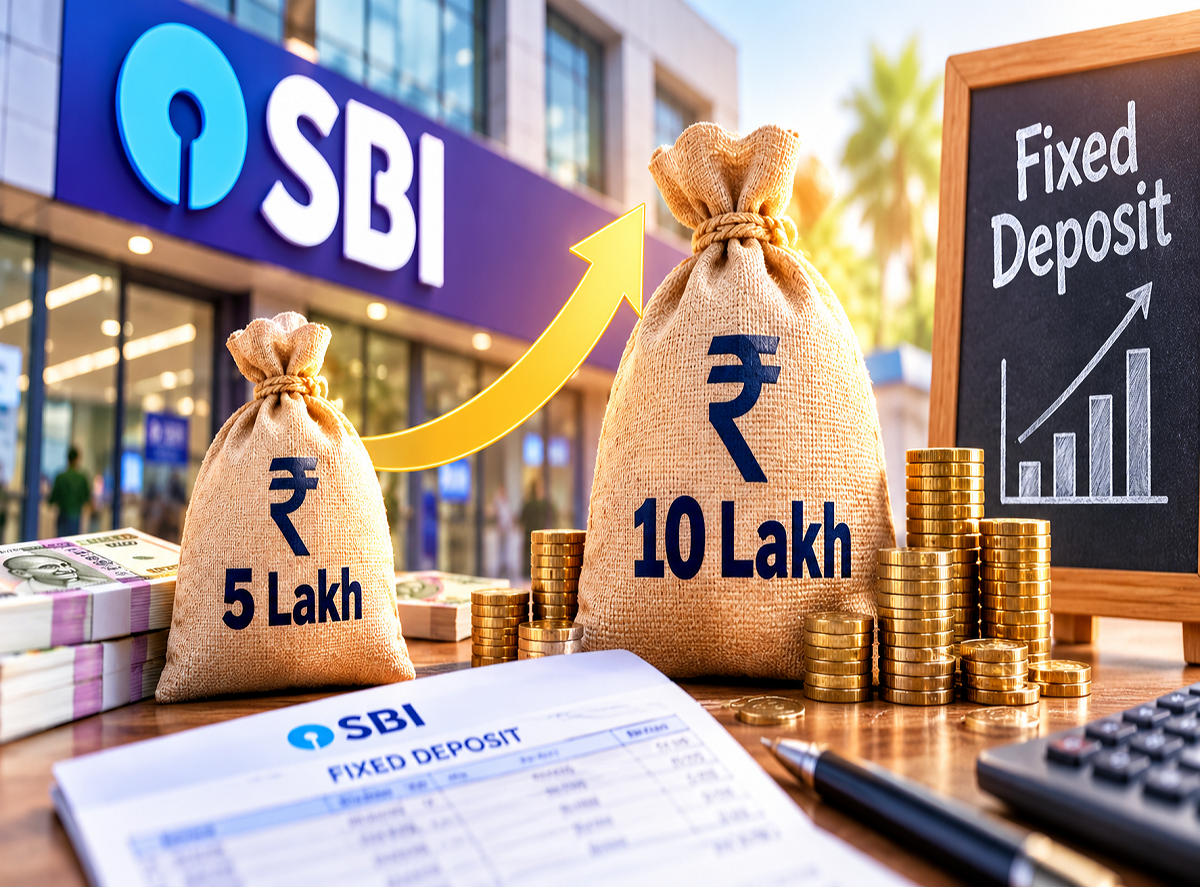
SBI Fixed Deposit Returns 2026: Fixed deposits remain a popular savings option among Indian investors who prefer predictable returns and relatively low investment risk. State Bank of India (SBI), the country's largest public-sector bank, offers fixed deposits across different tenures, with additional interest benefits generally available to senior citizens.
A recent calculation suggests that an investment of ₹5 lakh in an SBI fixed deposit could grow to approximately ₹10 lakh over 10 years for eligible senior citizens. However, the actual maturity amount depends on the interest rate applicable when the deposit is opened, the compounding method and the deposit's terms.
For regular investors, the same investment may generate a lower maturity amount because senior citizens generally receive preferential interest rates.
Before investing, customers should compare the available FD options and understand how interest accumulation works.
Can ₹5 Lakh Really Become ₹10 Lakh in an SBI FD?
The possibility of doubling a fixed deposit depends primarily on the interest rate and investment duration.
For example, at an assumed annual interest rate of 7.05%, compounded quarterly, a deposit of ₹5 lakh could grow to approximately ₹10 lakh over 10 years.
This calculation illustrates the effect of compound interest, where interest earned during earlier periods also generates additional interest.
However, a maturity value of ₹10 lakh is not guaranteed for every SBI FD investor.
The bank's applicable interest rate may differ depending on the deposit tenure, customer category and prevailing rate schedule.
The quoted return is also a pre-tax amount. Income tax on FD interest can reduce the investor's effective earnings.
SBI FD Returns on ₹5 Lakh for Different Tenures
The following table uses the interest rates mentioned in the supplied report to illustrate potential returns.
These are indicative calculations, not independently confirmed SBI interest rates for October 28, 2026.
| FD Tenure | General Investor Rate | General Investor Maturity | Senior Citizen Rate | Senior Citizen Maturity |
|---|---|---|---|---|
| 1 year | 6.25% | ₹5,31,990 | 6.75% | ₹5,34,614 |
| 2 years | 6.40% | ₹5,67,701 | 6.90% | ₹5,73,313 |
| 3 years | 6.30% | ₹6,03,131 | 6.80% | ₹6,12,099 |
| 4 years | 6.30% | ₹6,42,036 | 6.80% | ₹6,54,795 |
| 5 years | 6.05% | ₹6,75,088 | 7.05% | ₹7,09,129 |
| 6 years | 6.05% | ₹7,16,867 | 7.05% | ₹7,60,460 |
| 7 years | 6.05% | ₹7,61,231 | 7.05% | ₹8,15,507 |
| 8 years | 6.05% | ₹8,08,341 | 7.05% | ₹8,74,538 |
| 9 years | 6.05% | ₹8,58,367 | 7.05% | ₹9,37,842 |
| 10 years | 6.05% | ₹9,11,488 | 7.05% | ₹10,05,728 |
Note: Figures assume a cumulative FD with quarterly compounding, no premature withdrawal and no tax deduction from the amount invested. The rates are illustrative figures from the supplied report and must be verified against SBI's official rate schedule.
How Much Interest Can Senior Citizens Earn in 10 Years?
Consider a senior citizen investing ₹5 lakh for 10 years at an assumed interest rate of 7.05% annually.
With quarterly compounding, the approximate calculation would be:
- Initial investment: ₹5,00,000
- Assumed annual interest rate: 7.05%
- Investment period: 10 years
- Estimated interest earned: ₹5,05,728
- Estimated maturity value: ₹10,05,728
This means the investment could approximately double over the selected period.
A regular investor earning an assumed 6.05% over the same period would receive approximately ₹9,11,488.
The difference illustrates how additional interest benefits can affect long-term returns.
Why Do Senior Citizens Receive Higher FD Interest Rates?
Banks commonly provide preferential FD interest rates to eligible senior citizens.
At SBI, customers aged 60 years and above may qualify for additional interest benefits under the applicable deposit rules.
The additional rate varies by tenure and deposit product.
Certain long-term deposits may also offer benefits under specific senior citizen arrangements, subject to their availability and conditions.
Investors should not assume that the same additional interest applies to every FD tenure.
Before booking a deposit, senior citizens should verify the current interest rate and eligibility requirements directly with SBI.
How Does Compound Interest Increase FD Returns?
Compound interest plays an important role in determining long-term FD maturity values.
Under a cumulative fixed deposit, interest is periodically added to the deposit balance according to the applicable compounding rules.
Future interest is then calculated on the increased amount.
For example, a ₹5 lakh investment earning 7.05% annually with quarterly compounding would generate more interest over 10 years than over five years.
This is because the investment remains in place for additional compounding periods.
However, actual FD returns depend on the product structure. Non-cumulative deposits that pay interest periodically work differently from cumulative deposits.
Investors should select the option that matches their income requirements and financial goals.
Is an SBI Fixed Deposit Completely Risk-Free?
Bank fixed deposits are generally considered relatively low-risk investments because their interest rates are specified when the deposit is booked.
However, they are not entirely free from risk.
Bank deposits are covered by the Deposit Insurance and Credit Guarantee Corporation (DICGC), subject to applicable rules.
The insurance limit is ₹5 lakh per depositor per insured bank, covering eligible principal and interest combined.
Therefore, a deposit of ₹5 lakh plus accumulated interest can exceed the insured limit.
Investors should understand this distinction rather than assuming that every amount deposited in a bank is fully insured.
What About Income Tax on SBI FD Interest?
Interest earned from fixed deposits is generally taxable according to the investor's applicable income tax provisions.
The maturity values shown in the table are before income tax.
Depending on the investor's income and the applicable rules, tax deducted at source (TDS) may also apply.
Senior citizens may qualify for specific tax benefits or deductions under the relevant provisions, depending on the tax regime and assessment year.
Investors should consider their individual tax position when calculating the actual benefit of a long-term FD.
Can You Withdraw an SBI FD Before Maturity?
SBI offers premature withdrawal facilities for eligible fixed deposits, subject to the terms of the deposit.
However, closing an FD before maturity may result in a lower applicable interest rate or a premature withdrawal penalty.
Certain deposit products may have additional restrictions.
Investors who may need their money before the selected maturity date should carefully review these conditions.
Instead of placing all their savings in one long-term deposit, some investors may prefer dividing their money across multiple FDs with different maturity dates.
This approach, often called FD laddering, can provide greater flexibility.
How to Check SBI FD Interest Rates Online
Customers can verify current deposit rates through the official SBI website.
The general process includes:
- Visit https://sbi.co.in/.
- Navigate to the deposit products or domestic term deposit interest rates section.
- Check the latest interest rate schedule.
- Compare rates for general customers and senior citizens.
- Select the desired tenure and deposit amount.
- Review the maturity calculation before investing.
Customers can also enquire at an SBI branch or use the bank's authorised digital banking services.
Final Update
An SBI fixed deposit of ₹5 lakh could potentially grow to approximately ₹10 lakh over 10 years if an eligible investor receives an annual interest rate of around 7.05% with quarterly compounding.
At the illustrative rates used above, the estimated maturity amount is ₹10,05,728 for a senior citizen and ₹9,11,488 for a regular investor.
However, these are illustrative pre-tax calculations, not guaranteed returns or verified current SBI FD rates.
Before opening a fixed deposit, investors should confirm the latest interest rates, tax implications, premature withdrawal conditions and maturity value through SBI's official channels.