Business
Post Office Savings Scheme 2026: How to Claim Money After Account Holder's Death, Check Rules
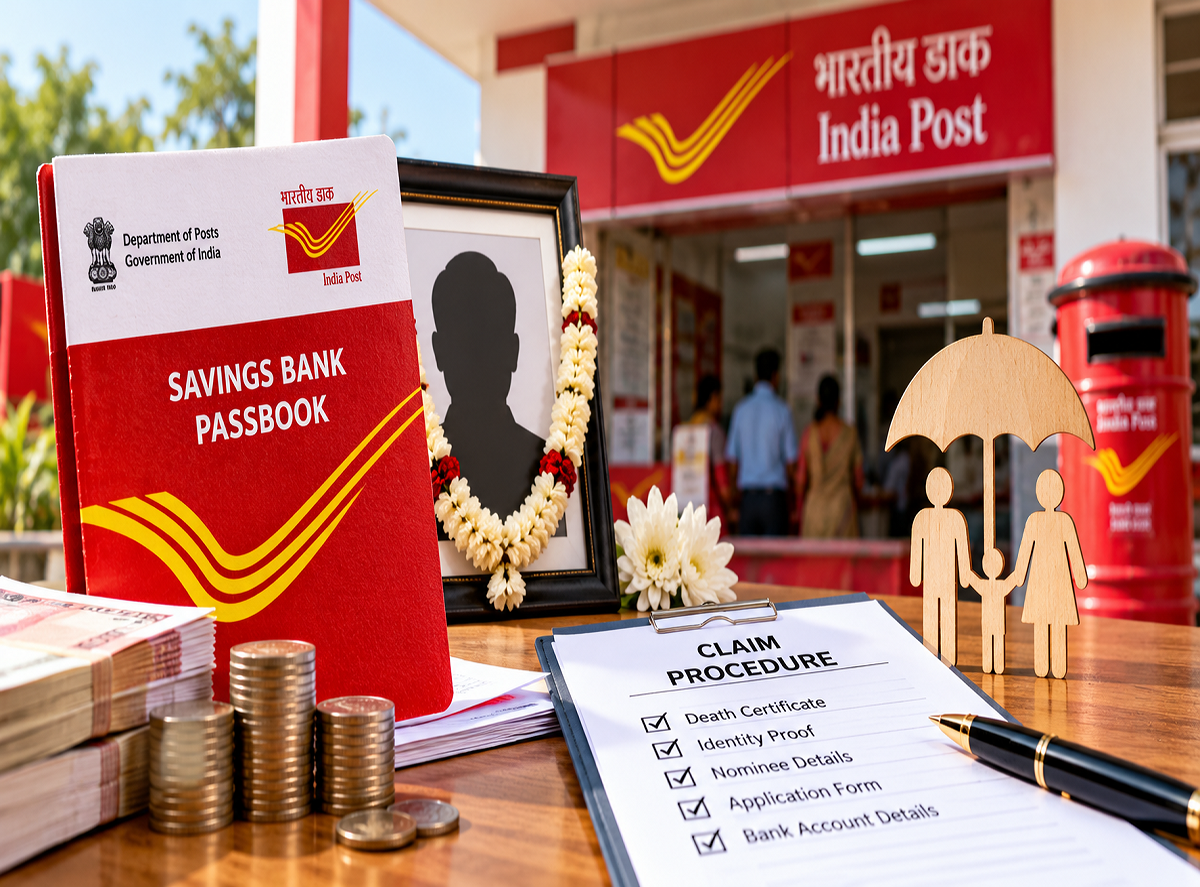
Post Office Savings Scheme 2026: Millions of Indian families invest their savings in post office schemes because of their government-backed structure and accessible banking services. Popular options include Post Office Savings Accounts, Recurring Deposits (RD), Time Deposits (TD), Monthly Income Scheme (MIS), National Savings Certificates (NSC) and Kisan Vikas Patra (KVP).
However, an important question arises when an account holder passes away: Who can claim the deposited money, and what documents are required?
India Post has established procedures for settling deceased depositors' accounts. The process generally depends on whether the account holder registered a nominee, the type of savings product and the documents available to the claimant.
Understanding these requirements can help families complete the claim process without unnecessary delays.
What Happens to Post Office Savings After the Account Holder Dies?
Money deposited in an eligible post office savings scheme does not automatically disappear when the account holder dies.
The outstanding balance or applicable maturity proceeds can be claimed through the prescribed settlement process.
Depending on the circumstances, payment may be made to a registered nominee, surviving account holder or legally entitled claimant.
However, the process can differ between individual accounts, joint accounts and savings certificates.
The amount payable may also depend on the specific scheme's rules regarding interest, maturity and premature closure following the depositor's death.
Families should therefore check the conditions applicable to the particular account rather than assuming that every post office product follows identical settlement rules.
How Can a Registered Nominee Claim the Money?
When the deceased account holder has registered a valid nomination, the settlement procedure is generally more straightforward.
The nominee should inform the relevant post office about the account holder's death and submit the prescribed claim application.
The post office will verify the nomination details, the death certificate and the claimant's identity.
Once the required checks are completed, the claim can be settled according to the applicable rules.
The nominee may generally need to provide:
- The account holder's death certificate.
- The original passbook or savings certificate, where applicable.
- The prescribed deceased-claim application form.
- The nominee's identity and address proof.
- Bank account or payment details, if required.
Additional documentation may be requested depending on the account and circumstances.
Important: Nomination generally enables the nominee to receive the money from the institution. It does not necessarily settle the ultimate ownership rights of legal heirs under applicable succession laws.
What If the Account Holder Did Not Register a Nominee?
If no valid nominee is recorded, the claim process may require additional verification.
The legal heirs or other eligible claimants must approach the post office and establish their entitlement under the applicable rules.
Depending on the claim amount and circumstances, India Post may permit settlement without a succession certificate when the prescribed conditions are satisfied.
In other cases, claimants may need to produce legal documents, such as a succession certificate, probate of a will or letters of administration.
Where several legal heirs are involved, the post office may require consent or disclaimers from other heirs.
An affidavit, indemnity bond and supporting declarations may also be necessary.
The precise documentation depends on the applicable small savings rules and the post office's claim-settlement requirements.
Documents Required for a Post Office Death Claim
Families should keep the necessary documents ready before submitting their application.
| Document | Purpose |
|---|---|
| Death certificate | Confirms the account holder's death |
| Post office passbook or certificate | Identifies the deposit or investment |
| Prescribed claim form | Initiates the settlement request |
| Claimant's identity proof | Verifies the person making the claim |
| Address proof | Confirms claimant information |
| Nomination details | Supports a nominee-based claim |
| Legal heir documents | May be needed when no nominee exists |
| Indemnity or consent documents | May be required in certain cases |
| Bank account details | Used for payment where applicable |
Not every document listed above is required in every case.
Claimants should obtain the applicable checklist from the post office before arranging legal documents or submitting their application.
How to Apply for a Post Office Deceased Account Claim
The claim process generally involves the following steps.
Step 1: Contact the post office
Visit the post office maintaining the deceased person's account or contact an authorised India Post office for guidance.
Step 2: Obtain the prescribed claim form
Request the relevant form for settlement of a deceased depositor's account.
Step 3: Check the nomination status
Ask the post office to verify whether a valid nominee is registered.
Step 4: Prepare supporting documents
Arrange the death certificate, account records, identity proof and any additional documents required for the claim.
Step 5: Submit the application
Complete the claim form accurately and submit it with the necessary supporting records.
Step 6: Complete verification
Post office officials will examine the application and verify the claimant's eligibility.
Step 7: Receive the settlement amount
Once the claim is approved, the amount will be released according to the applicable payment and scheme rules.
Claimants should retain copies of submitted documents and obtain an acknowledgement wherever available.
Can Legal Heirs Claim Money Without a Succession Certificate?
A succession certificate is not necessarily required for every post office deceased-depositor claim.
Certain claims without a nomination may be settled through a simplified procedure, subject to the prescribed monetary ceiling and documentation requirements.
Such cases may require an indemnity bond, affidavits and consent from other legal heirs.
However, where the claim does not qualify for simplified settlement, or where entitlement is disputed, formal legal documentation may be necessary.
The applicable monetary limits and requirements should be verified against the current government rules.
Families should avoid relying on outdated claim limits circulated through social media.
What Happens to Joint Post Office Accounts?
Joint accounts may follow a different procedure from accounts held by a single individual.
If one joint account holder dies, the treatment of the account depends on the scheme, account operating instructions and applicable survivorship provisions.
In certain cases, the surviving account holder may be permitted to continue or settle the account according to the rules.
However, this does not mean every joint deposit automatically becomes payable without verification.
The surviving account holder should notify the post office and provide the required documents.
Can Post Office Savings Certificates Be Transferred After Death?
Products such as National Savings Certificates and Kisan Vikas Patra have specific rules governing transfer and settlement after the holder's death.
Depending on the circumstances, a certificate may be transferred to an eligible person or settled according to the applicable provisions.
The treatment can depend on whether a nominee exists, whether the certificate has matured and the relevant scheme conditions.
Families should confirm the available options before requesting closure or transfer.
How Long Does a Post Office Death Claim Take?
There is no single processing period that should be assumed for every deceased-depositor claim.
The time required can depend on the completeness of documents, nomination status, account type and any legal verification involved.
Claims supported by valid nomination details may be easier to process than cases involving multiple heirs or disputed entitlement.
Submitting incomplete documents can result in additional enquiries and delays.
Claimants should ask the post office for an acknowledgement and follow up through official channels if processing takes longer than the applicable service standards.
Why Is Nomination Important in Post Office Savings Schemes?
Registering a nominee is an important step in financial planning.
It provides the institution with a designated person to contact and pay under the relevant nomination provisions if the account holder dies.
Without a nomination, family members may need to complete additional formalities to establish their claim.
Account holders should periodically review their nomination details, especially after major family changes.
They should also keep their passbooks, certificates and investment information organised so that family members can locate them when necessary.
Where Can Families Get Official Information?
Claimants can visit the official India Post website at https://www.indiapost.gov.in/ for information about post office savings schemes and available forms.
They may also contact their nearest post office for guidance on the deceased-claim settlement procedure.
Families should use authorised channels and avoid paying unknown agents who promise guaranteed or immediate settlement.
Sensitive documents, OTPs and banking credentials should never be shared with unverified individuals.
Final Update
Money held in post office savings accounts and eligible investment schemes can be claimed after the account holder's death through the prescribed settlement procedure.
If a valid nominee exists, the process is generally simpler. Without a nominee, legal heirs may need additional declarations, consent documents or legal certificates.
Families should keep the death certificate, passbook, identity proof and claim application ready before approaching the post office.
Checking the exact requirements for the relevant scheme can help avoid delays and ensure that the claim is processed according to India Post's rules.