Business
NPS to OPS New Rules 2026: Government Revises Pension Transfer Process for Death and Disability Cases
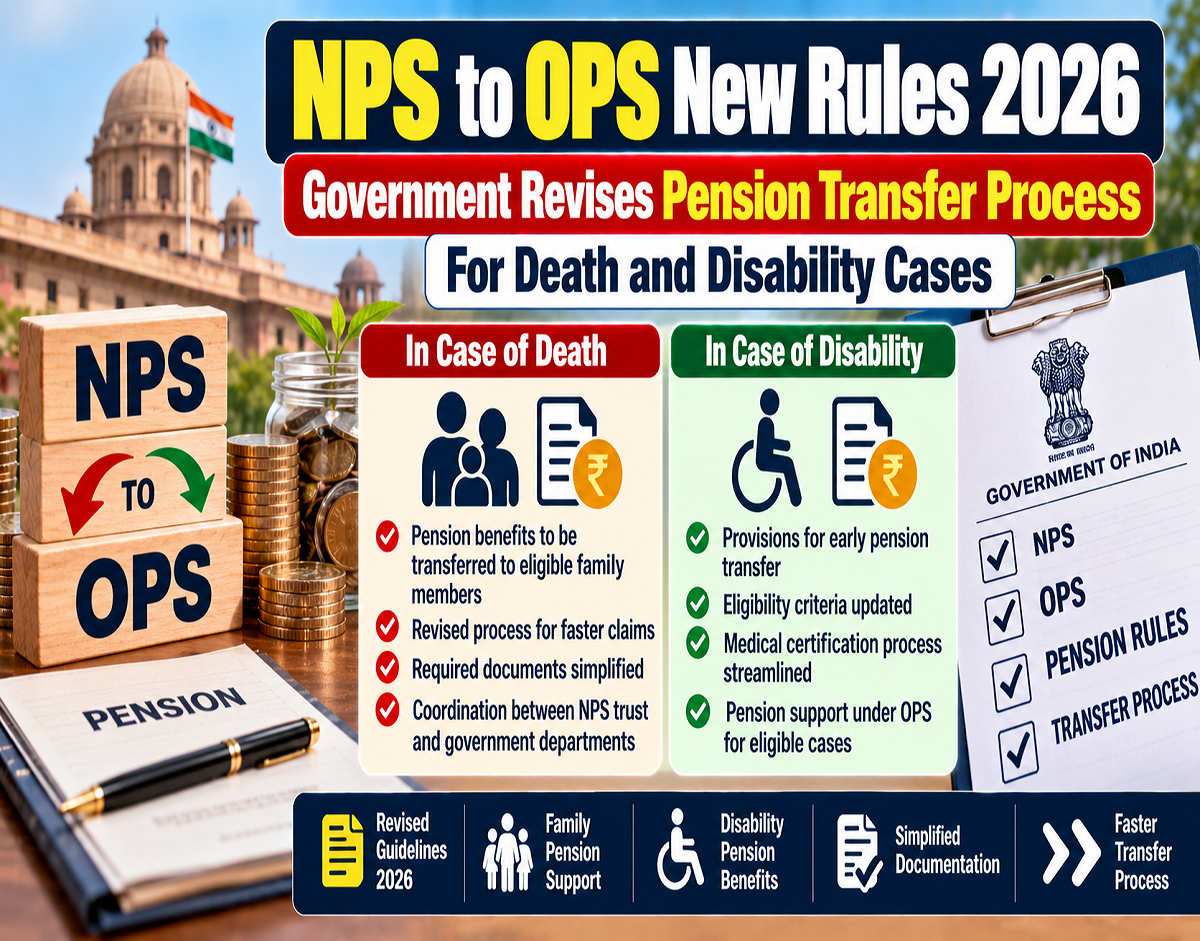
NPS to OPS Pension Rules 2026: The Central Government has introduced a revised Standard Operating Procedure (SOP) to simplify the processing of certain pension cases involving a transition from the National Pension System (NPS) to benefits under the Old Pension Scheme (OPS) framework.
The changes are particularly relevant to eligible central government employees and their families in cases involving death or disability.
According to reports dated October 22, 2026, the Ministry of Finance has approved revised procedures to address difficulties encountered while processing these pension cases.
The new guidelines replace the earlier SOP issued on September 17, 2025.
The revised process covers administrative requirements, the issuance of regular Pension Payment Orders (PPOs), the handling of provisional pension documents and responsibilities of pension-disbursing banks.
Importantly, this is not a general announcement restoring OPS for all NPS-covered government employees. The revised SOP applies to specific eligible pension cases under the existing rules.
What Has Changed in the NPS to OPS Pension Process?
The government has revised the administrative procedure used when an eligible pension case needs to be processed under the applicable old pension rules instead of continuing solely under the NPS framework.
Such situations may arise following the death of a government employee or in specified disability-related cases.
Earlier, departments, pension authorities and banks reportedly encountered difficulties in completing the necessary transfer and documentation procedures.
The revised SOP aims to improve coordination between the authorities responsible for processing pension claims.
It also clarifies the steps required to replace provisional pension arrangements with regular pension authorisation.
The objective is to reduce procedural complications for eligible pensioners and family members.
However, the revised process does not independently create pension eligibility. Claimants must continue to satisfy the relevant service and pension rules.
NPS to OPS New SOP 2026: Important Details
| Particulars | Latest Information |
|---|---|
| Government Authority | Ministry of Finance |
| Pension Systems Involved | NPS and applicable OPS pension provisions |
| New Development | Revised Standard Operating Procedure |
| Previous SOP | September 17, 2025 |
| Main Beneficiaries | Eligible death and disability-related pension cases |
| Regular PPO | To be issued after completion of the prescribed process |
| Provisional PPO | To be surrendered through the pension-disbursing bank |
| Life Certificate | Existing annual requirement continues |
| General OPS Restoration | Not announced |
| Purpose | Simplify pension processing and administrative coordination |
Why Did the Government Introduce a Revised SOP?
The reported reason for introducing the new guidelines is the practical difficulty encountered in transferring eligible pension cases from the NPS-related administrative framework to pension benefits governed by the applicable old pension provisions.
Such cases can involve multiple authorities, including the employee's department, pension processing offices, accounting authorities and pension-disbursing banks.
Delays or inconsistencies in documentation may complicate the process.
The revised SOP is intended to provide a clearer procedure for the organisations involved.
The Ministry of Finance has reportedly instructed the relevant departments and authorities to take the necessary implementation steps.
Officials are also expected to communicate the revised provisions to the personnel responsible for processing these pension cases.
Who Can Benefit From the New Pension Rules?
The revised SOP is relevant to specific categories of eligible pension cases.
These include cases in which an NPS-covered central government employee dies and the surviving family qualifies for benefits under the applicable pension provisions.
It may also cover qualifying disability-related cases where the prescribed rules permit benefits under the old pension framework.
However, eligibility is not determined solely by the fact that an employee was enrolled in NPS.
The nature of the case, the employee's service conditions, the applicable pension rules and the required documentation remain important.
Families and employees should seek clarification from the relevant department or pension authority rather than assuming automatic entitlement.
Regular PPO to Be Issued After Completing the Process
One of the important elements of the revised procedure concerns the Pension Payment Order.
A PPO is an official document authorising pension payments and recording the relevant pension particulars.
In some eligible cases, a provisional Pension Payment Order, or PPPO, may have been issued before the final administrative process was completed.
Under the revised procedure described in the report, a regular PPO will be issued after the required migration and pension processing steps are completed.
The responsibility for preparing and issuing the regular PPO rests with the relevant government offices and pension authorities.
This should help establish the final pension authorisation under the applicable rules.
What Happens to the Old Provisional Pension Payment Order?
After the regular PPO is issued, the pensioner must submit the existing provisional PPO to the pension-disbursing bank.
The bank will then process the document according to the revised procedure and forward the required copies to the designated authorities.
This step is intended to ensure that the provisional and regular pension records are handled correctly.
Pensioners should follow the instructions issued by their bank and pension authority.
They should also retain copies or acknowledgements of submitted documents wherever available.
NPS to OPS Pension Transfer: Step-by-Step Process
The broad administrative sequence described in the revised guidelines can be understood as follows:
- Eligibility assessment: The relevant department determines whether the pension case qualifies under the applicable death or disability-related provisions.
- Processing of the pension case: The responsible authorities complete the prescribed formalities for the eligible case.
- Issue of regular PPO: The competent pension authority prepares and issues the regular Pension Payment Order.
- Submission of provisional PPO: The pensioner submits the existing provisional PPO to the pension-disbursing bank after receiving the regular authorisation.
- Bank-level processing: The bank handles the provisional document and forwards the required records to the designated authorities.
- Continuation of pension compliance: The pensioner follows the applicable pension-disbursement requirements, including submission of the annual life certificate where required.
This is a simplified explanation of the reported process. The official SOP may prescribe additional forms, verification steps and responsibilities.
Will Pensioners Still Need to Submit a Life Certificate?
Yes. The revised pension processing arrangement does not remove the existing annual life certificate requirement.
Eligible pensioners generally need to submit their life certificate in November each year to support the continued disbursement of pension.
The life certificate confirms that the pensioner is alive and remains eligible to receive ongoing payments.
Depending on eligibility and available facilities, pensioners may submit the certificate through their bank or supported digital services.
The government's Jeevan Pramaan system provides a digital life certificate facility for eligible pensioners.
Pensioners should verify the applicable submission requirements and deadlines with their pension-disbursing authority.
Does This Mean OPS Has Returned for All Central Government Employees?
No.
The revised SOP should not be confused with a universal restoration of the Old Pension Scheme.
The National Pension System continues to operate for employees covered under its applicable rules.
The revised procedure addresses particular pension cases where existing provisions allow benefits to be processed under the old pension framework.
It does not mean that every employee enrolled in NPS can now choose OPS.
Similarly, it does not automatically convert all existing NPS retirement accounts into OPS pension accounts.
Any broader change to pension eligibility would require a separate official policy decision and the necessary legal or administrative provisions.
NPS Central Platform Launched for Pension Subscribers
In a separate development, a digital platform called NPS Central was launched on October 1, 2026.
The platform is intended to provide a common digital interface for NPS subscribers.
According to the report, it has been jointly developed and is managed by the three Central Recordkeeping Agencies (CRAs) operating within the NPS ecosystem.
The platform aims to simplify access to registration, investment and pension account management services.
By bringing services associated with different CRAs into a common interface, the initiative seeks to improve convenience for subscribers.
However, the launch of NPS Central is separate from the revised SOP governing eligible NPS-to-OPS pension cases.
What Is NPS Swasthya?
The report also refers to a facility called NPS Swasthya, for which registration can reportedly be completed through the NPS Central platform.
The initiative is described as combining a dedicated investment arrangement with additional health insurance-related benefits.
However, customers should verify the current product structure, eligibility, insurance coverage, charges and terms before enrolling.
Health-related benefits should not be assumed to apply automatically to every NPS subscriber.
What Should Employees and Pensioners Do Now?
Employees and family members dealing with an eligible death or disability-related pension case should contact the concerned government department or pension processing authority.
They should confirm whether their case falls within the scope of the revised SOP.
Those already receiving pension under a provisional PPO should seek instructions regarding the issuance of the regular PPO and submission of the provisional document.
It is also advisable to keep pension records, bank details, identification documents and relevant service-related paperwork readily available.
Pensioners should continue meeting the existing annual life certificate requirements.
For official information, individuals can consult the following government websites:
- Central Pension Accounting Office: https://cpao.nic.in/
- Department of Pension and Pensioners' Welfare: https://doppw.gov.in/
- Ministry of Finance: https://finmin.gov.in/
- National Pension System Trust: https://npstrust.org.in/
Final Word
The Central Government's revised SOP represents an administrative change aimed at simplifying certain pension cases involving NPS-covered employees who qualify for benefits under the old pension framework following death or disability.
The updated process replaces the September 17, 2025 guidelines and addresses the issuance of regular PPOs, the surrender of provisional PPOs and coordination among pension authorities and banks.
The existing annual life certificate requirement will continue.
The key distinction is that the new SOP simplifies the processing of eligible cases; it does not restore OPS for every NPS subscriber.
Affected employees, pensioners and family members should follow official departmental instructions to ensure that their pension documentation is completed correctly.
Disclaimer: This article is intended for general information. Eligibility for pension benefits depends on the applicable government service rules, official SOP and individual circumstances. Readers should consult the relevant pension authority for case-specific guidance.
Tighten the article for clarityRemove unsupported NPS Central details