Trending
Major Setback for Women in Government Jobs! Maternity Leave No Longer Available for Every Child
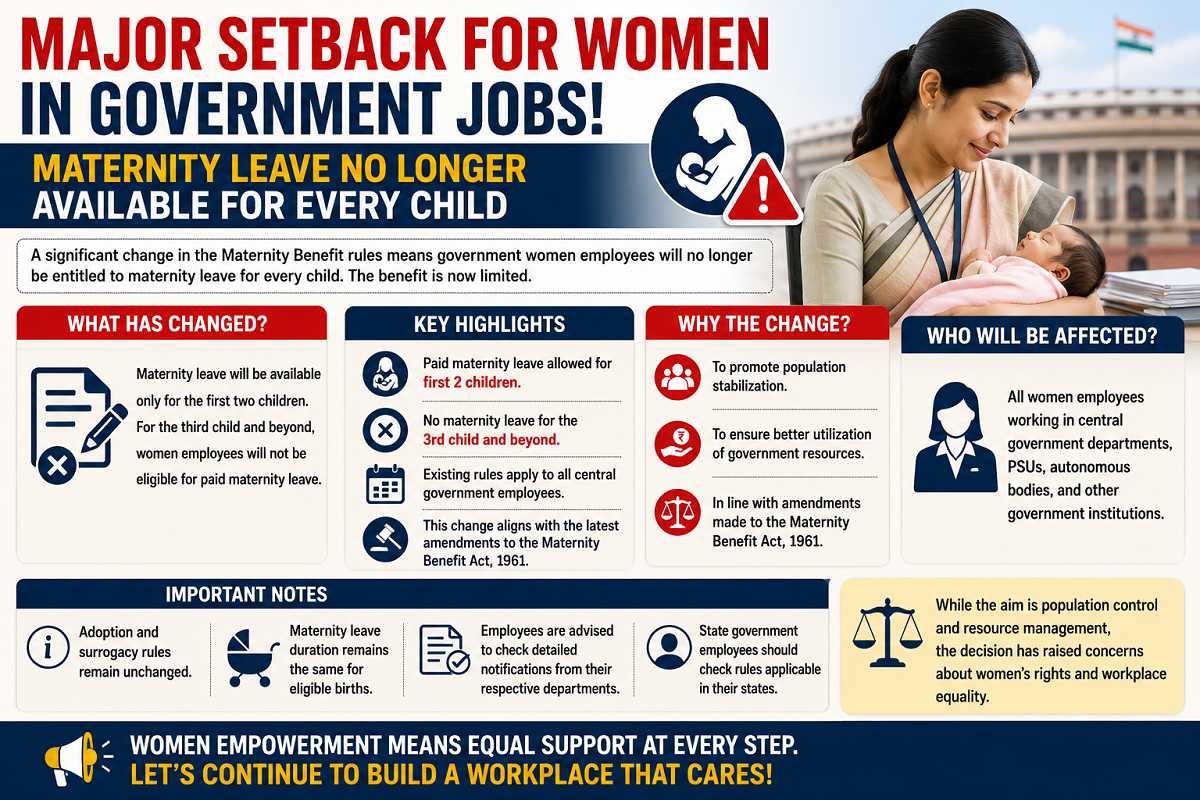
Maternity Leave Update: The Allahabad High Court has rejected a government employee’s request for maternity leave following the birth of her fourth child, holding that the benefit cannot be claimed beyond the limit prescribed under the applicable service rules.
A significant ruling concerning maternity leave for government employees has emerged from the Allahabad High Court. The court dismissed a petition filed by a woman government employee who sought six months of maternity leave after the birth of her fourth child.
The ruling is important because it highlights that maternity leave entitlement for government employees is governed by the specific service rules applicable to them. It should not be interpreted as a blanket rule eliminating maternity benefits for women employees generally.
What Was the Case?
The case involved government employee Shashi Kumari, who approached the High Court after her application for six months of maternity leave was rejected.
She challenged a June 19 order issued by the Block Education Officer in Sambhal denying her leave request following the birth of her fourth child.
According to the report, the employee argued that she had not taken maternity leave following the births of her first three children and therefore should be allowed to avail the benefit for her fourth child.
Her counsel reportedly argued that rejecting the application on this ground was arbitrary.
What Did the State Government Argue?
The state opposed the petition and maintained that the applicable rules did not permit maternity leave for the fourth child.
After considering the arguments, the High Court dismissed the petition, effectively upholding the decision denying maternity leave in this particular case.
The ruling underscores that eligibility can depend not simply on whether maternity leave was previously taken but also on conditions such as the number of surviving children specified under the relevant government service rules.
Does This Mean Women Will No Longer Get Maternity Leave for Every Child?
The judgment should not be interpreted that broadly.
The case concerns a government employee and the service rules applicable to her circumstances. Maternity benefits across India can differ depending on whether a woman works for the Central Government, a state government or an establishment covered by the Maternity Benefit Act.
Therefore, headlines suggesting that maternity leave has universally been stopped after a particular number of children can be misleading.
What Does the Maternity Benefit Act Provide?
For eligible employees covered by the Maternity Benefit Act, maternity benefit can generally extend to 26 weeks for a woman with fewer than two surviving children.
For a woman who already has two or more surviving children, the statutory maternity benefit is generally 12 weeks.
The Act also contains provisions concerning adoptive and commissioning mothers, subject to prescribed conditions.
Eligibility and the precise leave available can nevertheless vary for government employees because separate service rules may apply.
26 Weeks Does Not Apply in Every Pregnancy
One important distinction is that the 26-week maternity benefit is not automatically available for every childbirth.
Broadly, the framework provides a longer maternity-benefit period where the woman has fewer than two surviving children, while the entitlement is shorter where she already has two or more surviving children.
This is different from saying that maternity leave is universally prohibited after the second or third child.
Eligibility Conditions Also Matter
For establishments governed by the Maternity Benefit Act, eligibility generally requires a woman to have worked for the employer for at least 80 days during the 12 months immediately preceding the expected delivery date, subject to the provisions of the law.
The legislation also contains protections concerning employment during maternity absence.
What About Paternity Leave?
Central government male employees can receive 15 days of paternity leave, subject to applicable service conditions, including rules concerning the number of surviving children.
The leave can generally be taken around the time of childbirth within the prescribed period.
For India's private sector, however, there is no universal statutory paternity-leave entitlement comparable to the Maternity Benefit Act. Many private employers instead provide paternity leave through their own HR policies.
What Government Employees Should Understand
The key takeaway from the Allahabad High Court case is that maternity leave entitlement depends on the specific rules governing the employee, including conditions related to surviving children.
The judgment does not mean maternity leave has suddenly been abolished for women after a fixed number of pregnancies across India. Rather, the court declined to grant relief to an employee seeking maternity leave for her fourth child under the rules applicable to her case.
Employees should therefore check their relevant Central or state government service rules before determining their maternity-leave entitlement.