
Business
FD Matured but You Forgot to Withdraw? Know RBI Rules on Interest, Auto-Renewal and Unclaimed Money
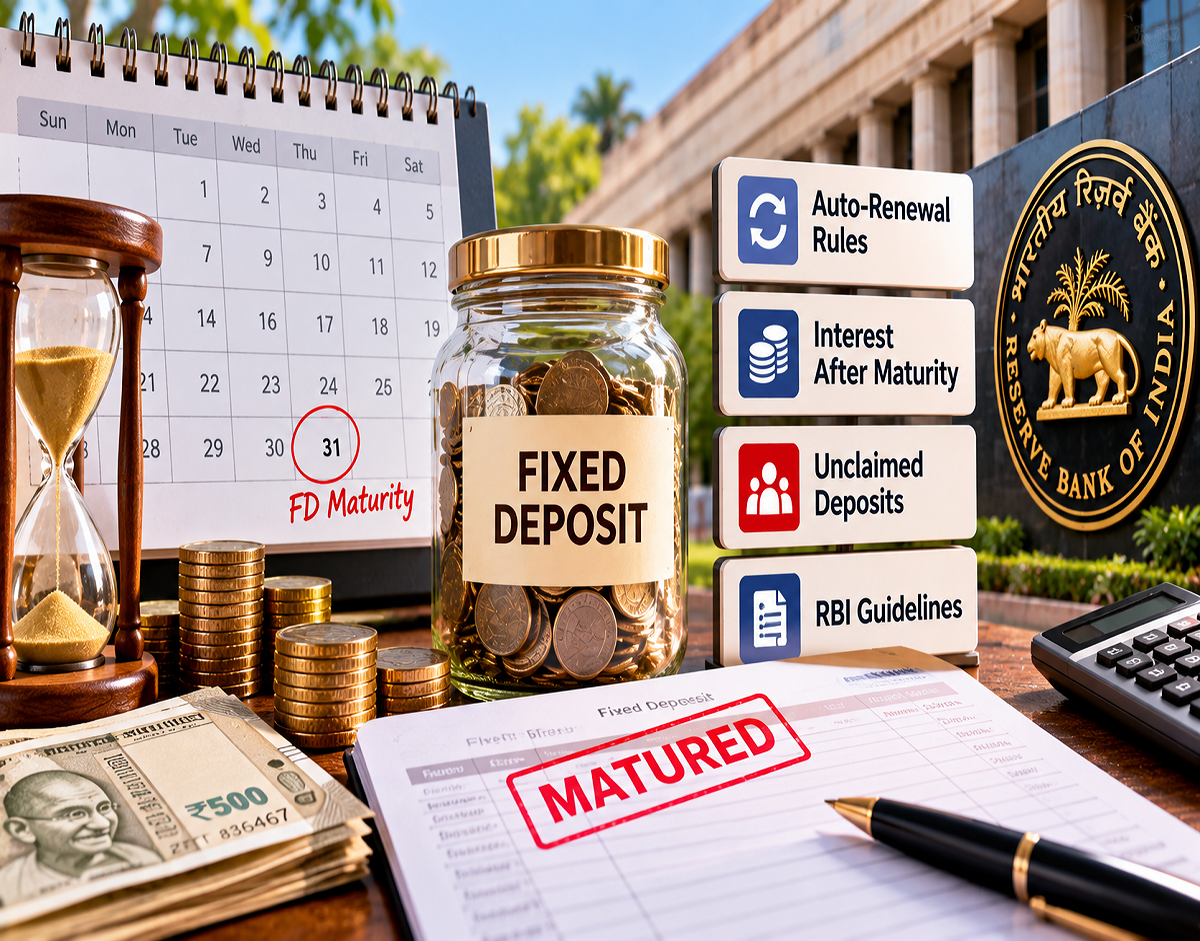
Fixed deposits are widely used by people who want predictable returns over a chosen tenure. You deposit a fixed amount, select the tenure and know the applicable interest rate in advance. But what happens if your FD reaches maturity and you forget to withdraw or reinvest the money?
Does the bank automatically renew it? Will the matured amount continue earning the old FD interest rate? And what happens if nobody claims the money for 10 years?
The answer depends largely on the maturity instructions given to the bank and the status of the deposit after maturity.
Under the rules applicable to overdue domestic term deposits, money left unpaid after an FD matures does not necessarily continue earning the original FD rate. In certain cases, a significantly lower rate may apply.
Here's how the process works.
What Happens When an FD Matures?
When you open an FD, the bank generally records instructions regarding what should happen at maturity.
If auto-renewal has been selected, the bank may renew the deposit for the applicable tenure according to its terms. The renewed FD would generally carry the interest rate applicable when the new deposit is created rather than automatically continuing with the original rate.
If instructions say that the maturity proceeds should be credited to your linked savings account, the bank can transfer the money to that account according to its process.
A different situation arises when an FD has matured but the proceeds remain unpaid and have not been renewed.
Such money may be treated as an overdue term deposit.
FD Maturity Rules at a Glance
| Situation | What May Happen | Interest Treatment |
|---|---|---|
| Auto-renewal enabled | FD may be renewed | Rate applicable to the renewed FD |
| Maturity proceeds to be credited to account | Money may move to linked account | Applicable account interest thereafter |
| Matured FD remains unpaid | Amount may remain as an overdue deposit | Lower of savings rate or contracted matured FD rate |
| Renewed FD closed early | Treated as premature withdrawal | Interest/penalty according to bank policy |
| Deposit remains unclaimed for 10 years or more | May be transferred to DEA Fund | Can subsequently be claimed through the bank |
What If You Gave No Fresh Instructions?
This is where the interest calculation becomes particularly important.
If a domestic term deposit has matured but the proceeds remain unpaid, RBI rules provide for interest on the overdue amount.
According to the rule cited in the source, the applicable interest rate on such an overdue deposit is the lower of the savings-account interest rate or the contracted interest rate on the matured term deposit.
This means investors should not assume that their matured FD will continue generating the same return indefinitely.
If your original FD was earning 7% but the applicable savings-account rate is only 3%, the lower rate can become relevant for the overdue period.
₹5 Lakh FD Example: How Much Interest Could You Miss?
Consider a simple illustration.
Suppose you invested ₹5 lakh in an FD carrying 7% annual interest.
The FD reaches maturity, but instead of being renewed, its proceeds remain unpaid with the bank.
Assume the applicable savings-account interest rate is 3%.
Since 3% is lower than the original contracted FD rate of 7%, the overdue amount would earn interest at the lower applicable rate under the rule described above.
Here's a simplified one-year comparison:
| Scenario | Interest Rate | Approx. Interest on ₹5 Lakh for One Year |
|---|---|---|
| Original FD rate | 7% | ₹35,000 |
| Lower rate applicable after maturity | 3% | ₹15,000 |
| Difference | 4 percentage points | ₹20,000 |
In this illustration, the difference amounts to approximately ₹20,000 over one year.
This is why leaving a matured FD unattended for an extended period can reduce the interest you might otherwise have earned by actively reinvesting the money at an available term-deposit rate.
The calculation is illustrative; actual interest treatment depends on the applicable rules, bank terms and deposit circumstances.
What If Your FD Was Automatically Renewed?
There can also be a completely different outcome.
Suppose your FD matured but you forgot about it, and the deposit had an auto-renewal instruction.
In that case, the bank may have created a new FD.
The first thing to do is check when the renewal happened, the tenure of the renewed deposit and the interest rate applicable to it.
Do not assume that the renewed FD carries the same interest rate as the original deposit.
Interest rates can change between the date when the first FD was opened and the date when it is renewed.
Need the Money After Auto-Renewal?
Suppose you actually needed the maturity proceeds but discovered that the deposit had already been renewed.
You may have to request premature closure of the new FD.
Banks can apply their own premature-withdrawal conditions in accordance with applicable regulations and policies.
Depending on the bank and deposit product, this could result in a lower effective interest rate and/or a premature-withdrawal penalty.
The source notes that penalties are commonly seen in the 0.5% to 1% range, but this should not be treated as a universal charge. The actual penalty can differ by bank, deposit size, tenure and product.
Check the specific premature-closure terms of your FD before withdrawing.
What Happens If the Money Is Forgotten for 10 Years?
A longer period of inactivity brings another important RBI framework into the picture.
If a qualifying bank deposit remains unclaimed for 10 years, the amount is transferred to the Depositor Education and Awareness (DEA) Fund maintained under the RBI framework.
This does not mean that the depositor permanently loses ownership of the money.
The depositor—or an eligible claimant such as a legal heir in an appropriate case—can still approach the concerned bank to claim the amount.
The bank handles the claim and follows the prescribed procedure for obtaining reimbursement from the fund where applicable.
Can You Claim Money After It Goes to the DEA Fund?
Yes. Transfer to the DEA Fund should not be interpreted as confiscation of the customer's deposit.
A genuine claimant can approach the bank where the deposit was originally maintained.
The bank may ask for documents needed to verify identity, ownership or legal entitlement to the funds.
In cases involving a deceased depositor, the bank's deceased-claim procedure and requirements concerning nominees or legal heirs may also become relevant.
Therefore, families should keep important bank and investment records organised and inform nominees about major deposits where appropriate.
Forgotten an Old FD? UDGAM Can Help
People sometimes know that they or a family member had an old bank account or FD but cannot remember where the money was held.
RBI's UDGAM (Unclaimed Deposits – Gateway to Access inforMation) facility can help consumers search for unclaimed deposits across participating banks.
However, there is an important distinction.
UDGAM is primarily a search facility. It does not mean RBI directly pays the customer the unclaimed deposit.
Once a relevant deposit is identified, the claimant generally needs to approach the bank concerned and complete its claim procedure.
Don't Assume a Matured FD Is Still Earning the Same Rate
One of the most important mistakes to avoid is assuming that money left with a bank after FD maturity automatically continues earning the original fixed-deposit interest rate.
That may not be the case.
The outcome can differ depending on whether the FD was renewed, the proceeds were transferred to another account or the amount became an overdue deposit.
For example, a 7% FD left overdue when the relevant savings rate is 3% could result in a substantial difference in interest over time.
Check These Details When Opening an FD
A little planning can prevent problems years later.
When opening or renewing an FD, check what instructions are recorded for maturity. Confirm whether auto-renewal is enabled and whether both principal and interest will be renewed or transferred elsewhere.
Also make sure the linked bank account, mobile number, email address and nomination details are updated where applicable.
Saving the maturity date in your phone calendar can be particularly useful. Setting a reminder several days before maturity gives you time to compare the bank's latest FD rates and decide what to do next.
Should You Renew or Withdraw at Maturity?
There is no single answer suitable for every depositor.
If you do not need the money and want to keep it in a fixed deposit, compare the interest rates available at maturity before deciding whether to renew.
If you need the funds for expenses or another financial goal, allowing the deposit to renew automatically could create an unnecessary premature-withdrawal issue later.
Likewise, simply leaving the proceeds unpaid after maturity may result in a lower interest rate than you expected.
Bottom Line
Forgetting about an FD after maturity does not mean your money simply disappears, but what happens next can significantly affect the interest you receive.
An auto-renewal instruction may result in a new FD at the applicable rate, while maturity proceeds can be transferred to a linked account if that is what you instructed the bank to do.
If the matured amount remains unpaid as an overdue deposit, the applicable interest can be the lower of the savings-account rate and the contracted rate on the matured FD, under the rule described above.
And if a qualifying deposit remains unclaimed for 10 years, it can be transferred to the RBI's DEA Fund framework—but eligible claimants can still seek the money through the concerned bank.
The simplest precaution is to keep track of your FD maturity dates, check the maturity instructions when opening the deposit and review your options before the tenure ends.
Disclaimer: This article is for general informational purposes only. Interest rates, penalties and deposit terms can vary between banks and products. Check the latest terms with your bank or consult a qualified financial professional before making an investment decision.



