Business
IRDAI Proposes New Insurance Commission Rules: How Policyholders Could Benefit From Lower Costs
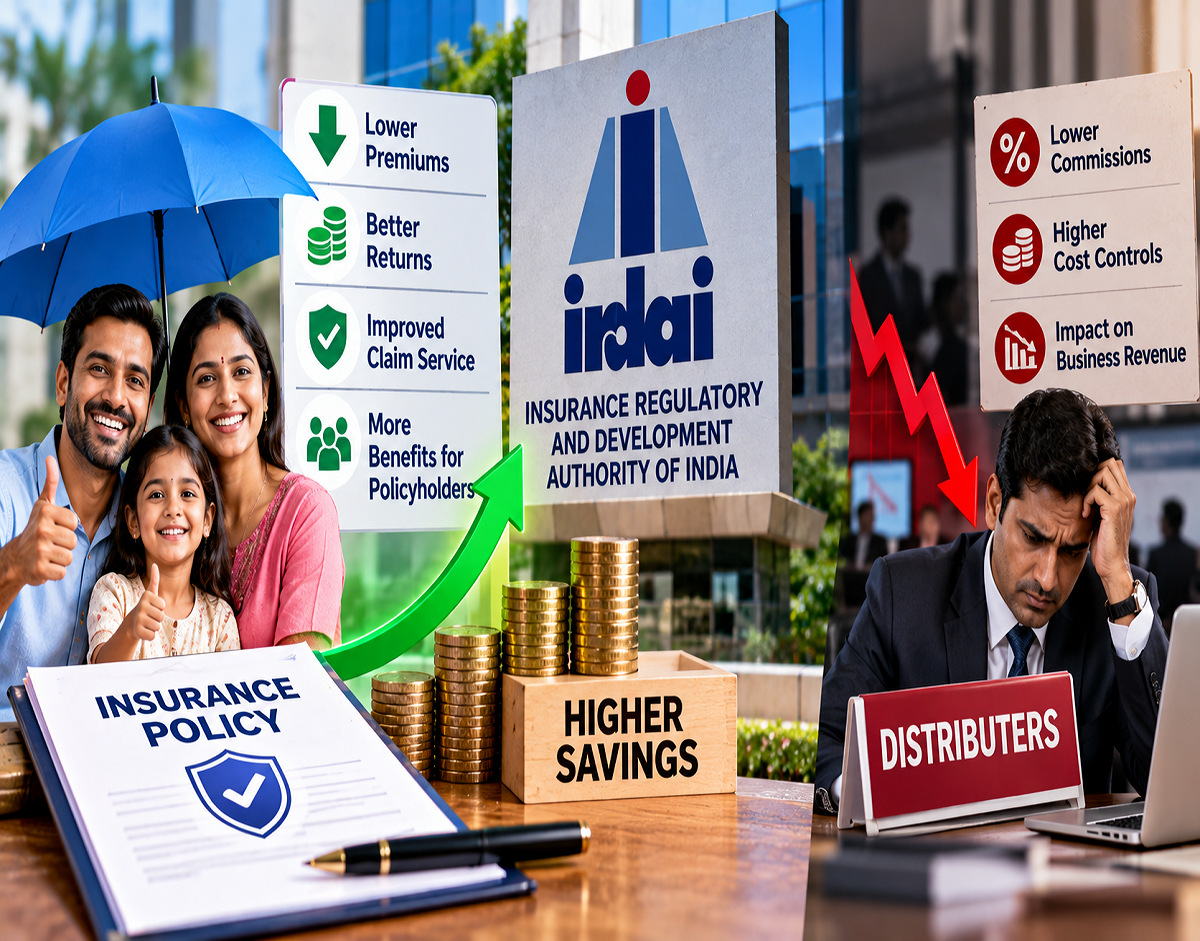
Buying insurance in India could become more transparent and potentially more cost-efficient if a new set of proposals from the Insurance Regulatory and Development Authority of India (IRDAI) is implemented.
The insurance regulator has released a consultation paper titled “Recalibrating Economics of Insurance Distribution”, proposing major changes to the way insurers spend money on distribution, commissions, rewards and other operating expenses.
Among the biggest proposals is a five-year roadmap to reduce insurers’ Expenses of Management (EoM). IRDAI has also proposed tighter limits on commissions and incentives paid to distributors, along with measures aimed at reducing mis-selling and improving policyholder outcomes.
For consumers, lower distribution expenses could potentially improve value over time. However, policyholders should not assume that insurance premiums will automatically fall or that returns on savings-oriented policies will immediately increase.
These are proposed reforms, and their eventual impact will depend on the final regulations and how individual insurers respond.
Why Does IRDAI Want to Change Insurance Distribution?
India's insurance industry has expanded considerably, but IRDAI's consultation paper raises concerns about the relationship between premium growth, distribution expenses and actual expansion in insurance coverage.
According to data cited in reports on the consultation paper, approximately 266 lakh new individual life insurance policies were sold in FY2016. By FY2025, that figure had increased only modestly to around 270 lakh.
The number of in-force individual policies has also remained around the 3,270-lakh level, according to the data cited in the source.
IRDAI's concern is that distribution expenditure has risen considerably even though growth in policy numbers has been relatively limited.
The regulator is therefore examining whether the existing distribution model delivers adequate value to policyholders and supports the broader goal of expanding insurance coverage.
Distributor Payments Have Increased Sharply
One of the key issues identified in the consultation process is the pace at which payments to insurance distributors have increased.
Between FY2023 and FY2025, new business premium generated through a sample of corporate agents increased by around 28%, from approximately ₹63,000 crore to ₹80,000 crore.
However, total distributor remuneration—including commissions, rewards and incentives—rose much faster.
These payments increased from around ₹9,580 crore to ₹21,600 crore, representing an increase of approximately 125%.
A similar pattern was reported in general insurance.
Premium routed through brokers increased by around 37%, while broker commissions reportedly jumped 173%, from ₹6,348 crore in FY2023 to ₹17,348 crore in FY2025.
IRDAI's proposed reforms seek to bring distribution expenses into closer alignment with the value being delivered to customers.
What Are Expenses of Management?
Expenses of Management, commonly called EoM, broadly cover the expenses incurred by an insurance company in running and distributing its business within the applicable regulatory framework.
These expenses can include commissions and distribution costs as well as other operating expenditure.
Higher expenses can affect the economics of insurance products because a portion of the premium collected from customers goes towards acquiring, distributing and servicing the business.
IRDAI is now proposing a significantly tighter framework for these expenses.
Life Insurers Could Face a 12.5% EoM Limit
Under the proposed roadmap, life insurance companies would move towards a company-level EoM framework linked to Gross Direct Premium Income (GDPI).
The proposed glide path would bring the EoM level to:
- 15% within two years
- 12.5% within five years
For insurers that were already below the proposed benchmark in FY2025, the consultation paper also envisages movement towards a longer-term 10% sector goal, depending on the applicable framework.
This is a substantial proposed change to the way insurance companies manage their distribution and operating costs.
General Insurance EoM Could Fall to 20%
General insurance companies would also face tighter expense limits.
The proposal envisages reducing the relevant EoM level to:
- 25% within two years
- 20% within five years
The calculation would also shift towards domestic Gross Direct Premium Income rather than the existing Gross Written Premium framework.
IRDAI is additionally proposing measures designed to make expense calculations more transparent and harder to circumvent through alternative payment structures.
New Commission Structure Could Change How Insurance Is Sold
IRDAI's consultation paper also proposes explicit limits on distributor remuneration.
Instead of allowing high upfront commissions and separate incentives to accumulate outside a straightforward commission structure, the proposed framework seeks to capture different forms of distributor payments within the applicable remuneration limits.
For life insurance, commission limits would depend on factors including the product, distribution channel and premium-paying term.
The source report highlights the following proposed first-year limits for certain life insurance structures:
| Premium-Paying Term | Distribution Entity | Individual Agent |
|---|---|---|
| Less than 5 years | Up to 5% | Up to 6.25% |
| 5 years | Up to 10% | Up to 12.5% |
| 6–8 years | Up to 14% | Up to 17.5% |
| 10 years or more | Up to 20% | Up to 25% |
These figures are part of the proposed framework and should not be treated as commission limits already in force.
Rewards and Incentives Also Under Scrutiny
The regulator is not looking only at headline commission rates.
A key objective is to prevent companies from technically complying with commission limits while compensating distributors through separate rewards, incentives or other arrangements.
IRDAI has therefore proposed bringing direct and indirect remuneration within a more comprehensive commission framework.
Cost audits are also proposed for insurers and large insurance distribution entities.
This could give the regulator greater visibility into how much insurers actually spend to acquire business.
Tougher Action Proposed Against Mis-Selling
Another important part of the consultation paper concerns the way insurance is sold.
IRDAI has proposed stronger safeguards against mis-selling, including measures addressing the compulsory bundling of insurance with loans or other credit products.
The regulator has also proposed restricting volume-linked or reward-linked incentives for employees of banks and non-banking financial companies involved in insurance sales.
Under another proposal, the identity of the person responsible for selling a policy could be linked with the transaction.
The framework also envisages the possibility of clawing back commissions in cases involving mis-selling, along with greater public disclosure.
The objective is to shift incentives away from simply selling the maximum number of policies and towards suitability, persistency and customer service.
Could Insurance Premiums Become Cheaper?
This is where consumers need to distinguish a potential benefit from a guaranteed outcome.
Reducing management and distribution expenses could create room for insurers to improve product economics.
For some products, insurers may potentially use lower costs to offer more competitive pricing.
But IRDAI's proposal does not automatically mean every insurance premium will fall.
Premiums depend on several other factors.
For life insurance, these can include mortality assumptions, interest rates, product design and the benefits promised under the policy.
For health and general insurance, claim experience, medical inflation, repair costs, catastrophe exposure and reinsurance costs can also play significant roles.
Therefore, lower distribution costs can help improve efficiency, but consumers should not interpret the proposal as an across-the-board premium cut.
Could Savings Policies Offer Better Value?
Savings-oriented life insurance products could also potentially benefit from lower expenses.
If less of the premium is absorbed by acquisition and distribution expenses, more efficient product economics could potentially translate into better policyholder value.
This may be relevant for products such as traditional savings policies and ULIPs.
But here too, higher maturity returns are not guaranteed simply because commission limits are reduced.
Actual returns or benefits depend on the type of policy, charges, investment performance where applicable, bonuses, guarantees and the final product structure adopted by the insurer.
Why Insurance Distributors Are Concerned
While lower distribution expenses may improve cost efficiency, the proposed changes could materially affect companies that depend heavily on insurance commissions.
Brokerages and analysts have warned that sharply lower commissions could put pressure on insurance distributors, corporate agents and bancassurance channels.
Some industry participants have also argued that a rapid reduction in commissions could affect new-business volumes in the short term.
Insurers may consequently have to invest more heavily in proprietary sales networks and technology if existing distribution channels become less economically attractive.
The impact could be particularly significant for smaller insurers that have relatively high operating costs while they build scale.
What Does It Mean for Online Insurance Platforms?
Online insurance distributors could also face changes to their economics if the proposed commission limits become final.
Platforms that generate substantial revenue from commissions paid by insurance companies may have to adjust their business models if distributor payouts decline.
Analysts have consequently identified distributors such as PB Fintech and Turtlemint among businesses potentially exposed to the proposed changes.
However, movements in company share prices or analyst estimates should not be treated as proof of the eventual regulatory impact. The consultation process is still underway, and the final framework may differ from the draft.
IRDAI Also Wants More Commission Transparency
Consumers may benefit from another important part of the proposed framework: greater disclosure.
IRDAI wants insurers and large distributors to explain their commission policies and remuneration structures in simpler, more accessible language.
Specified commercial insurance policies could also carry commission-related disclosures.
This could give customers greater visibility into the economics behind the insurance product being sold to them.
Claims and Customer Service Remain Important
The consultation paper's broader objective is not simply to reduce commissions.
IRDAI wants the distribution model to place greater emphasis on affordability, policy persistency, quality of advice, servicing and policyholder outcomes.
This comes at a time when customer complaints remain an important concern.
According to figures cited in the source, complaints recorded on the Bima Bharosa platform increased from 78,347 in FY2023 to 1,37,361 in FY2025, with a large proportion related to claims.
Lower expenses alone will not automatically improve claim settlement, but the proposed framework is intended to change incentives across the insurance distribution ecosystem.
These Are Proposals, Not Final Rules
Policyholders should keep one point in mind above everything else.
IRDAI has issued a consultation paper.
That means the lower EoM limits, proposed commission caps and other changes are currently part of a regulatory consultation process.
They should not yet be described as final rules applicable to every insurance company.
Feedback from insurers, intermediaries, policyholders and other stakeholders can be considered before a final regulatory framework is issued.
What Policyholders Should Do Now
Existing policyholders do not need to cancel, surrender or change their insurance policies merely because the consultation paper has been released.
Policy terms continue to be governed by the applicable contract and existing regulations.
People buying a new policy should continue to compare the premium, coverage, exclusions, waiting periods, surrender conditions, charges and claim-related provisions rather than choosing a product based only on an agent's recommendation.
For investment-linked or savings-oriented insurance, buyers should also understand the distinction between guaranteed and non-guaranteed benefits.
Bottom Line
IRDAI's proposed distribution reforms could reshape how insurance is sold in India.
The regulator is seeking to reduce Expenses of Management over a five-year period, tighten distributor commission structures, improve disclosure and introduce stronger safeguards against mis-selling.
For policyholders, a more efficient distribution system could potentially lead to better value, more transparent selling and, in some cases, more competitive pricing.
But cheaper premiums and higher investment returns are possible outcomes—not benefits that have already been guaranteed.
For now, these measures remain proposals. Their actual impact on insurance companies, distributors and customers will become clearer only after IRDAI completes the consultation process and finalises the regulatory framework.